CBSE Class 12 Physics 2026 Previous Year Paper With Solutions
CBSEPhysics2026 Previous Year Paper
Paper code: 55/1/1 · 2026Practise with the full English CBSE Class 12 Physics 2026 main examination paper, set 55/1/1. Use the worked solutions after your attempt to check not just your final answers, but also the principles, assumptions and steps behind them.
This set is one of the year's papers. See every set from 2026, grouped by series.
What this year-wise paper includes
This resource pairs the original English question paper with worked solutions. It retains the printed questions, options and diagrams, and the explanations cover the printed internal choices. The cover has a question-number index, so you can go straight to an explanation when reviewing a specific response rather than scrolling through the entire file.
This is a full board paper, not a chapter worksheet. It brings together electrostatics and current electricity, magnetism and induction, optics, the photoelectric effect, atoms and nuclei, and semiconductors. That mix makes it useful for checking whether you can recognise the relevant idea when a question appears without a chapter heading.

Physics 2026 | Class 12 | Previous Year Paper | Code 55/1/1
In the StudentCurio app
Complete CBSE Class 12 Physics 2026 paper with worked solutions, covering questions across the syllabus. Helps students practise board-exam questions and review step-by-step answers.
How the 70 marks are distributed
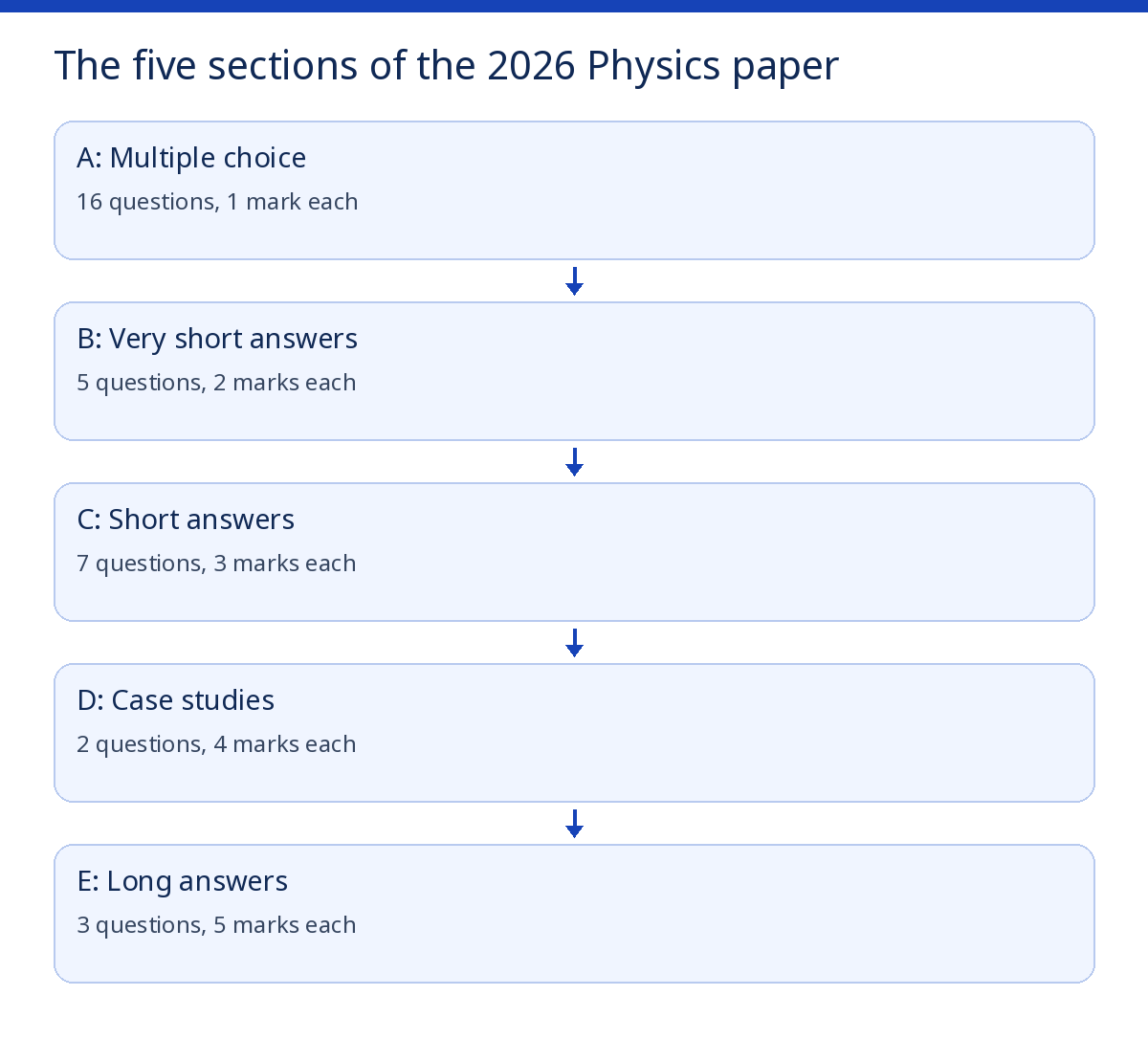
The paper allows three hours and contains 33 questions in five sections. Calculators are not allowed, and the instructions provide physical constants for use where needed.
- Section A: Questions 1–16 carry 1 mark each. This section includes standard multiple-choice items and assertion–reason items.
- Section B: Questions 17–21 are very short answers worth 2 marks each.
- Section C: Questions 22–28 are short answers worth 3 marks each.
- Section D: Questions 29 and 30 are case studies worth 4 marks each.
- Section E: Questions 31–33 are long answers worth 5 marks each.
All question numbers are compulsory. There is no overall choice: where an internal choice is printed, select one of the alternatives within that question. Section A has no internal choices. For assertion–reason items, decide whether each statement is true before asking whether the reason explains the assertion.
Good to remember: Conditions decide which rule applies
In electrostatics, a capacitor problem can change simply because the battery is disconnected. For an ideal isolated capacitor, the charge on the plates is fixed; for a capacitor still connected to an ideal battery, the potential difference is fixed. When a dielectric is introduced or removed, start by identifying which quantity stays fixed before choosing a relation for the stored energy.
For the magnetic field inside a long circular wire, distinguish enclosed current from total current. The enclosed current is proportional to the area inside a concentric circular path only if the current density is uniform. The symmetry of the long straight wire is what lets you treat the field magnitude as constant around that path.
In wave optics, keep single-slit diffraction minima separate from double-slit interference maxima. Both can involve finding where features from two wavelengths coincide, but the condition you apply depends on the setup and on whether the question asks for a bright or dark fringe.
What the two case studies ask you to read
The moving-coil galvanometer case starts with an instrument description: a magnetic field produces a deflecting torque on the current-carrying coil, and a spring provides a counter-torque. The follow-up items move between how the instrument works, what affects its sensitivity and how it can be adapted to measure current or voltage over a specified range. Keep those tasks separate: explaining a deflection is not the same as choosing a circuit arrangement for a new range.
The photoelectric-effect case gives a graph of stopping potential against incident frequency for two metals. Before tackling the items, identify the axes and distinguish a frequency read from the horizontal axis from a potential read from the vertical axis. The case tests whether you can connect features of a graph to the physical quantities under discussion.
What to show in written answers
The written sections ask for more than numerical results. They include a potential-energy sketch for a pair of nucleons, an equivalent diode circuit and a ray diagram for a refracting telescope in normal adjustment. Practise making each representation do its own job: label the axes of a graph, show the conducting path in a circuit, and mark the rays and optical elements needed to explain image formation.
Long-answer questions pair tasks such as stating a law, deriving an expression and applying a result. In the dipole derivation, for example, the paper explicitly separates the general equatorial-field expression from the far-field form. Keep the approximation where it belongs: the far-field form applies only when the distance from the dipole centre is much greater than half the charge separation.
Quick self-check: Review the first step that went wrong
For a board-style attempt, keep the solutions closed, use the printed constants when needed and work without a calculator. Follow the printed internal choices on that first pass. Afterward, return to the alternatives you did not attempt for extra practice with different topics or different ways of presenting the same concept.
The worked explanations separate formula used, concept used and explanation in steps. Use those labels to locate the first difference between your reasoning and the explanation. Did you miss a condition in the question, choose a rule that did not fit the setup, or lose a sign or unit when applying it? If your final answer matched, still check whether you could justify the key step. Then close the solution and redo that step independently. This guide leaves out answer choices, keys and worked numerical results so you can attempt the questions without seeing them here.
Spotted an error? Report a correction. Practise this in the app: notes, formula sheets and mind maps.













































































































































































Loading comments…