CBSE Class 12 Physics 2026 Solved Question Paper
CBSEPhysics2026 Previous Year Paper
Paper code: 55/5/3 · 2026Practise with the full English-language CBSE Class 12 Physics 2026 main-examination paper, code 55/5/3. Use the original questions and diagrams for a timed attempt, then use the worked explanations to identify where your reasoning went off track.
This set is one of the year's papers. See every set from 2026, grouped by series.
Know the paper format before you start
This year-wise resource is a complete paper, not a chapter test. The paper has 33 questions, a three-hour time limit and a maximum of 70 marks. Section A has 16 one-mark multiple-choice questions, including assertion–reason items. Section B has five two-mark very short answers, and Section C has seven three-mark short answers. Section D has two four-mark case studies, while Section E has three five-mark long answers.
There is no overall choice: attempt every question number, choosing one alternative where an internal choice is printed. Selected questions outside Section A offer such choices. Calculators are not allowed, and the paper supplies physical constants for use where needed. For a timed attempt, follow these instructions and leave the solutions closed until you finish.

Physics 2026 | Class 12 | Previous Year Paper | Code 55/5/3
In the StudentCurio app
A solved CBSE Class 12 Physics paper for 2026 covering topics including electrostatics, optics, current electricity, magnetism, electromagnetic induction and semiconductors. Includes a worked question on torque and magnetic moment of a current loop, useful for board-exam practice and reviewing solution methods.
Use the solutions to find the first error
The file retains the English questions, options and diagrams, and the worked explanations cover the printed internal choices. The question-number index helps you find the relevant explanation after an attempt. The solutions separate the formula used, the concept used and the explanation in steps. Use those labels to distinguish a wrong choice of principle from a mistake made after choosing the right one.
For a numerical response, compare your setup before checking your arithmetic. In a vector problem, for instance, a wrong direction may come from how you read the diagram rather than how you calculated the magnitude. For a derivation, find the first line you cannot justify. If you skipped an internal alternative during the timed attempt, try it separately before opening its solution. This guide omits the worked result for Question 3 because the PDF flags a mismatch between its calculation and the printed options.
Read the case-study diagrams as evidence
In the parallel-plate case, read the plate labels and coordinate axes before deciding how to express a direction. Keep electric potential, a scalar, separate from electric field, a vector. When reviewing the electron’s motion, distinguish the field direction from the force direction: the sign of the particle’s charge matters when you connect the two. In the paper’s other electrostatics questions, that scalar–vector distinction affects how you combine contributions from multiple charges: potentials add algebraically, whereas fields add as vectors.
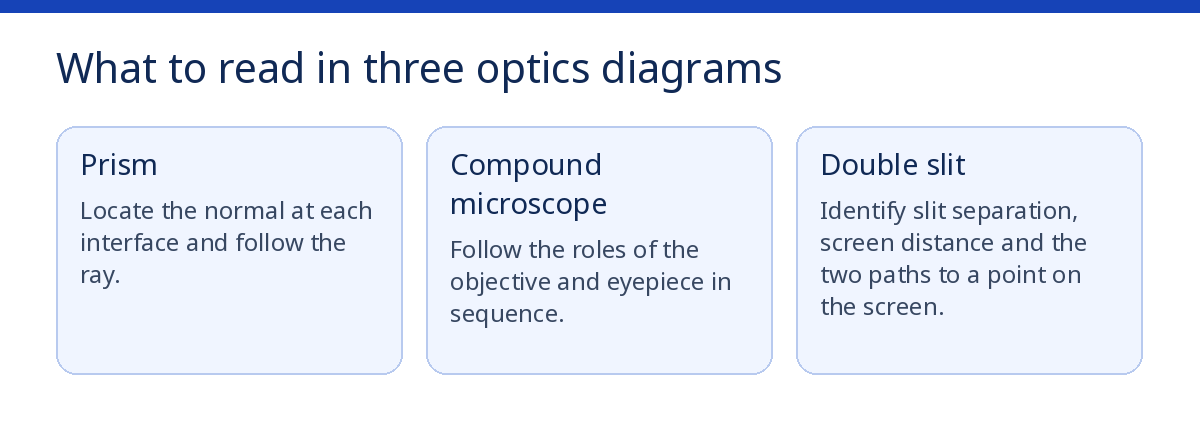
The Young’s double-slit case uses a different kind of diagram. Separate the slit spacing from the distance to the screen, and distinguish fringe width, the spacing between successive fringes of the same kind, from path difference, which compares the distances travelled by two waves to a particular point. One describes the spacing of the pattern; the other helps explain what appears at a given point.
Choose between a ray model and a wave model
A prism ray trace follows light from one interface to the next. At each interface, measure the angle of incidence from the normal, not from the surface. Total internal reflection is only possible when light travels from a higher to a lower refractive index and the incidence angle exceeds the critical angle. In a compound microscope diagram, the aim is different: show how the objective and eyepiece act in sequence, so the reader can follow the role of each lens.
For double-slit interference and single-slit diffraction, focus instead on how waves superpose to produce a pattern. In the double-slit setup, light from two coherent slits overlaps. In single-slit diffraction, light from different parts of the same opening superposes. When comparing the patterns, link the arrangement to a visible feature rather than merely naming the phenomena.
Good to remember: check what changes and which way
For electromagnetic induction, distinguish magnetic flux from its rate of change. Flux describes the magnetic field through a surface; a large but steady flux through a loop does not by itself induce an emf. This distinction connects the moving-magnet setup to the transformer questions, where the key issue is whether the flux linking the secondary winding changes. The charging-capacitor question involves a different kind of change: it uses the changing electric field between the plates to connect displacement current with the conduction current in the leads.
In the magnetic torque material, the angle is measured between the area vector, which is normal to the loop, and the magnetic field. An angle measured from the plane of the loop is not interchangeable with it. When reviewing the long-answer alternative on magnetic force, check the direction of current in each straight segment. Add the forces as vectors rather than adding their magnitudes without checking their directions.
Quick self-check: does your response match the task?
For an assertion–reason item, did you check each statement on its own before deciding whether the reason explains the assertion? For the full-wave rectifier question, does your response connect the circuit diagram to diode operation and to the input and output waveforms? A diagram may show the connections clearly without explaining how the circuit behaves during each half-cycle.
The current electricity alternatives test different skills. Can you distinguish deriving a general balance condition for a Wheatstone bridge from finding a branch current in a particular circuit? Can you connect electron drift to the conductivity of a material rather than treating conductivity as a property of the wire’s dimensions? In numerical questions such as those on doped silicon and photoemission, check that each intermediate result leads to the quantity requested. An energy, for example, is not interchangeable with a potential, even when the two are related.
Spotted an error? Report a correction. Practise this in the app: notes, formula sheets and mind maps.













































































































































































Loading comments…