CBSE Class 12 Physics 2026 Previous Year Paper: Set 55/2/3
CBSEPhysics2026 Previous Year Paper
Paper code: 55/2/3 · 2026This full English CBSE Class 12 Physics 2026 main-examination paper pairs the original questions and diagrams with worked solutions. Use it for a three-hour board-exam practice attempt, then review whether your errors came from choosing the wrong principle, misreading a condition or carrying out the calculation.
This set is one of the year's papers. See every set from 2026, grouped by series.
How the 70-mark paper is organised
Set 55/2/3 contains 33 questions across five sections. Section A has sixteen one-mark multiple-choice questions, including assertion–reason items. Section B has five two-mark very short answers, and Section C has seven three-mark short answers. Section D has two four-mark case studies, and Section E has three five-mark long answers.
All question numbers are compulsory, but selected questions outside Section A offer an internal choice. For a timed attempt, take only one branch where a choice is printed; you can return to the alternate branch in a later practice session. Calculators are not allowed, and the paper supplies physical constants. Keep that list available during the attempt so you can distinguish a recall problem from a unit conversion or arithmetic error.

Physics 2026 | Class 12 | Previous Year Paper | Code 55/2/3
In the StudentCurio app
The CBSE Class 12 Physics 2026 paper set 55/2/3 with worked solutions, spanning topics including electrostatics, current electricity, magnetism, optics, semiconductors and modern physics. Helps students practise board-exam questions and review solution methods.
Electricity: check what stays fixed
The electrostatics questions move between point charges, field lines, equipotential surfaces and capacitors. An equipotential surface has the same potential at every point, but that does not mean the electric field has the same magnitude everywhere on it. In a sketch, distinguish the surface from the field lines: where the field is nonzero, those lines meet the surface at right angles.
The dielectric question specifies that the capacitors remain connected to a battery. That connection fixes their potential difference; an isolated charged capacitor instead has fixed charge. Identifying which condition applies comes before choosing an energy expression. The current electricity questions require a different kind of setup: when applying Kirchhoff’s rules, mark assumed branch directions and use them consistently. A negative current indicates that the actual direction is opposite to the one assumed.
Magnetism, induction and AC use different diagrams
The paper asks for magnetic field directions as well as derivations involving a circular coil, parallel current-carrying conductors and mutual inductance. A geometry sketch helps you identify where a field is being evaluated or which area is relevant to magnetic flux. Keep the field produced by a current distinct from the emf induced by a change in flux. Lenz’s law concerns opposition to the change in flux, not opposition to the original field in every situation.
In the series AC circuit, the phasor diagram serves a different purpose: it shows voltage components and their phases relative to the common current. Read the graph axes just as carefully. The capacitive-reactance plot uses reciprocal angular frequency on the horizontal axis, not angular frequency itself.
Optics: decide what the diagram must show
Ray optics in this set includes a concave mirror, a prism with a silvered face, a convex-lens case study and a refracting telescope. A ray diagram is useful when it shows how the image or ray path follows from the arrangement. For example, an object extending along the principal axis has endpoints at different object distances. Treating the whole object as if it were in a single transverse plane misses that feature of the mirror problem.
Wave optics shifts the emphasis from ray paths to phase relationships. Coherent sources maintain a constant phase difference, which makes a stable interference pattern possible. Complete cancellation also requires equal amplitudes at the observation point; a phase difference that produces destructive interference does not by itself guarantee zero intensity. That distinction helps when reading both assertion–reason items and intensity graphs.
Modern physics: quantities that are easy to confuse
The modern-physics questions cover Bohr’s hydrogen model, photons, the photoelectric effect, matter waves and nuclear structure. The Bohr questions refer to the model’s allowed orbits, so keep the role of the principal quantum number clear when reading relationships for energy, angular momentum or orbital period. In the photon question, energy-equivalent mass refers to , not rest mass; a photon has zero rest mass.
The matter-wave questions distinguish particles with the same kinetic energy from particles accelerated through the same potential difference. The latter condition does not guarantee equal kinetic-energy gains when the charge magnitudes differ. In the nuclear classification task, separate atomic number from mass number before comparing nuclides: isotopes share a proton number, whereas isotones share a neutron number.
How to read the two case studies
The semiconductor passage ties carrier motion at a p–n junction to rectification. Its starting point is the unbiased junction, where diffusion and drift currents balance. Read that as zero net current, not as the absence of both processes. When moving from the passage to a subpart, check whether you are being asked about a carrier type, a concentration or the behaviour of the junction.
The optics passage describes a fixed object and screen while a convex lens moves between them. Sketch the arrangement before using any distances: the object-to-screen separation is fixed, whereas the object-to-lens and lens-to-screen distances vary. A sharp image on the screen is a real image, so the diagram must show emerging rays actually converging there.
Review check: find the first step you would change
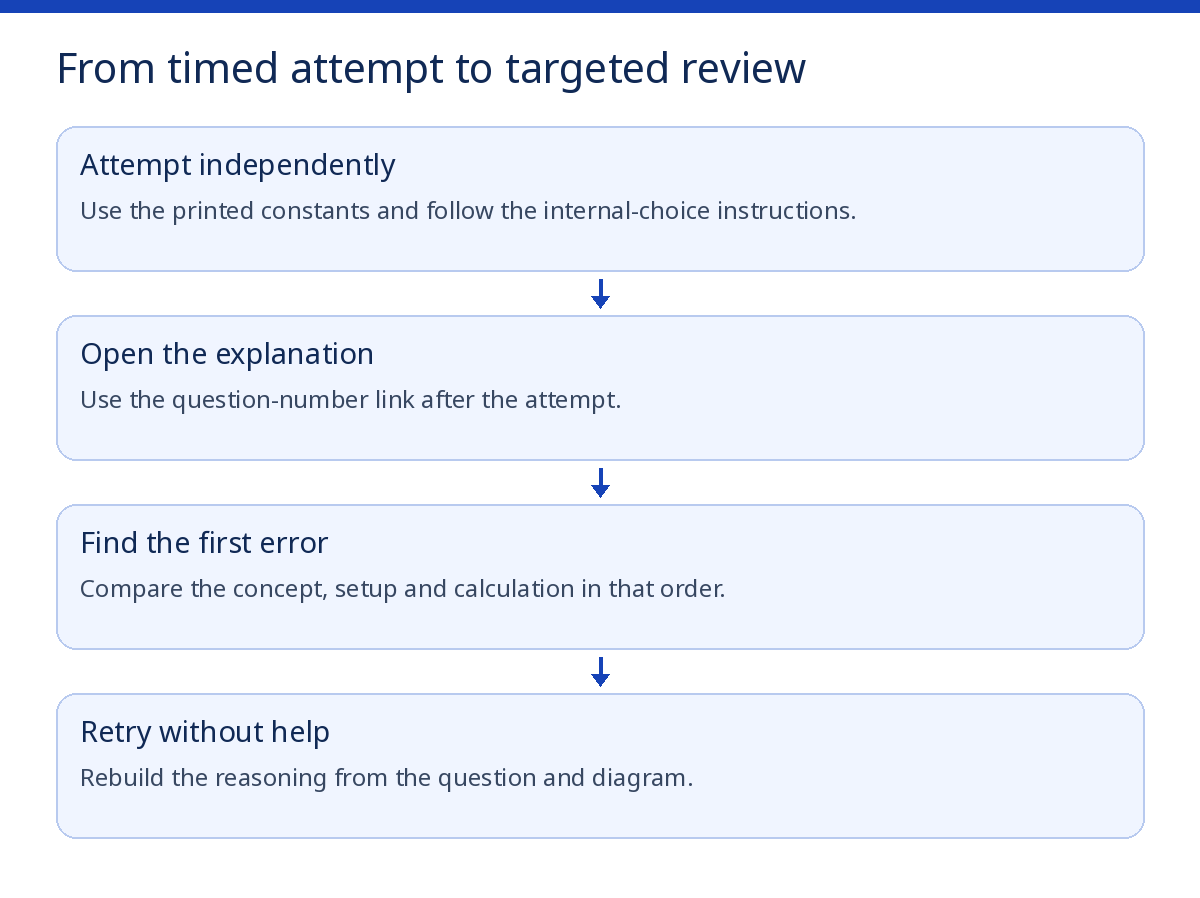
The PDF’s question-number links let you go straight from a completed attempt to a worked explanation. The explanations separate the formula, concept and reasoning steps. Compare the concept with your own setup before reading the calculation. If your principle was sound, locate the first line where your work diverged: a direction, unit conversion, graph axis or diagram label may explain the difference.
For a derivation, close the solution and try to reconstruct the argument from your diagram and assumptions. For an assertion–reason item, check the two statements independently before deciding whether one explains the other. This guide leaves out the wording-sensitive items Q29(iii), the non-OR branch of Q30(iv), and Q32 OR (iii), as well as Q1’s numerical result, whose option formatting is unclear in the excerpt.
Spotted an error? Report a correction. Practise this in the app: notes, formula sheets and mind maps.













































































































































































Loading comments…