CBSE Class 12 Physics 2026 Paper With Worked Solutions
CBSEPhysics2026 Previous Year Paper
Paper code: 55(B) · 2026Practise with the full, adapted English-language CBSE Class 12 Physics 2026 paper, labelled 55(B). Use the three-hour paper to rehearse the five-section format, then compare your reasoning with the worked explanations.
This set is one of the year's papers. See every set from 2026, grouped by series.
Know the format before you start
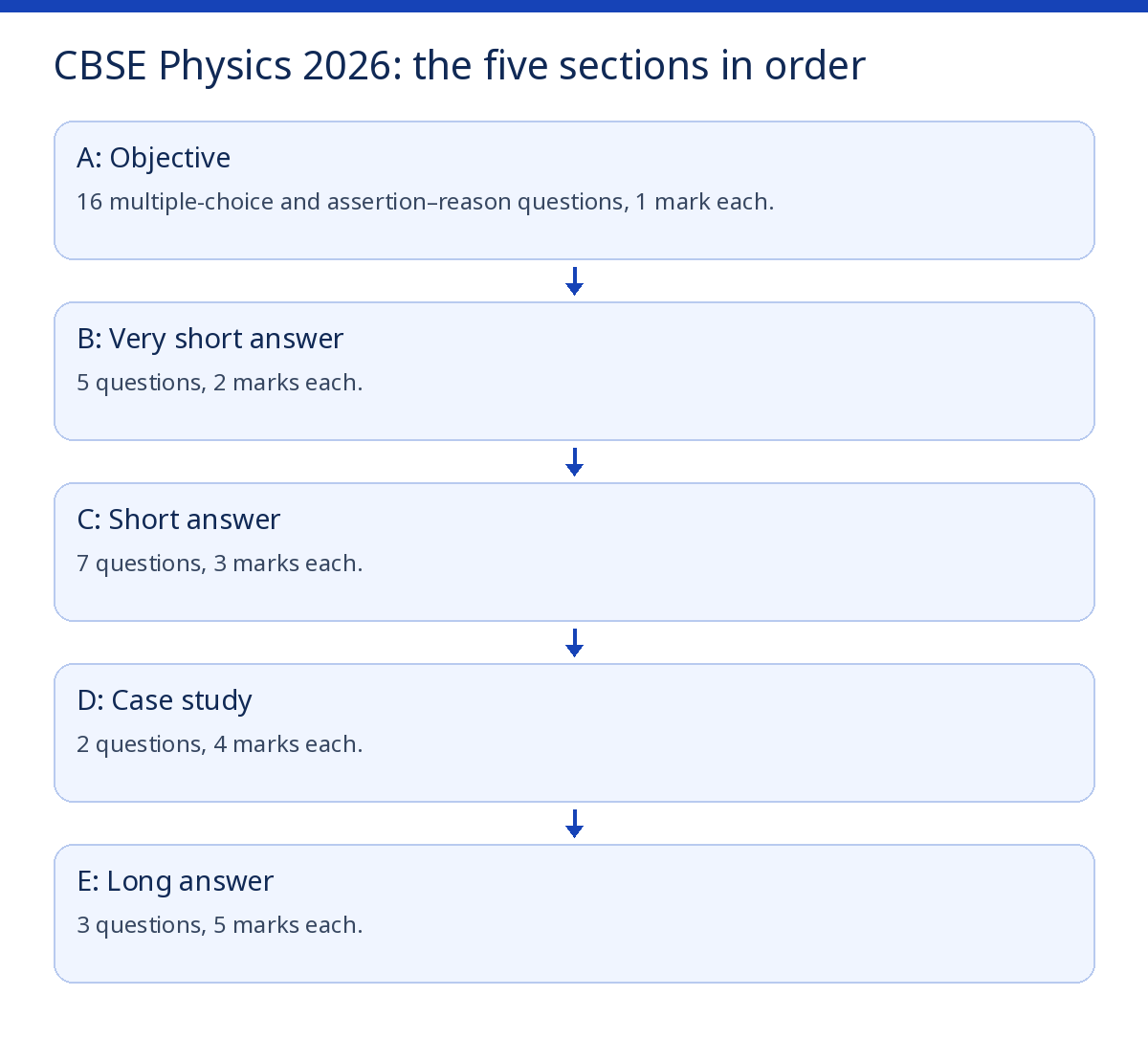
This year-wise file pairs the question paper with worked solutions. The cover identifies it as an adapted main-examination paper and states that the original English questions, options and diagrams are retained. The paper carries 70 marks and contains 33 questions. Calculators are not allowed, and the instructions supply physical constants for use where needed.
- Section A: 16 one-mark questions, including multiple-choice and assertion–reason items.
- Section B: Five two-mark very short answers.
- Section C: Seven three-mark short answers.
- Section D: Two four-mark case studies.
- Section E: Three five-mark long answers.
All question numbers are compulsory. An internal OR lets you choose between printed alternatives within a question; it does not let you skip that question. Some questions in Sections B to E offer internal choices, but none in Section A do.

Physics 2026 | Class 12 | Previous Year Paper | Code 55(B)
In the StudentCurio app
A complete CBSE Class 12 Physics 2026 examination paper with questions and worked solutions across electricity, magnetism, optics, modern physics and other syllabus areas. It helps students practise the exam format and review solution methods.
Electricity and magnetism across the paper
The electricity questions move from charge and average current to a battery with internal resistance, then to electron drift and the factors that determine a conductor’s resistance. The battery and drift prompts are useful together: one asks you to account for quantities in a circuit, while the other asks you to explain the motion of charge carriers inside a conductor. A correct calculation in the first does not replace a physical explanation in the second.
The magnetism questions likewise ask for more than numerical values. The field around a current-carrying wire calls for both magnitude and direction, whereas the induction questions examine changing magnetic flux and connect Lenz’s law with conservation of energy. The electromagnetic-wave problem adds another distinction: finding a wavelength or period is a different task from identifying how the electric field, magnetic field and propagation directions relate.
Optics, modern physics and semiconductors
The optics coverage spans both ray optics and wave optics. Mirrors, lens sign conventions, refraction at a curved surface and telescopes give you practice interpreting geometry and image formation. Coherence and single-slit diffraction ask you to reason about waves instead. In diffraction, distinguish an angular width from the width measured on a screen: they describe the same pattern in different ways, and a change in the observation geometry need not affect both quantities alike.
Modern-physics questions cover photoelectric emission, de Broglie wavelength, atomic energy levels and nuclear physics. The semiconductor questions range from doping and junction bias to half-wave rectification. That progression lets you test whether you can connect the behaviour of a junction to its role in a circuit, rather than remembering the names of semiconductor types in isolation.
What the case studies and long answers ask you to do
The two case studies concern an electric dipole in a uniform electric field and a moving charge in a uniform magnetic field. Read the shared setup before tackling individual subparts. Mark which directions and field conditions are given, then check whether a subpart introduces a new condition. In the dipole case, for example, the net force and the turning effect are separate quantities; treating them as interchangeable would lead you to ask the wrong question about the setup.
The long-answer section combines derivations and explanations with applications. Its alternatives include electrostatics or capacitance, mutual inductance or alternating current, and diffraction or telescopes. Before choosing a branch, read all its parts: recognising the opening concept is not the same as being able to justify a later step. This guide leaves out the disputed case-study details in Q29(ii), Q29(iii)(a) and Q30(i).
Before you use a formula, check its conditions
- Capacitor energy: When a dielectric is inserted, establish whether the charge or the voltage is held constant before predicting a change in stored energy. The two constraints are not interchangeable. If your reasoning assumes an isolated capacitor or one kept at fixed voltage, make that assumption explicit.
- De Broglie wavelength: The wavelength is related to momentum. If you express momentum in terms of kinetic energy using the classical relation, you are making a non-relativistic approximation. State that assumption before comparing particles accelerated through a potential difference.
- Photoelectric emission: Threshold frequency is a condition on photon energy. When discussing intensity, specify that the frequency is held fixed, and distinguish a change in photoelectric current above threshold from a change in the maximum kinetic energy of the emitted electrons.
Turn the worked solutions into a second attempt
For a timed run, complete the question paper before opening the linked solutions. Choose one branch at each internal choice, as you would during the paper. In an assertion–reason item, judge each statement on its own before asking whether the reason explains the assertion. That last step matters because two true statements can describe related facts without one explaining the other.
The solution pages separate Formula used, Concept used and Explanation in steps. When reviewing, find the first point where your reasoning diverged: did you choose the wrong principle, overlook a condition, or make a sign, direction or unit error while applying the right method? Then return to the question and rewrite that part without looking at the explanation. On a later pass, use the worked explanations for the alternatives you did not choose to check whether your first choice reflected stronger understanding or simply a more familiar opening prompt.
Spotted an error? Report a correction. Practise this in the app: notes, formula sheets and mind maps.













































































































































































Loading comments…