CBSE Class 12 Physics 2026 Previous Year Paper (55/1/3)
CBSEPhysics2026 Previous Year Paper
Paper code: 55/1/3 · 2026Use this solved, year-wise paper to practise the full 2026 CBSE Class 12 Physics main examination. Attempt the English paper under its three-hour limit, then use the worked explanations to check how you chose a principle, interpreted a diagram or set up a derivation.
This set is one of the year's papers. See every set from 2026, grouped by series.
Know the paper pattern before you start
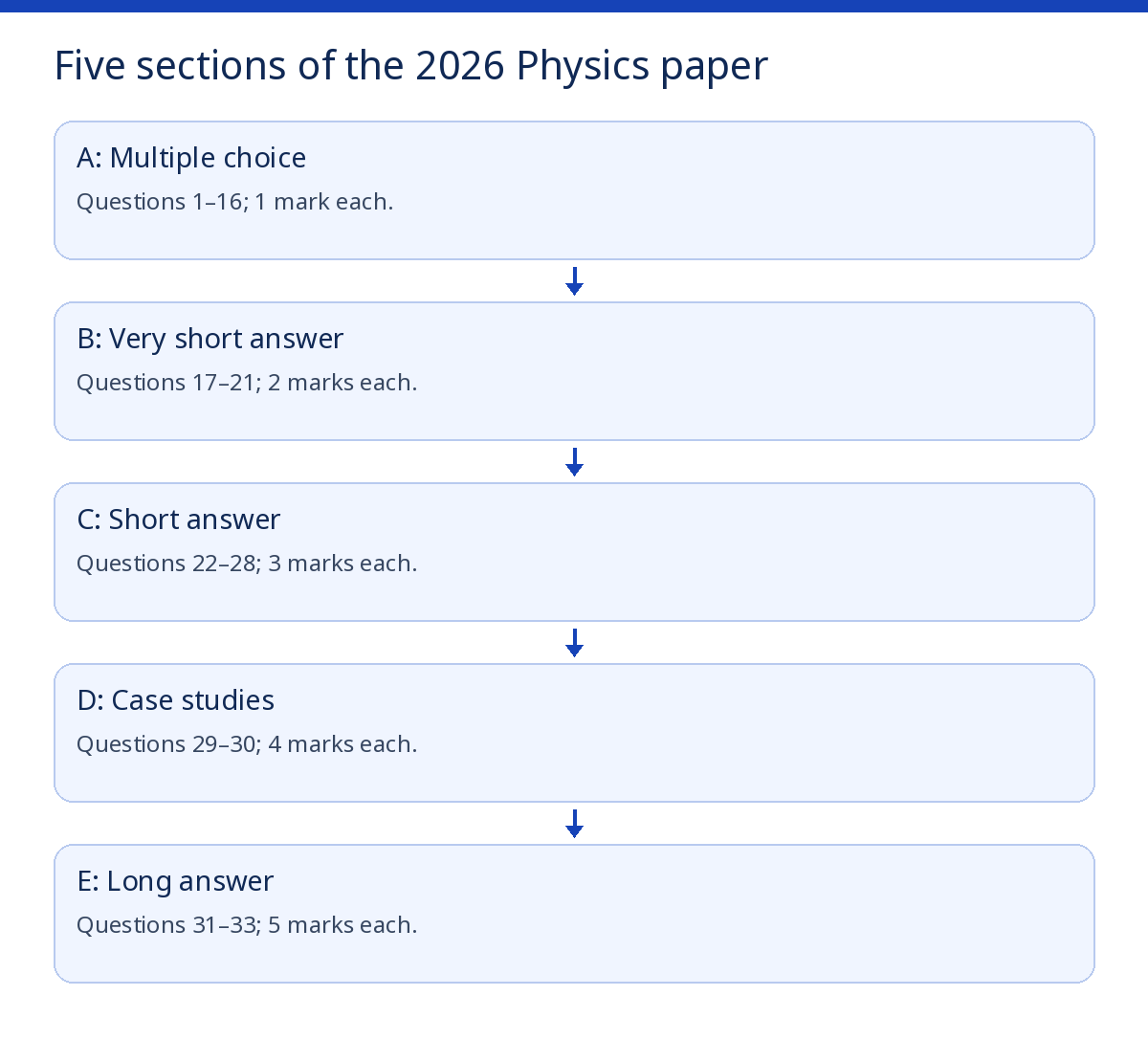
Paper 55/1/3 carries 70 marks and contains 33 questions across five sections. Section A has 16 one-mark multiple-choice questions, including assertion–reason items. Section B has five two-mark very short answers, and Section C has seven three-mark short answers. Section D has two four-mark case studies, and Section E has three five-mark long answers. Together, they ask you to do more than recall formulas: you also have to interpret figures, justify conclusions and develop multi-part written responses.
There is no overall choice. All question numbers are compulsory, but some questions in Sections B through E give an internal choice. For a timed attempt, answer only one alternative where an OR is printed. Use the other branch for separate practice after the attempt.

Physics 2026 | Class 12 | Previous Year Paper | Code 55/1/3
In the StudentCurio app
A solved CBSE Class 12 Physics examination paper from 2026, with worked answers including a question on electric dipoles and equivalent cells in parallel. Helps students practise board-exam questions and review solution methods.
Read the qualifiers in Section A
The objective questions cover topics such as wave interference, electromagnetic waves in a dielectric, a p–n junction at equilibrium, electric potential, the Bohr model and a series LCR circuit. Before looking at the options, identify what the question actually asks for. A magnitude calls for a different check from a direction, and a statement about equilibrium must be judged under the conditions given, not under an applied bias.
For an assertion–reason item, judge the truth of the two statements separately before asking whether the reason explains the assertion. Two statements can concern the same topic without one explaining the other. When reviewing, write a short justification even if you selected the right option; that makes it easier to distinguish sound reasoning from a lucky choice.
Common mix-ups in short answers
The short-answer sections move between derivations, numerical setups and diagrams. The drift-velocity prompt, for example, asks for both an order of magnitude and a derivation. Giving a typical magnitude does not establish the relation to current. In the capacitor question, distinguish the initial charging stage from the later changes: the battery is disconnected before the plate separation and dielectric are changed. Do not treat the initial battery voltage as a voltage that the battery still maintains.
Apply the same close reading to optics. The internal choice on fringe coincidence contrasts single-slit diffraction with Young’s double-slit interference. Both alternatives involve two wavelengths and a common fringe position, but one asks about dark fringes and the other about bright fringes. Name the setup and the required fringe type before choosing a relation.
Read the case-study passage and graph together
Section D uses two different kinds of evidence. The moving-coil galvanometer case describes a current-carrying coil, a magnetic field and a spring that supplies a counter-torque. As you read, keep the magnetic torque that deflects the coil distinct from the spring’s opposing torque. For the meter-conversion items, draw the proposed connection and label the coil resistance, full-scale deflection current and desired meter range. That gives you a way to check your circuit reasoning before comparing the options.
The photoelectric-effect case instead asks you to interpret a graph of stopping potential against incident frequency for two metals. Read the axes before using a slope or an intercept. Keep the quantity plotted on the vertical axis distinct from the energy of an emitted electron; a voltage and an energy cannot be substituted for one another without conversion.
Make the reasoning visible in long answers
Section E pairs derivations with applications. The optics question offers a lens route or a concave-mirror route. When practising the multi-lens problem, keep track of which lens each distance is measured from. One lens’s image determines the object for the next, so simply carrying a distance forward without changing the reference point can spoil an otherwise correct method.
The other long-answer choices connect induction with a solenoid and rotating rod, or with a step-up transformer. The final question offers electrostatics or a circuit with parallel cells. In the dipole derivation, keep the general equatorial-field expression separate from the far-field approximation, which is requested only for . In the parallel-cell alternative, sketch the stated terminal connections and distinguish the cells’ internal resistances from the external load.
Use the worked solutions as a second pass
Attempt the paper before following its solution links. The examination instructions prohibit calculators and provide physical constants for use where needed. Practise under that restriction, and check for any values supplied within an individual question before taking them from the general list. For diagram-based items, use the printed figure rather than relying on a text extraction to recover labels or directions.
The worked explanations separate formula used, concept used and explanation in steps. Compare your response in that order: was the relation suitable, did you recognise why it applied, and where did your written reasoning first diverge? If the error began with a sign convention, circuit connection or graph label, redo the setup before repeating the arithmetic. Then try the unused internal choice without reading its explanation first.
Spotted an error? Report a correction. Practise this in the app: notes, formula sheets and mind maps.













































































































































































Loading comments…