CBSE Class 12 Physics 2026 Paper 55/3/1 With Solutions
CBSEPhysics2026 Previous Year Paper
Paper code: 55/3/1 · 2026Use the full English-language 2026 main examination paper to practise CBSE Class 12 Physics under board-exam conditions. Then use the worked solutions to check not just your answers, but also the assumptions, diagrams and reasoning behind them.
This set is one of the year's papers. See every set from 2026, grouped by series.
Read the paper structure before starting the clock
This year-wise resource pairs the full CBSE Class 12 Physics paper, code 55/3/1, with worked solutions. The main examination lasts 3 hours and carries 70 marks. The file retains the original English questions, options and diagrams, so you can attempt it in its printed order before opening the explanations.
Section A contains 16 one-mark multiple-choice questions, including four assertion–reason items. Section B has five two-mark very short answers, and Section C has seven three-mark short answers. Section D contains two four-mark case studies, while Section E has three five-mark long answers. All 33 questions are compulsory: an internal choice lets you select one of the alternatives where offered, not skip the question. Section A has no internal choice. Use the constants listed in the paper where needed and attempt the calculations without a calculator.

Physics 2026 | Class 12 | Previous Year Paper | Code 55/3/1
In the StudentCurio app
Complete CBSE Class 12 Physics paper code 55/3/1 with worked solutions, covering topics across the syllabus, including electrostatics, current electricity, optics, magnetism, nuclear physics and semiconductors. It helps students practise board-exam questions and review solution methods.
Follow electric and magnetic ideas across sections
The paper moves between electric fields, capacitor networks, current electricity and magnetic effects. Its longer electrostatics questions ask you to interpret a potential graph or reason about fields and flux in different regions of a conducting arrangement. For a Gauss’s law question, identify which charges the chosen surface encloses before doing any algebra. Distinguish finding the net flux from finding the field at a point: pulling the field magnitude out of the flux integral requires suitable symmetry.
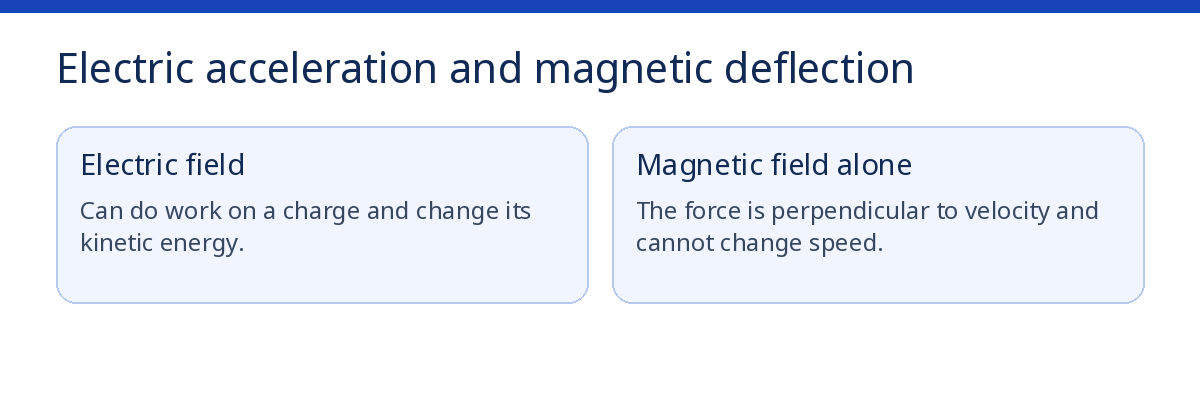
The case studies ask you to carry information from a common setup into several subparts. In the capacitor case, trace the connections and note how long the circuit has been connected before applying a steady-state model. In the charged-particle case, separate the electric acceleration stage from the later magnetic motion. An electric field can change kinetic energy by doing work; a magnetic force alone is perpendicular to the particle’s velocity and cannot change its speed.
Keep induction and alternating-current quantities distinct
Induction and alternating current appear in several forms: changing magnetic flux, the response of an inductor to different sources, a phasor diagram and a series resistor–inductor–capacitor calculation. These tasks test different kinds of reasoning. A phasor sketch should make the phase relationship visible; a calculation must distinguish impedance, which is measured in ohms, from the dimensionless power factor.
In the series circuit, identify the angular frequency before finding the reactances. Inductive reactance increases with frequency for fixed inductance, whereas capacitive reactance decreases with frequency for fixed capacitance. Also check whether the sinusoidal source is specified by its peak voltage or its rms voltage. Those values are not interchangeable when calculating rms current.
Optics: choose the model before choosing an equation
The optics questions span thin lenses, telescopes, refraction at surfaces, total internal reflection, diffraction and double-slit interference. A ray diagram is useful for following refraction and locating an image, but it does not explain why superposing waves produce bright and dark fringes. In a wave-optics setup, distinguish the width of each slit from the separation between them; they describe different features of the arrangement.
Two conditions are particularly worth writing beside your practice work. Adding lens powers directly assumes thin lenses in contact. Total internal reflection requires light to travel from a higher to a lower refractive index and strike the boundary at an angle greater than the critical angle, measured from the normal. At the critical angle itself, the refracted ray is along the boundary.
Common mix-ups in modern physics and semiconductor questions
The paper samples the photoelectric effect, de Broglie wavelengths, nuclear size and binding energy, fission and fusion, and semiconductor behaviour. For photoemission, keep photon energy and work function in the same units before comparing them. The work function is a threshold energy; a photon below that threshold does not yield a photoelectron with negative kinetic energy.
For diode questions, distinguish the resistance inferred from a change in voltage and current from the ratio of voltage to current at one operating point. A diode’s current–voltage characteristic is not generally linear, so those quantities need not agree. When drawing a bias circuit, label the p and n regions and the supply polarity before explaining the effect on the junction barrier.
Turn the worked solutions into a second attempt
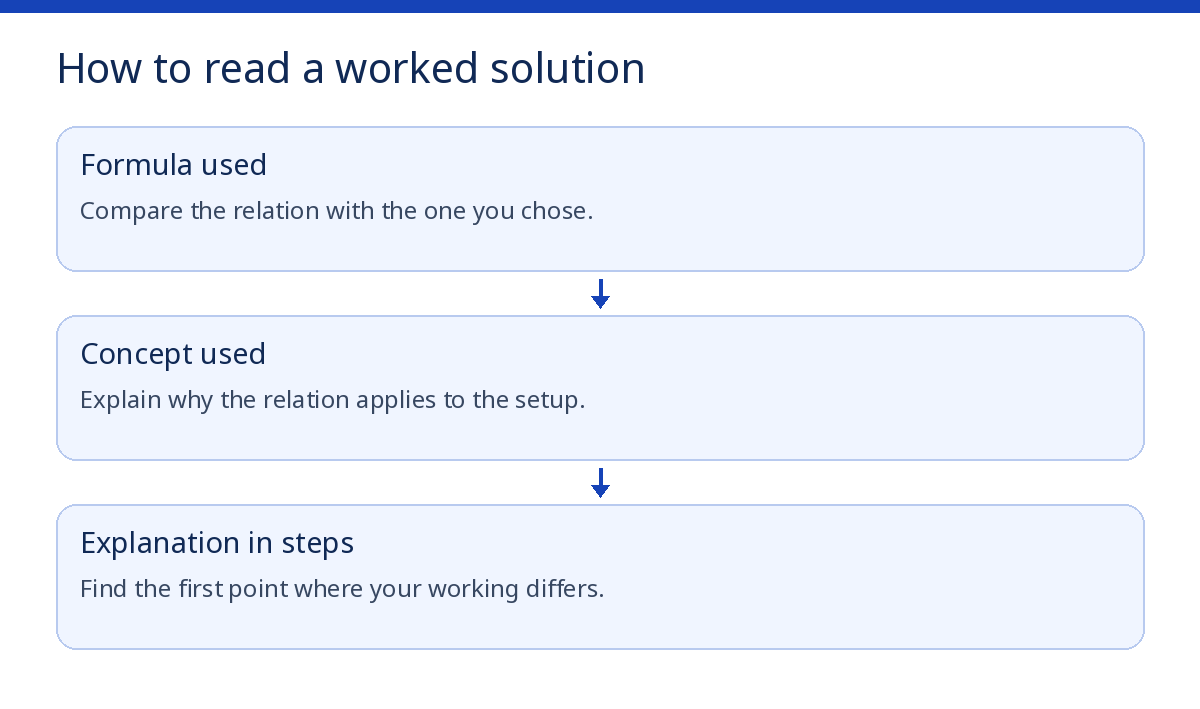
After your timed attempt, use the question-number links to open the relevant explanation. The solution format separates the formula used, the concept used and the explanation in steps. Compare in that order: was your equation appropriate, did you state why it applied, and where did your working first diverge? That comparison is more useful than checking only whether the final line matches.
For assertion–reason items, judge each statement separately before asking whether the reason explains the assertion. For a longer response, check whether you supplied all the requested parts, such as a labelled diagram, a derivation or a justification. Then try an unused internal alternative without looking at its worked method. Scoring note: Leave the rotating-loop multiple-choice item (Q2) out of your practice score. The file flags a mismatch with the printed options; this guide omits the disputed result.
Spotted an error? Report a correction. Practise this in the app: notes, formula sheets and mind maps.













































































































































































Loading comments…