CBSE Class 12 Physics 2026 Previous Year Paper Guide
CBSEPhysics2026 Previous Year Paper
Paper code: 55/4/2 · 2026Use the full English-language 2026 CBSE Class 12 Physics main examination paper (55/4/2) for a three-hour, 70-mark practice attempt. The worked solutions help you review not just the calculation, but also why a particular principle applies.
This set is one of the year's papers. See every set from 2026, grouped by series.
Know the paper before you start
This is a year-wise previous year paper, not a chapter worksheet. It retains the original English questions, options and diagrams, so you can practise switching between topics and question formats within one sitting. There are 33 questions across five sections, and calculators are not allowed. Use the constants listed in the paper when needed, rather than looking them up during the attempt.
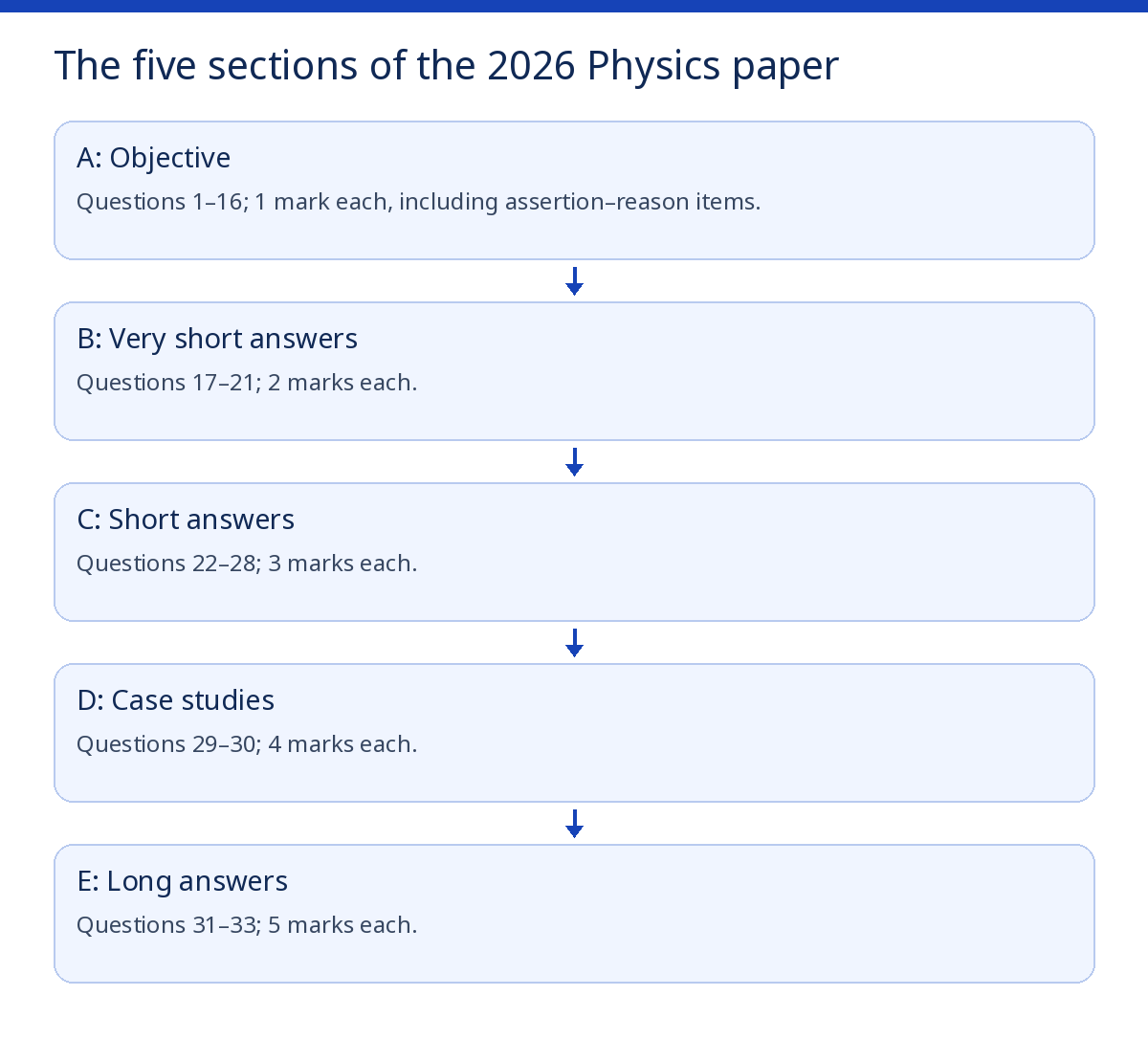
- Section A: Questions 1–16 carry one mark each and include assertion–reason items.
- Sections B and C: Questions 17–21 are two-mark very short answers; Questions 22–28 are three-mark short answers.
- Sections D and E: Questions 29–30 are four-mark case studies; Questions 31–33 are five-mark long answers.
All questions are compulsory, but some questions outside Section A offer internal choices. Choose one branch where an alternative is printed; an internal choice does not let you skip a numbered question altogether.

Physics 2026 | Class 12 | Previous Year Paper | Code 55/4/2
In the StudentCurio app
A complete CBSE Class 12 Physics paper for 2026, with worked solutions, covering topics including electrostatics, current electricity, optics, magnetism, electromagnetic induction, semiconductors and nuclear physics. Useful for board-exam practice and reviewing solution methods.
Read circuits and fields before choosing an equation
The paper moves from electrostatics and charge motion to current electricity, magnetic effects and induction. In a circuit problem, start by marking the cell polarities, junctions and assumed current directions. A negative current obtained from a consistent set of equations points opposite to the direction you assumed; it does not by itself indicate an algebra error. In the long-answer material on sources, distinguish a cell's emf from its terminal voltage when it supplies current through a circuit.
The induction questions use different ways of changing magnetic flux: one describes a time-varying magnetic field, while another shows a loop being withdrawn from a field and gives a current–time graph. Before using an equation, identify what changes in the setup and what the graph actually plots. That distinction matters: a current–time graph and a flux–time graph do not assign the same physical meaning to an area or a slope.
Common mix-ups: optical geometry and AC quantities
Optics appears through single-slit diffraction, a telescope case study, and longer questions involving a prism or wavefronts. In diffraction, angular spread and linear width on a screen are different quantities. Note which one the prompt asks you to sketch or discuss before deciding whether the screen distance matters. In ray optics, use the printed diagram to locate the surface normal at each encounter with a prism face; normal incidence at one face does not establish the incidence angle at the next.
In alternating current, peak, mean and root-mean-square values are not interchangeable. The paper checks these distinctions in a short item and later asks for an RMS current in a series LCR circuit, with a transformer as the long-answer alternative. When reviewing sinusoidal quantities, label each value as peak or RMS before substituting it, and check that the current you report is the kind requested.
Connect the models in modern physics and semiconductors
The modern physics questions draw on hydrogen spectra, the Bohr model, matter waves, photoelectric emission and nuclear density. Two questions may both mention wavelength but refer to different objects: one wavelength can belong to the incident light and another to an electron. The paper brings these together in a short-answer prompt that explicitly treats the work function as negligible. Keep that assumption local to that prompt; other questions provide work functions because they matter to the comparison being made.
The semiconductor questions also ask you to change models. Doping calls for reasoning about electron and hole concentrations, while a diode question asks you to consider the junction under a specified bias. A full-wave rectifier answer needs both circuit reasoning and waveforms. When reviewing your own sketch, check that the device behaviour you describe is consistent with the output you drew, rather than treating the diagram and explanation as unrelated tasks.
Quick self-check: what does the figure contribute?
Use the original diagrams alongside the prose, particularly for the telescope and resistance case studies. For the telescope, ask which lens produces the intermediate image and how that image enters the description of the second lens. Check whether the subpart specifies normal adjustment before applying a relation for that arrangement. For the resistance setup, ask what each meter measures and which part of the circuit the rheostat changes. Trace the connections before predicting what a slider movement does.
Try the same check on a graph or ray diagram: could you point to the feature that supports a line in your reasoning? If your explanation would read exactly the same with the figure removed, go back and see whether you have missed a direction, connection or geometric condition. This guide leaves the resistance case study's measurement-error subpart out of the review because its options do not clearly distinguish absolute from fractional error.
Review with the worked solutions after the attempt
The file links question numbers to worked solutions and provides a way back to the question. The explanations separate the formula, concept and steps, and the resource covers the printed internal choices. Use those layers to locate the first point where your reasoning diverged, rather than judging the attempt from the final option or numerical value alone.
For a calculation, check whether the model was appropriate before checking the substitution, sign and units. For a derivation or diagram-based response, look for a missing condition or an unexplained link between two steps. Then close the solution and rewrite that part from the original prompt. Once you have reviewed the branch you attempted under timed conditions, use the unattempted internal choice as fresh practice in the other topic.
Spotted an error? Report a correction. Practise this in the app: notes, formula sheets and mind maps.













































































































































































Loading comments…