CBSE Class 12 Physics 2025 Solved Question Paper
CBSEPhysics2025 Previous Year Paper
Paper code: 55/6/3 · 2025Use the full 2025 CBSE Class 12 Physics main examination paper (55/6/3) for a three-hour practice attempt, then compare your reasoning with the worked solutions. The English-language paper is a year-wise resource covering multiple syllabus topics, not a chapter-wise question bank.
This set is one of the year's papers. See every set from 2025, grouped by series.
Know the format before you start the clock
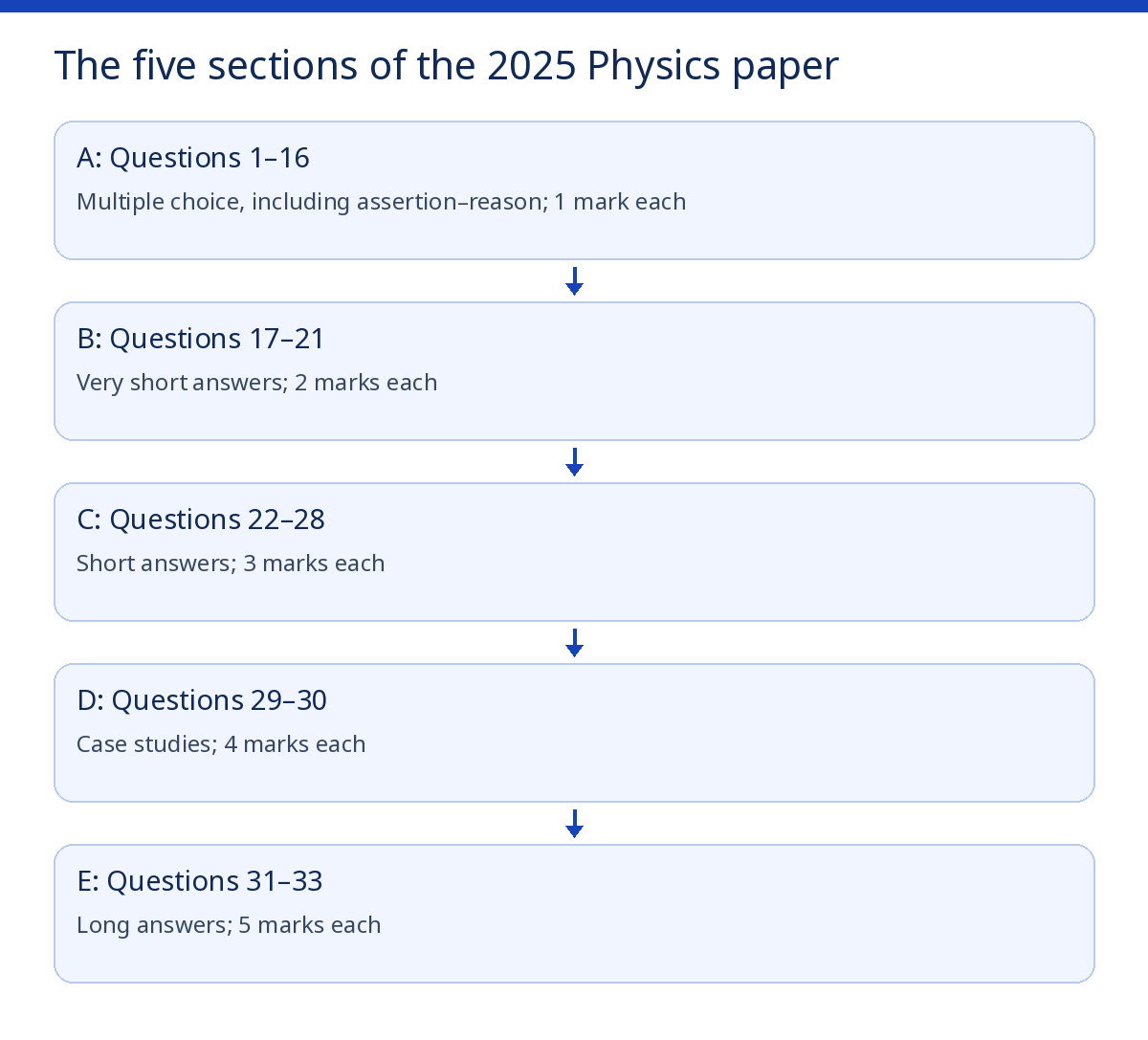
The paper has a time limit of three hours, carries 70 marks and contains 33 questions across five sections. Section A has 16 one-mark multiple-choice questions, including assertion–reason items. Section B has five two-mark very short answers, and Section C has seven three-mark short answers. Section D has two four-mark case studies. Section E has three five-mark long answers.
There is no overall choice: all questions are compulsory, but some questions outside Section A offer an internal choice. On a timed attempt, follow the printed choices rather than answering both alternatives. Calculators are not allowed. Use the question pages for diagrams and any supplied constants; this guide omits values and options where the text extract does not reliably preserve signs, exponents or symbols.

Physics 2025 | Class 12 | Previous Year Paper | Code 55/6/3
In the StudentCurio app
Complete solved CBSE Class 12 Physics paper for 2025, with questions and worked solutions across multiple syllabus chapters, including ray-optics problems. It helps students practise the board-exam format and review problem-solving methods.
What this paper asks you to do
The paper moves between current electricity, magnetism, electromagnetic induction, alternating current, optics, electrostatics, semiconductors and atomic and nuclear physics. The demands change across sections. An objective question may test whether you can distinguish closely related ideas, while a written question can require a calculation, a justification, a graph or a labelled diagram. The long-answer section includes tasks where a physical principle must be connected to a device or to a mathematical expression.
In an assertion–reason item, judge the two statements independently before deciding whether the reason explains the assertion. For written questions, pay attention to verbs such as state, obtain, draw and justify. A numerical result does not replace a requested explanation, and a formula alone does not show how a requested expression was obtained.
Circuit review: check the connections before the algebra
The paper tests circuit reasoning through a switched network, a multi-branch circuit and alternating-current questions. For the switched network, mark the conducting paths separately for each switch position before reducing the circuit. When components cannot be reduced by simple series and parallel combinations, use the junction and loop rules with consistent current directions and signs. A negative result for a branch current means its direction is opposite to the one you assumed, not that the setup automatically needs to be redone.
For alternating current, keep instantaneous quantities and rms values distinct. When comparing sinusoidal component voltages in a series circuit, check their relative phases before combining their magnitudes. The same arithmetic you would use for steady voltage drops cannot simply be applied to rms magnitudes.
Common optics mistake: choosing the equation too early
The paper includes interference, refraction at a spherical surface, mirror imaging and a compound microscope. These tasks do not all describe the same physical process. In an interference problem, distinguish the intensity at a particular point from an average over a fringe pattern. In a ray-optics problem, first identify whether light is reflecting from a mirror, refracting at a boundary or passing through successive elements of an instrument.
For image formation, use the diagram to fix your sign convention before assigning distances. A question about a spherical boundary between two media is not a thin-lens problem merely because it mentions a radius of curvature. For the microscope, distinguish the intermediate image formed by the objective from the final image viewed through the eyepiece, and carry the stated final-image condition into your setup.
Before answering a case study: mark what changes
The two case studies concern capacitors and semiconductors. In the capacitor passage, separate quantities that describe the geometry, such as plate separation and overlap, from quantities such as charge and potential difference. Capacitance depends on geometry and the medium between the conductors. If a change affects the stored energy, identify the electrical conditions before drawing a conclusion: whether the capacitor remains connected to a source matters to which quantity is held fixed.
In the semiconductor passage, distinguish what happens during the formation of a p–n junction from what happens when an external voltage is applied. Doping describes how an extrinsic semiconductor is made; diffusion and drift describe carrier motion; bias describes the applied voltage condition. Sorting the passage this way helps you select the relevant information without treating every subpart as a test of the same idea.
Use the worked solutions to find the first wrong step
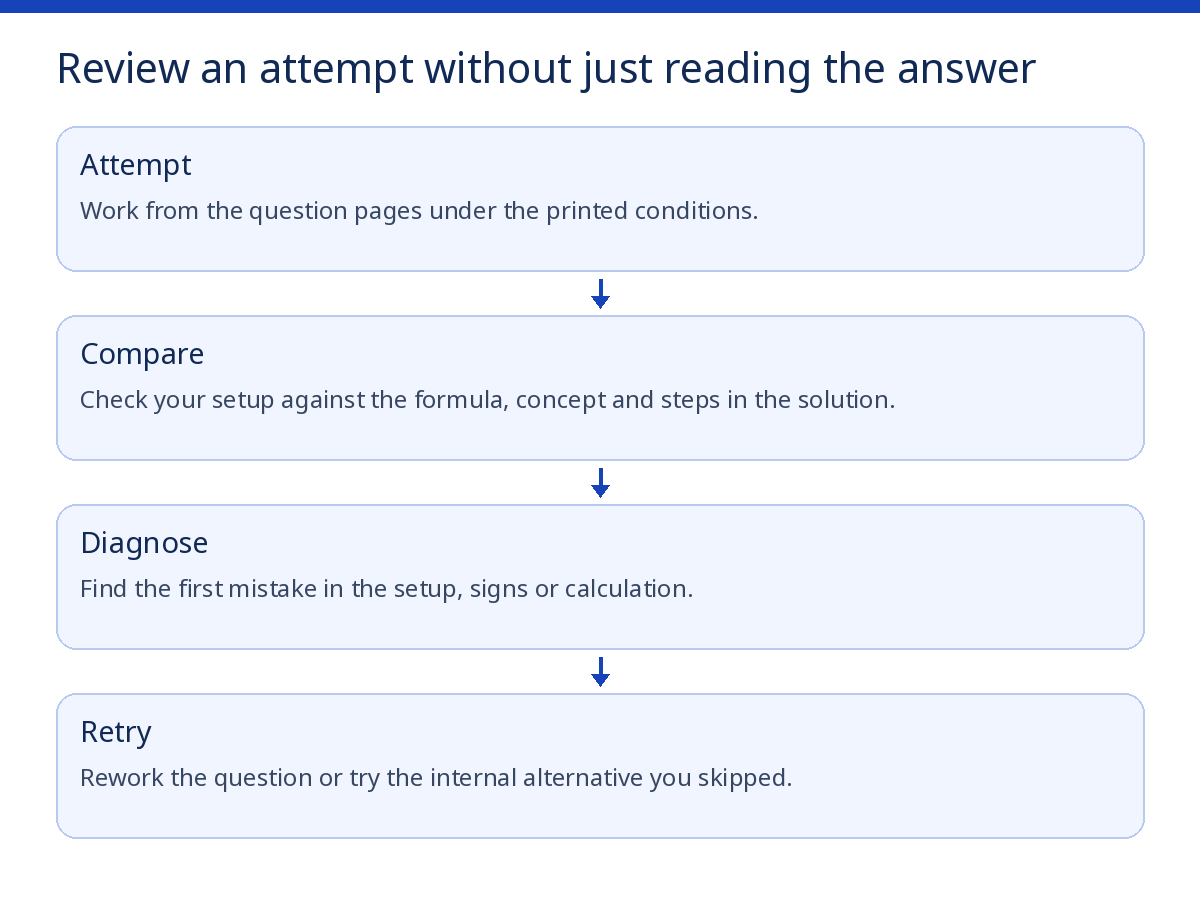
The file keeps the original English questions, options and diagrams separate from the worked explanations. Its question-number index lets you move to an individual solution, and the explanations are organised around the formula, the concept and the steps. Make your first pass without consulting those pages so your written work shows which decisions you could make independently.
When you compare attempts, look for the first point where your reasoning diverged. A wrong sign after a sound setup calls for a different review from using a relation under the wrong conditions. If your method differs from the worked one, compare the assumptions and check whether it delivers all the requested parts. The solutions include the printed internal alternatives, so after the timed attempt you can try a branch you did not choose and see whether it exposes a different gap.
Spotted an error? Report a correction. Practise this in the app: notes, formula sheets and mind maps.













































































































































































Loading comments…