CBSE Class 12 Physics 2025 Previous Year Paper With Solutions
CBSEPhysics2025 Previous Year Paper
Paper code: 55/7/1 · 2025Practise the full English-language 2025 CBSE Class 12 Physics main-examination paper, set 55/7/1, under its three-hour, 70-mark format. Then use the worked solutions to check not only your answers but also how you chose a formula, read a diagram or set up a derivation.
This set is one of the year's papers. See every set from 2025, grouped by series.
Know the format before you start
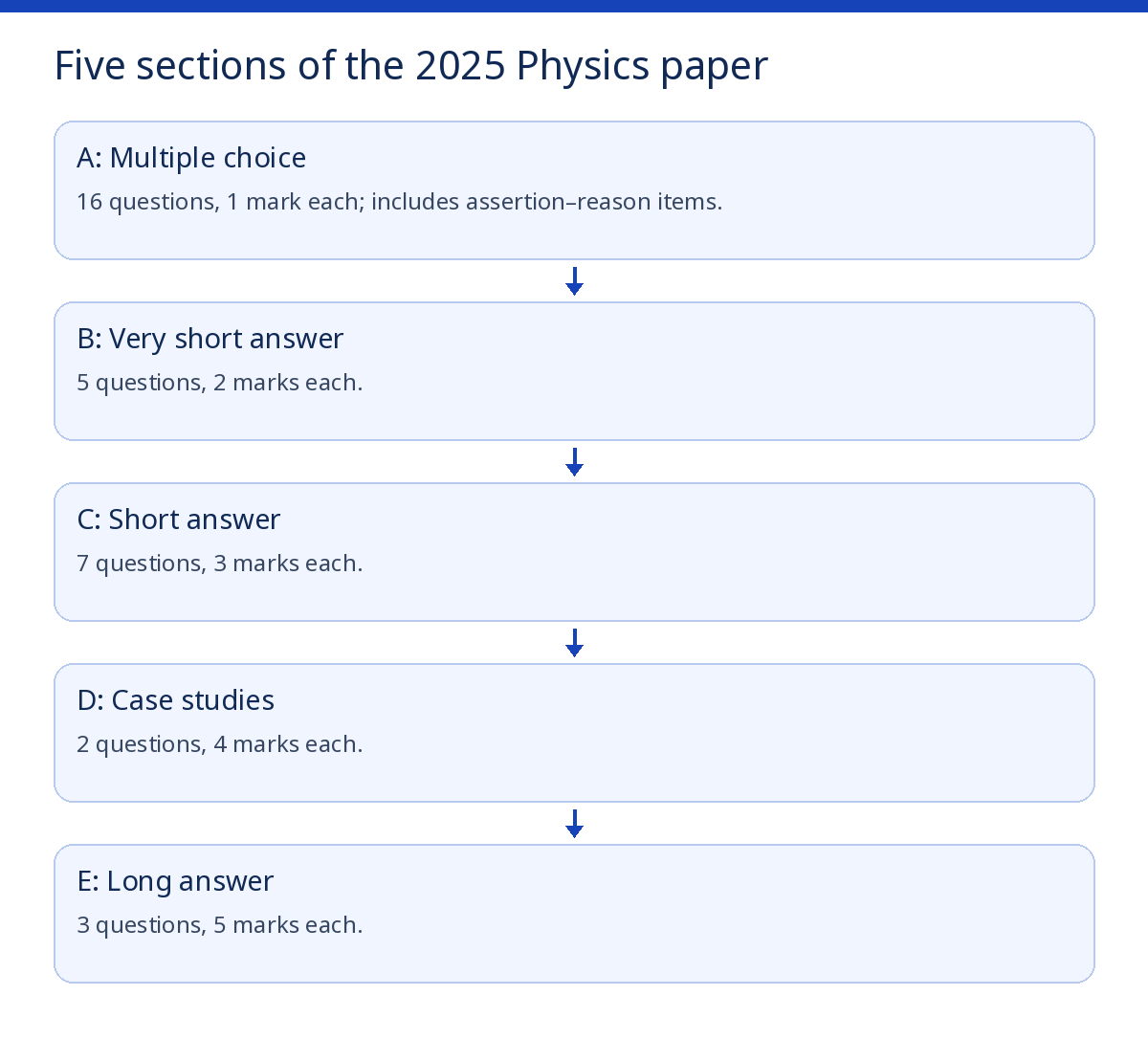
The paper has 33 compulsory questions across five sections. Section A contains 16 one-mark multiple-choice questions, with assertion–reason items at the end. Section B has five two-mark very short answers, and Section C has seven three-mark short answers. Section D contains two four-mark case studies. Section E has three five-mark long answers.
Internal choice is not overall choice. Where the paper prints an alternative, select one of the offered parts or branches as directed; you cannot skip the question altogether. Internal choices appear in some questions in Sections B to E, but not in Section A. For a realistic first attempt, use the original English questions and diagrams, keep the worked solutions closed and follow the paper’s no-calculator rule.

Physics 2025 | Class 12 | Previous Year Paper | Code 55/7/1
In the StudentCurio app
The 2025 CBSE Class 12 Physics paper, set 55/7/1, with worked solutions covering the syllabus. It helps students practise the board-exam format and review solution methods.
What the paper asks you to do with the syllabus
This is a year-wise board paper covering multiple parts of Class 12 Physics, not a chapter worksheet. Its questions range across electrostatics and capacitors, current electricity, magnetism, induction and alternating current, electromagnetic waves, optics, and topics such as photons, atomic transitions, nuclear energy and semiconductors.
The same broad topic can call for different kinds of work. Current electricity includes circuit analysis, graphs for a cell with internal resistance, and a case study about charge transport in a metal. Optics moves between explaining interference and diffraction, applying refraction to particular geometries, and drawing a labelled diagram for an optical instrument. After the attempt, note whether a difficulty came from the topic itself or from the form of the task: recalling a relationship, interpreting a graph, explaining a distinction or constructing a derivation.
The conductor case study: separate material and wire properties
The conductor passage starts with random electron motion and then introduces drift velocity, the average velocity associated with an applied electric field. It distinguishes drift from relaxation time, the average time between successive collisions, and defines mobility as the magnitude of drift velocity per unit electric field.
Keep those ideas separate from the dimensions of a wire. In the uniform-wire model, relates resistance to the material’s resistivity, the wire’s length and its cross-sectional area. Conductivity is the reciprocal of resistivity, not of the wire’s resistance. That distinction helps when reading a case study that shifts from one conductor to another: first identify whether the quantity describes the material under the stated conditions or depends on the specimen’s geometry.
The optics case study: identify the interface first
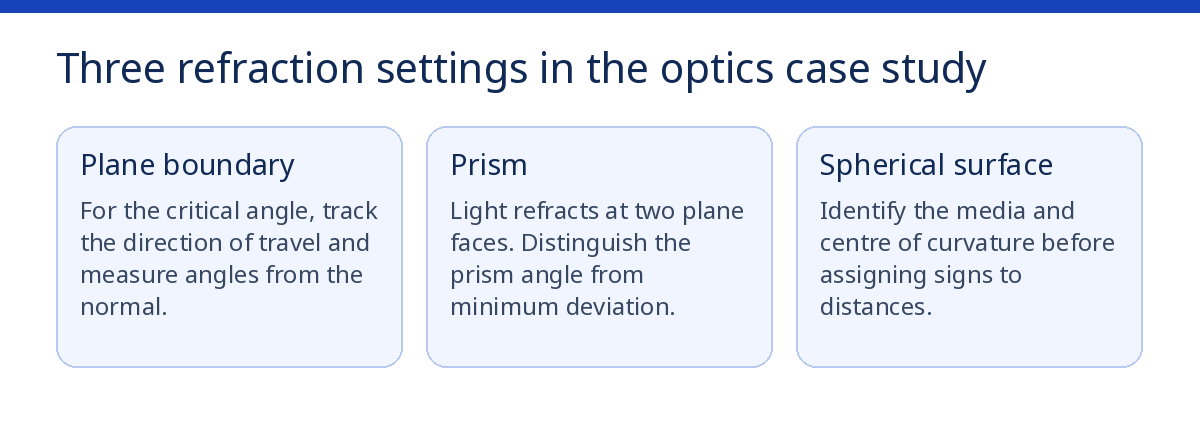
The optics passage links three settings: a plane boundary between two media, the two faces of a prism, and a spherical refracting surface. All involve refraction, but they do not use the same geometry. At the critical angle, light travelling from the optically denser medium toward the optically rarer medium has a refracted angle of . The incidence and refraction angles are measured from the normal, not from the surface.
For a prism, distinguish the prism angle from the angle of minimum deviation. The passage also refers to a simplified relation for a thin prism; that approximation is not a general replacement for the minimum-deviation relation. At a spherical boundary, identify the two media and the centre of curvature before assigning signs to distances.
Before using a formula, check what the question assumes
The optics choice involving a lens combination explicitly says that the lenses are thin and in contact. Those conditions matter: the usual addition of lens powers for that combination cannot simply be carried over to a system of thick lenses. In the electrostatics long-answer choice, the distance from the dipole centre is specified to be much greater than half the charge separation. Treat that as the condition for a far-field approximation, not as a detail to drop once the algebra begins.
Underlining such qualifiers during an attempt makes your reasoning easier to review. This guide omits numerical details from the capacitor-bank prompt and partially transcribed answer options rather than reconstructing missing symbols or units from the text extract.
Use the worked solutions to locate the first wrong step
The file has a question-number index and presents its worked explanations under Formula used, Concept used and Explanation in steps. After an independent attempt, compare your setup with the concept first. If you used the right principle but obtained a different result, check your substitutions, units and signs before rereading the entire solution. If your setup was wrong, identify the assumption or diagram feature you missed and try writing a new setup before looking further.
The file states that its explanations include all printed internal choices. Review the branch you attempted first. Then try the alternative separately if it tests a weaker topic or a different skill. This preserves the choice you made in the timed attempt while giving the unused branch a purpose in revision.
Quick self-check for reasoning and presentation
For an assertion–reason item, can you judge the truth of each statement separately before deciding whether the reason explains the assertion? Two statements can both be true without the second accounting for the first. For a graph response, can you name the quantity on each axis and explain how the physical model determines the trend, rather than just sketching a plausible curve?
For a long answer that asks for a labelled diagram and an explanation, check whether the labels are actually used in your reasoning. A useful review is to pick one missed response and rewrite only the part that failed: the opening principle, the graph labels, the diagram or the step where an approximation enters.
Spotted an error? Report a correction. Practise this in the app: notes, formula sheets and mind maps.













































































































































































Loading comments…