CBSE Class 12 Physics 2025: Solved Paper 55/1/2
CBSEPhysics2025 Previous Year Paper
Paper code: 55/1/2 · 2025Use the full English-language 2025 CBSE Class 12 Physics main-examination paper as a three-hour, 70-mark practice test. Then use the worked solutions to check not just your calculations, but also why each formula applies.
This set is one of the year's papers. See every set from 2025, grouped by series.
What this year-wise paper contains
This file is organised around one complete examination paper, set 55/1/2, rather than around individual chapters. It retains the original English questions, options and diagrams. The cover provides links by question number, and the worked explanations identify the formula used, the concept behind it and the steps that connect the two. The explanations also cover the printed internal choices.
That structure lets you use the same file for two distinct purposes: attempting a full board paper and reviewing specific decisions afterward. The topics visible in the worked explanations range from electrostatics, current electricity and magnetism to optics, matter waves, nuclear physics and semiconductors. The mix gives you practice in recognising the governing idea without a chapter heading to point you toward it.

Physics 2025 | Class 12 | Previous Year Paper | Code 55/1/2
In the StudentCurio app
Complete solved CBSE Class 12 Physics paper 55/1/2 for 2025, with questions spanning the syllabus and worked explanations. Helps students practise the board exam and review solution methods.
Attempt the paper before opening the solutions
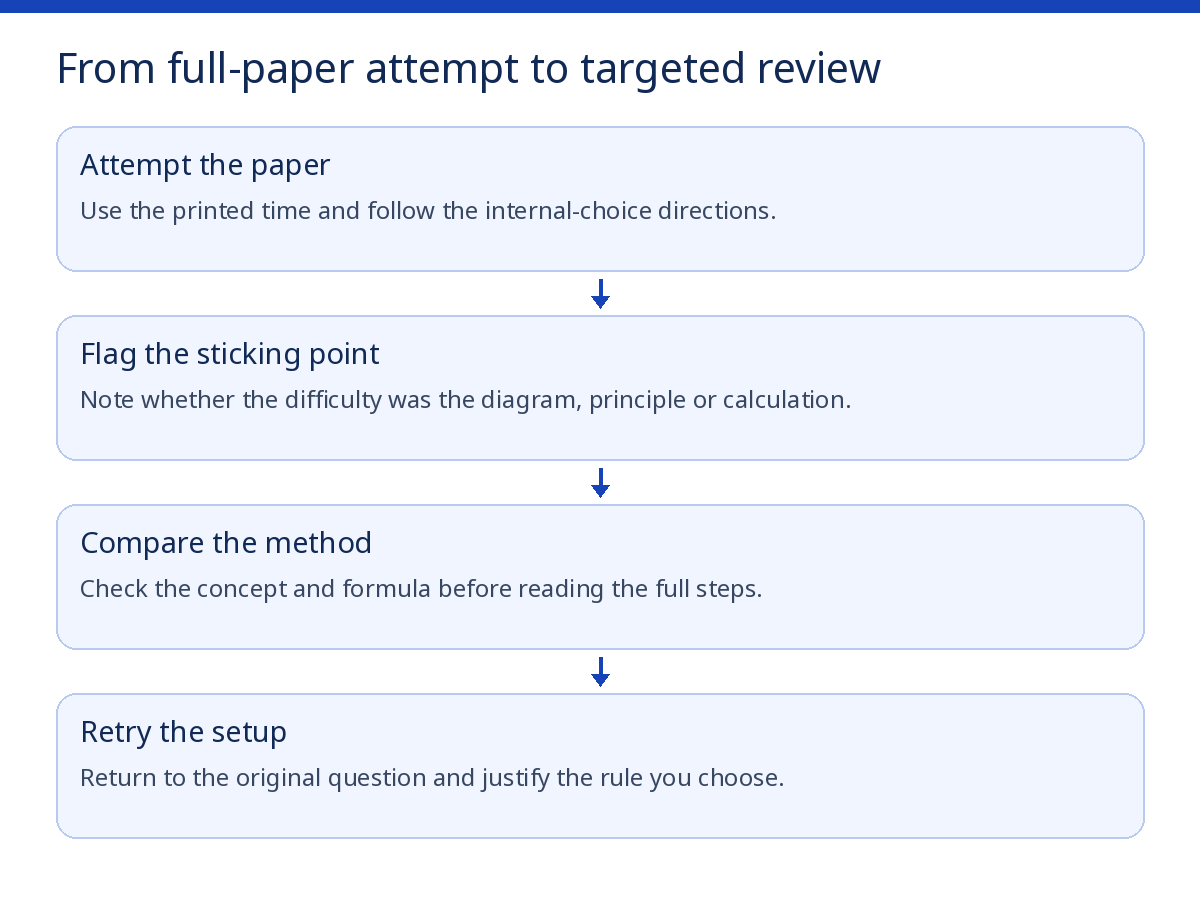
For an exam-style attempt, set aside the printed three hours and follow the question paper's directions for internal choices. Keep the worked pages closed while you write. Attempt the required branch of a choice during the sitting, rather than answering both simply because both explanations are available. The other branch can become a fresh practice question afterward.
When you get stuck, mark where it happened: interpreting a diagram, choosing a principle or carrying out the calculation. For an assertion–reason item, judge the two statements separately before asking whether the reason actually explains the assertion. Leaving a trace of your reasoning, even when you are unsure, gives you something more useful to compare with the worked explanation than a selected option alone.
When the circuit formula applies
The current-electricity explanations connect a wire's resistance to both geometry and material. For a uniform wire, , where is length, is cross-sectional area and is resistivity. For a circular wire, . Before treating resistance as proportional to length or inversely proportional to the square of the radius, check which quantities are held fixed. A change in geometry is not the same as a change in resistivity.
The microscopic relation connects electric field to current density. For the uniform conductor model, substituting and connects that relation to the circuit form . A constant resistance in Ohm's law requires unchanged physical conditions and approximately constant resistivity. Appreciable heating can change resistivity, and a diode does not in general have a linear current–voltage relation.
Common mix-ups with direction and sign
A magnetic force calculation and an induction calculation use signs for different purposes. In , the length vector points along conventional current, and the order of the cross product determines force direction. If the field has several components, carry the unit vectors through the calculation rather than working only with magnitudes.
In , the minus sign expresses Lenz's law: in a closed circuit, the induced current produces a magnetic effect that opposes the change in flux. If a prompt asks for the magnitude of the emf, use the magnitude of the rate of flux change; if it asks about polarity, keep track of the chosen orientation. Equal amounts of flux change need not produce equal emf magnitudes when they occur over different time intervals.
Read the conditions behind the optics formulas
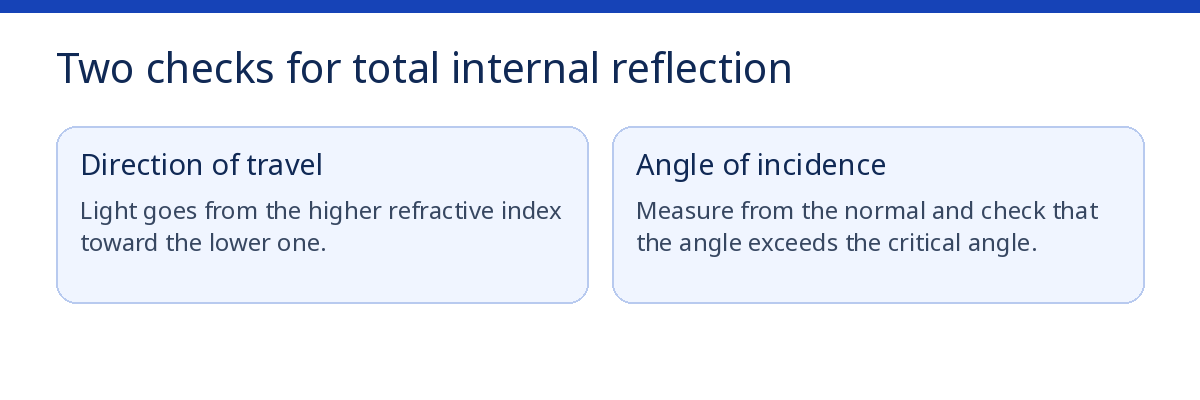
In ray optics, total internal reflection requires two checks. Light must travel from the higher refractive index toward the lower one, and its angle of incidence, measured from the normal, must exceed the critical angle. The critical-angle relation uses the index of the incident medium in the denominator. Checking the direction first prevents you from applying the angle test to the wrong pair of media.
In wave optics, distinguish the slit width in single-slit diffraction from the path difference in two-wave interference. The first single-slit minimum obeys . In interference, path difference contributes to the phase difference, and the intensity expression used in the worked material assumes two coherent contributions of equal intensity with no additional initial phase difference. Identify the situation before choosing a relation.
Keep energy, power and momentum distinct
The modern-physics material gives you a way to check whether you have identified the quantity being asked for. Photon energy is ; for light of a single frequency, dividing its power by the energy per photon gives the number of photons emitted per second. Power and photon energy are not interchangeable: one is measured in joules per second and the other in joules.
A matter-wave calculation instead starts from . The substitution uses the non-relativistic momentum relation. Before comparing wavelengths, check whether the problem fixes speed or momentum. Equal momentum gives equal de Broglie wavelengths, whereas equal speed does not imply equal momentum for particles with different masses.
After marking, find the first step to change
Use the question-number links to review the items you flagged. Read the concept used line first and compare it with the principle you chose. If they agree, look for the first difference in the setup: a sign convention, a unit conversion, a condition on the formula or a feature of the diagram. If your final option matches but your reasoning differs, check whether your method still follows from the conditions in the question.
For an internal choice, review the branch you attempted before trying the other branch without looking at its explanation. A useful final self-check is to return to one missed item and state, in a sentence, what feature of the question tells you which rule applies. Then redo the setup from the original paper.
Spotted an error? Report a correction. Practise this in the app: notes, formula sheets and mind maps.













































































































































































Loading comments…