CBSE Class 12 Physics 2025 Previous Year Paper (55/6/1)
CBSEPhysics2025 Previous Year Paper
Paper code: 55/6/1 · 2025Practise the complete English-language CBSE Class 12 Physics Main Examination 2025 paper, code 55/6/1. Use the three-hour paper for a timed attempt, then review how the worked solutions connect each method to the physics behind it.
This set is one of the year's papers. See every set from 2025, grouped by series.
How the 70-mark paper is organised
This year-wise file contains the full 2025 paper, with the original English questions, options and diagrams retained. It has 33 questions across five sections. Section A has 16 one-mark multiple-choice questions, including four assertion–reason items. Section B has five two-mark very short answers, and Section C has seven three-mark short answers. Section D has two four-mark case studies, while Section E has three five-mark long answers.
There is no overall choice: all numbered questions are compulsory. Where an internal choice is printed, attempt one alternative during a mock. Some questions in Sections B to E offer such choices; Section A does not. Calculators are not allowed, and the paper supplies physical constants for use where needed.

Physics 2025 | Class 12 | Previous Year Paper | Code 55/6/1
In the StudentCurio app
The complete CBSE Class 12 Physics Main Examination 2025 paper (55/6/1), with worked solutions and questions spanning the syllabus. Helps students practise a full board exam and review solution methods.
What the paper asks you to do with the syllabus
The paper moves between representations as well as topics. Current electricity appears in a graph, a resistor network and a derivation for cells with internal resistance. Magnetism and induction bring in field geometry, forces on current-carrying conductors and induced emf. The alternating-current questions move between circuit quantities and the operation of a generator or transformer. Recognising a chapter is only the first step: the wording tells you whether to interpret, calculate, derive or explain.
Optics likewise spans interference, refraction, ray tracing and optical instruments. Modern physics includes photon quantities, the Bohr model and nuclear properties. These questions are useful for checking whether you can carry a physical idea from one format to another. For example, a ray-tracing task demands a diagram that respects the geometry of the interfaces, while an image-position calculation demands a consistent sign convention.
Common mistakes: using a rule without its conditions
In an AC circuit, do not assume that the rms voltages across components can be added as ordinary positive numbers to recover the source rms voltage. The component voltages may be out of phase. During review, check whether you distinguished the instantaneous voltage, the peak value and the rms value before doing any arithmetic.
In electromagnetic induction, distinguish an induced emf from a sustained circulating current. Changing magnetic flux can induce an emf, but a circulating current requires a closed conducting path. In ray optics, check that the sign convention used for the distances in your equation matches the one used in your sketch. A numerical image distance alone does not fully answer a question that also asks for the nature of the image.
Read the two case studies as physical models
The capacitance case study links conductor geometry, the insulating medium, dielectric polarisation and stored energy. When reading a subpart, separate changes to the capacitor itself from changes to its electrical conditions. Plate spacing and overlap concern geometry; the presence of a dielectric concerns the medium. If an argument assumes that charge or potential difference stays fixed, check that the arrangement actually supports that assumption.
The semiconductor case study moves from doping to the formation of a p–n junction, then to bias and rectification. Keep those stages distinct: doping concerns the carrier populations in a material, diffusion and drift enter the junction model, and bias concerns the effect of an applied voltage. Reading the passage this way helps you identify which part of the model a subquestion is testing instead of treating every statement in the passage as equally relevant.
Quick self-check before comparing answers
For an assertion–reason item, ask three separate questions: Is the assertion true? Is the reason true? If both are true, does the reason explain the assertion? Two accurate statements about the same topic do not necessarily form an explanation. Use the response codes printed in this paper rather than relying on a code sequence you remember from another test.
For a long answer, check that every requested output is present. A labelled diagram, a statement of principle, a derivation and a direction are different tasks. When an expression is to be examined in a limiting case, keep the general expression separate from the approximation and state the condition that justifies the simplification.
Use the worked solutions for a second pass
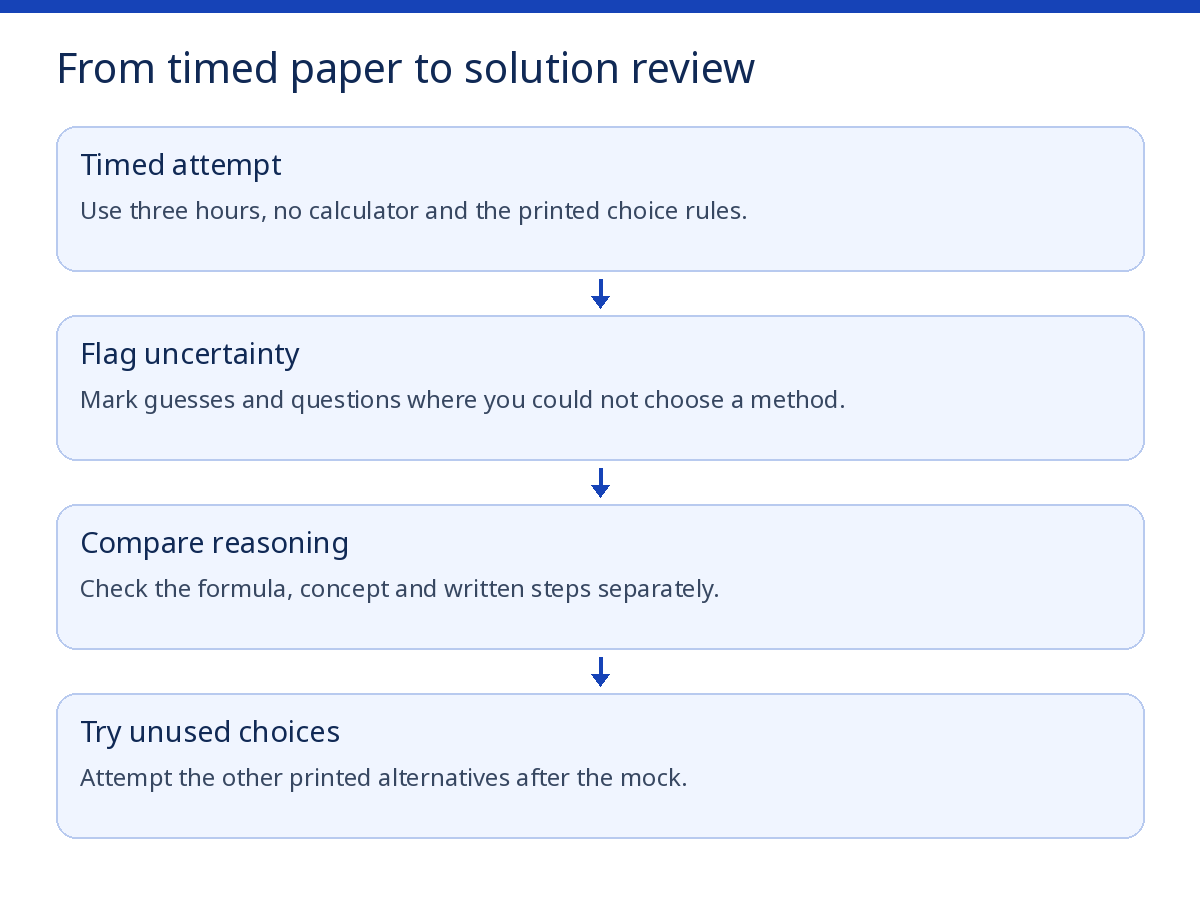
Start with the question paper rather than the solution pages. Attempt it in three hours without a calculator, following the printed choices. Mark answers you guessed and questions where you knew the topic but could not select a method. Both are worth reviewing, even when your final answer happens to match the file.
The file provides question-number navigation, and the worked solutions distinguish the formula used, concept used and explanation in steps. Compare your reasoning in that order: Was the relation appropriate, did its conditions hold, and where did your written steps diverge? The explanations also cover the printed internal alternatives, so you can attempt the unused branches after the timed sitting.
This guide leaves out the interpretation of the opening graph and the colour-based photoelectric answer: the graph wording and solution’s description of the axes differ, and a colour label alone does not specify an exact wavelength for a threshold comparison. Where extracted text loses symbols or signs, consult the original PDF page rather than reconstructing the question from the transcription.
Spotted an error? Report a correction. Practise this in the app: notes, formula sheets and mind maps.













































































































































































Loading comments…