CBSE Class 12 Physics 2025 Paper 55/7/2 with Solutions
CBSEPhysics2025 Previous Year Paper
Paper code: 55/7/2 · 2025Practise the full English-language CBSE Class 12 Physics 2025 main examination paper, Set 55/7/2, under its three-hour, 70-mark format. Then use the worked solutions to check not just your final answer but also your choice of principle, diagram and calculation method.
This set is one of the year's papers. See every set from 2025, grouped by series.
How the 2025 paper is organised
This year-wise resource presents one complete board paper rather than a chapter-wise question bank. It retains the original English questions, options and diagrams, so you can practise recognising the relevant topic without being told which chapter to use. The worked explanations cover the printed internal choices as well as the compulsory parts.
Section A contains sixteen one-mark multiple-choice questions, including four assertion–reason items. Section B contains five two-mark very short answers, and Section C contains seven three-mark short answers. Section D has two four-mark case studies, while Section E has three five-mark long answers. All 33 questions are compulsory, but some questions in Sections B through E offer an internal choice. There is no overall choice, and calculators are not allowed. For a timed attempt, answer only one branch wherever a choice is offered; save the other branch for review.

Physics 2025 | Class 12 | Previous Year Paper | Code 55/7/2
In the StudentCurio app
Complete CBSE Class 12 Physics 2025 Set 55/7/2 paper with worked solutions, covering topics across the syllabus, including electricity and magnetism, optics, modern physics, and semiconductors. It helps students practise the board-paper format and review solution methods.
Current electricity: separate circuit constraints from material properties
Current electricity appears in both a short question on drift velocity and a case study linking microscopic electron motion to measurable quantities such as current density and resistivity. The useful distinction is between what the circuit fixes and what depends on the conductor. A series connection constrains the current through its components; a parallel connection constrains the potential difference across its branches. Neither statement alone tells you the drift speed.
For a conductor with uniform current density across its cross-section, the magnitude relation is , where is the number of mobile electrons per unit volume, is the magnitude of the electron charge, is the cross-sectional area and is the drift speed. In review, label which quantities describe the material, which describe geometry and which depend on the connection. That classification makes it easier to spot when an assumption about equal current has been carried into the wrong circuit.
Magnetism and induction: decide what the geometry controls
The magnetic questions ask you to move between field direction, force or torque, and induction. The paper includes circular coils, a current loop in a magnetic field, self- and mutual inductance, and the moving-coil galvanometer. Before writing a magnitude, use the diagram to identify the direction of the relevant field or the orientation of the loop. When fields from different coils point in different directions, they must be combined as vectors rather than added as bare magnitudes.
For induction, distinguish a changing current in the same coil from a changing current in another coil. The first is the setting for self-induction; the second is the setting for mutual induction when the changing current alters the flux linked with the other coil. For an instrument question, a labelled diagram should help explain the function of a part, not merely show where it sits.
Common mistake: choosing an optics rule by keyword
The optics case study moves between critical angle, prism deviation and refraction at a spherical interface. These involve different geometries even though all involve refraction. A critical angle exists for light incident from the optically denser side and corresponds to a refracted ray at to the normal. The paper also distinguishes the general minimum-deviation relation for a prism from the thin-prism approximation; the approximation is not a substitute when the thin-prism condition is absent.
The long-answer choices extend optics practice to instruments and wave optics. For a telescope or microscope, identify the final-image condition before selecting a magnifying-power expression. For wave optics, check whether the pattern is produced by superposing coherent waves or by diffraction at a single slit. Both can produce bright and dark regions, but that resemblance does not make their position or intensity rules interchangeable.
Modern physics and semiconductors: name the quantity first
The paper draws on photons, photoelectric emission, the Bohr model and nuclear binding energy. These topics use energy in different ways: photon energy describes the incident radiation, a work function describes the energy needed to remove an electron from a metal, and binding energy per nucleon reports nuclear binding on a per-particle basis. In a numerical answer, state what your energy represents and keep its units consistent with the constants you use. A correct conversion cannot rescue a calculation based on the wrong physical quantity.
Semiconductors require a different kind of precision. The paper asks for donor or acceptor levels in energy-band diagrams and also examines the junction diode. When checking a sketch, distinguish the energy levels of the doped material from a diagram of the junction region. One represents energies; the other represents a region in the device.
Quick self-check: can you justify your first step?
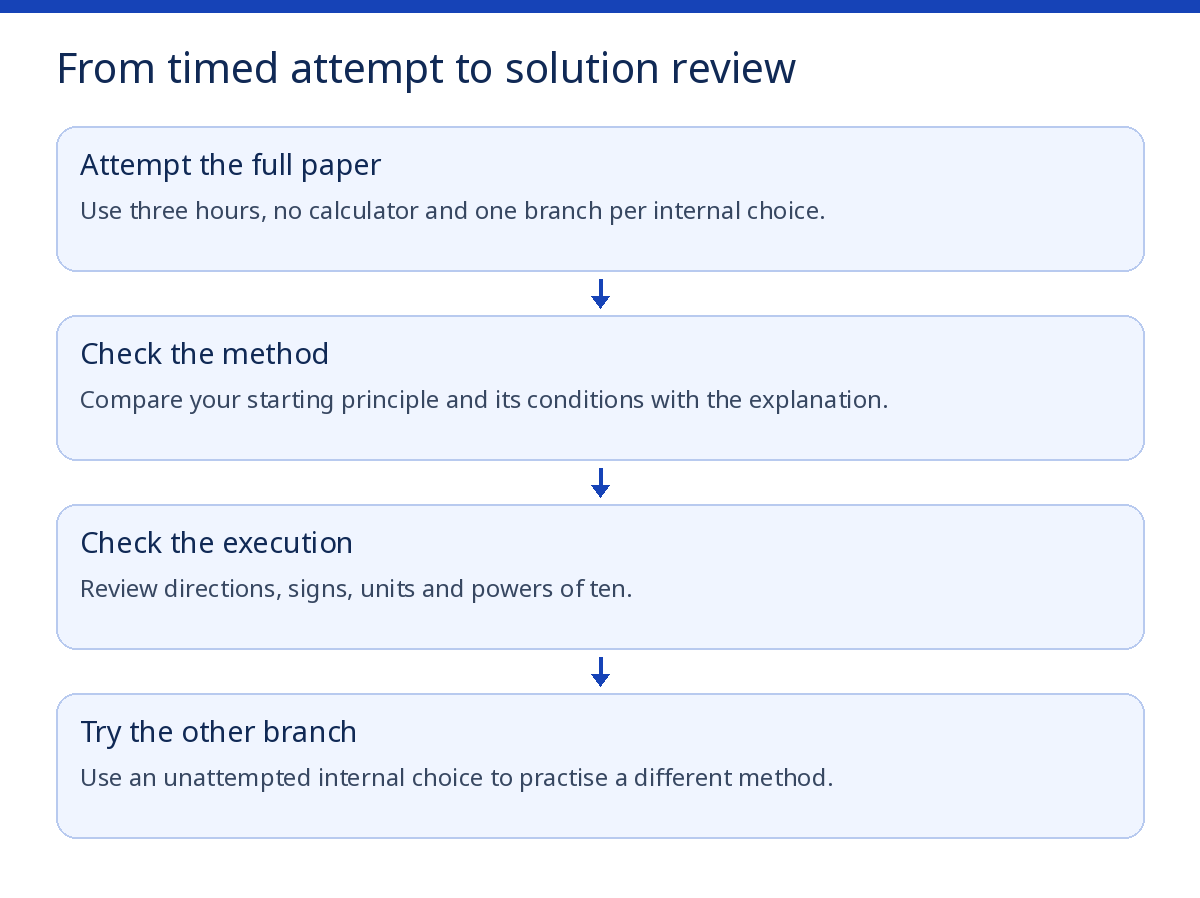
The file links question numbers to worked solutions structured around the formula, the concept and the explanation in steps. After your timed attempt, compare your first substantive line with the solution before checking the final result. Ask whether you used the right model, stated the condition that makes it applicable and interpreted the diagram correctly. Then check signs, powers of ten and units separately. For an assertion–reason item, make two truth judgments before deciding whether the reason actually explains the assertion.
Use the unattempted internal choices to test methods you avoided on the first pass. For exact constants, numerical options and diagram labels, consult the rendered PDF pages. This guide omits numerical details from passages where the extracted text does not reliably preserve symbols, signs or units.
Spotted an error? Report a correction. Practise this in the app: notes, formula sheets and mind maps.













































































































































































Loading comments…