CBSE Class 12 Physics 2025 Paper with Worked Solutions
CBSEPhysics2025 Previous Year Paper
Paper code: 55/2/3 · 2025Practise with the complete English-language 2025 CBSE Class 12 Physics main examination paper, set 55/2/3. Use the worked solutions to check not just your final answers, but also the assumptions, diagrams and reasoning behind them.
This set is one of the year's papers. See every set from 2025, grouped by series.
What this year-wise paper contains
This is a full CBSE Class 12 board paper, organised by examination year rather than by chapter. The 2025 main examination paper carries a maximum of 70 marks and has a duration of 3 hours. The file retains the original English questions, options and diagrams. Its question-number index lets you return to individual items, and the worked solutions cover the printed internal choices.
The solutions separate the formula used, the concept used and the explanation in steps. That structure is useful because each part answers a different question: What relation did you choose? Why does it fit the situation? How did you apply it? The paper lets you practise making those decisions when the topic changes from one question to the next.

Physics 2025 | Class 12 | Previous Year Paper | Code 55/2/3
In the StudentCurio app
The complete 2025 CBSE Class 12 Physics paper, set 55/2/3, is provided with worked solutions. It includes questions from across the syllabus, helping students practise board-exam questions and review solution methods.
Take the paper before opening the explanations
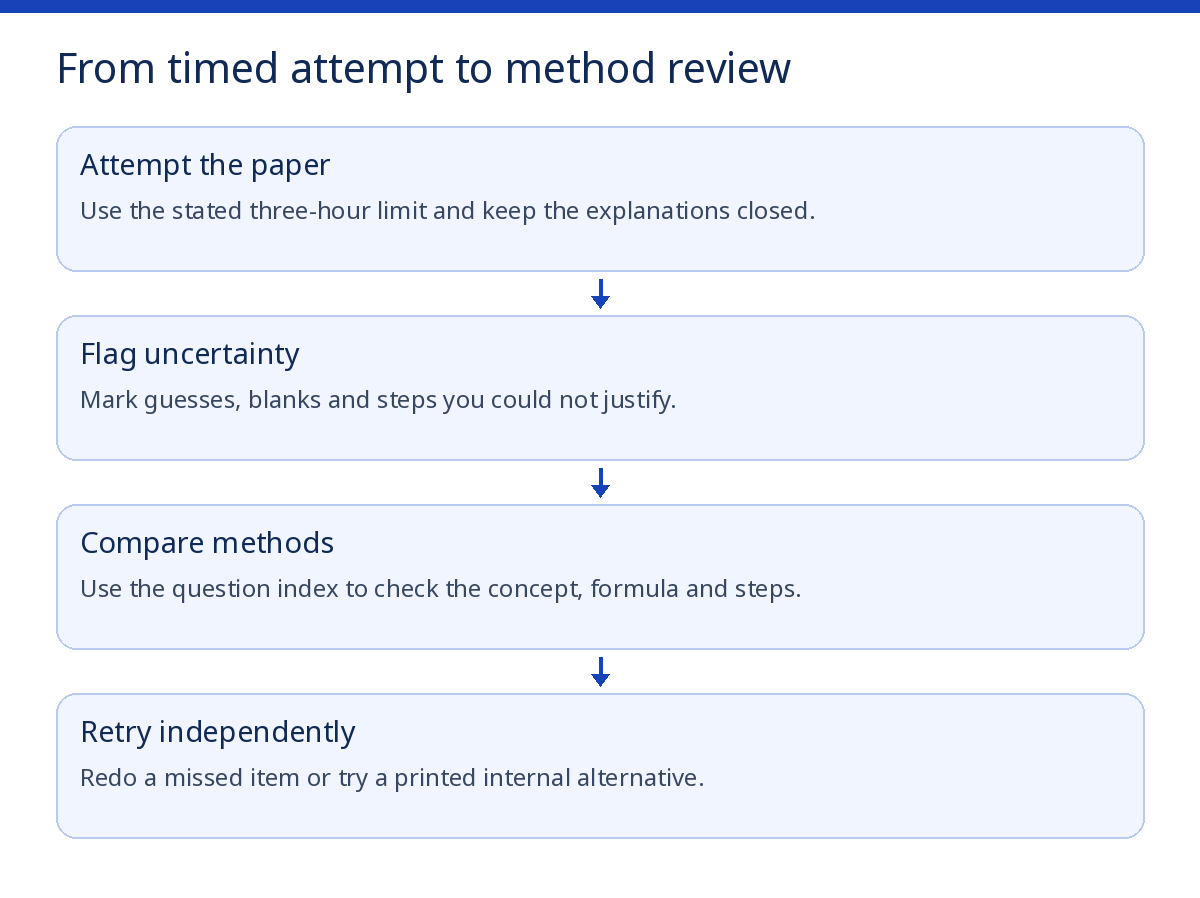
For a board-style attempt, set aside the stated three hours and work from the question pages. Keep the solution pages closed and follow the paper’s printed instructions, including where it offers an internal choice. Save the unattempted alternatives for review so that working through both versions does not change the conditions of your timed attempt.
On your answer sheet, mark questions you guessed or answered with a method you could not fully justify. After the attempt, revisit those as well as the questions you left blank or got wrong. A correct option reached by guessing tells you less about what you understand than a written explanation does. Use the solution index to compare your reasoning with the relevant explanation while your own method is still fresh.
Electrostatics and circuits: identify what is measured
The electrostatics questions give you practice distinguishing a quantity’s direction from its magnitude. An electric dipole moment points from the negative charge to the positive charge. When dipole moments combine, add them as vectors rather than adding their magnitudes without checking their directions. Another distinction concerns the field itself: zero work around a closed path applies to an electrostatic field, not to every electric field.
In circuit questions, identify the component across which voltage is measured and the branch in which current is measured before applying Ohm’s law. For an ohmic load, the voltage across it divided by the current through it gives its resistance. The source emf is a different quantity: when the source has internal resistance and supplies current, some voltage is dropped internally.
Common mistake: reading current instead of its slope
The induction and alternating-current questions reward attention to what changes. Under Lenz’s law, the induced effect opposes the change in magnetic flux, not necessarily the original magnetic field. First decide whether the flux is increasing or decreasing. Only then work out the direction of the induced field and, if asked for a current direction, check the viewing side shown in the diagram.
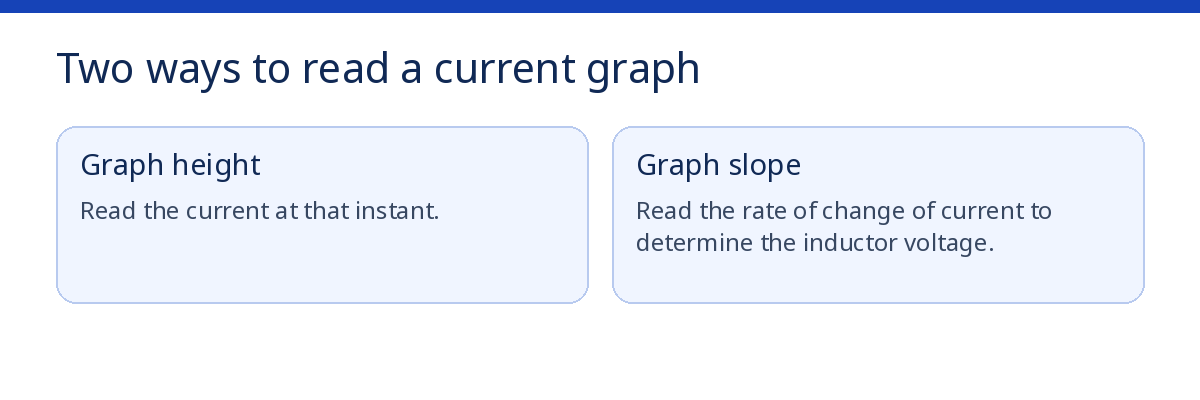
For an ideal inductor, the voltage drop in the direction of the reference current is , for constant inductance. On a current-versus-time graph, use the slope, not the height of the trace. A straight segment with a nonzero slope gives a constant voltage on that interval even though the current is changing. In transformer questions, count the turns between the relevant terminals rather than assuming that every labelled section belongs to the chosen winding span.
Optics: keep angular spacing and diffraction distinct
The optics material tests more than one way of reasoning about light. To judge whether diffraction is appreciable, compare wavelength with the size of the aperture or obstacle. A wavelength comparison is useful here because the scale of the opening or obstacle matters; a statement about frequency alone does not establish how pronounced diffraction will be.
In the small-angle double-slit relation , the fringe spacing is angular, the angle is expressed in radians, and the wavelength and slit separation must be in consistent units. In review, check whether you identified angular spacing before substituting. A degree-to-radian conversion is a separate step from converting the wavelength to the same length unit as the slit separation.
Good to remember: a model has conditions
The semiconductor questions distinguish an ideal circuit model from the behaviour being modelled. An ideal reverse-biased diode is treated as an open switch; that is not a claim that a real junction always carries exactly zero reverse current. Bias also affects the depletion region: reverse bias widens it, while forward bias narrows it.
The atomic and photoelectric material calls for a different distinction. Hydrogen energy levels are specified relative to the ionisation limit, so bound-state energies are negative and the principal quantum number is a positive integer. When judging whether emitted light can eject an electron from a metal, compare photon energy with the metal’s work function. The relevant photon energy comes from the difference between levels, not the energy of either level by itself.
Quick self-check after comparing methods
For an assertion–reason item, make three separate judgments: Is the assertion true? Is the reason true? If both are true, does the reason actually explain the assertion? This prevents a familiar statement from passing as an explanation just because it concerns the same topic.
For a calculation or diagram, cover the worked steps and name the quantity you need, the rule that connects it to the given information, and any condition that makes that rule applicable. Then retry a missed question or a printed alternative. If you can justify the setup without the solution in view, you have checked something that matching the final answer alone cannot show.
Spotted an error? Report a correction. Practise this in the app: notes, formula sheets and mind maps.













































































































































































Loading comments…