CBSE Class 12 Physics 2025: Solved Paper Set 55/4/3
CBSEPhysics2025 Previous Year Paper
Paper code: 55/4/3 · 2025Practise the full English-language 2025 CBSE Class 12 Physics main examination, set 55/4/3. The year-wise file retains the original questions, options and diagrams and includes worked explanations for all printed internal choices.
This set is one of the year's papers. See every set from 2025, grouped by series.
How the 70-mark paper is organised
The paper contains 33 questions across five sections, with three hours allowed and no calculator. Section A contains 16 one-mark multiple-choice questions, including four assertion–reason items. Section B has five two-mark very short answers, and Section C has seven three-mark short answers. Section D contains two four-mark case studies. Section E has three five-mark long answers.
There is no overall choice. All numbered questions are compulsory, but some questions in Sections B to E offer internal alternatives. For a timed attempt, answer one alternative wherever the paper asks you to choose. Save the other branch for review: it may test different content, as in the long-answer choice between ray optics and wave optics.

Physics 2025 | Class 12 | Previous Year Paper | Code 55/4/3
In the StudentCurio app
Complete solved CBSE Class 12 Physics examination paper for 2025, set 55/4/3, with worked solutions. It covers topics including optics, electrostatics, circuits, magnetism, electromagnetic induction, semiconductors and modern physics, helping students practise and review board-exam problems.
Optics: identify the setup before choosing a formula
The optics questions move between image formation and patterns on a screen. On the ray-optics side, the paper includes lenses in contact and minimum deviation through a prism. A lens problem requires a consistent sign convention for object distance, image distance and focal length. If the screen moves, distinguish its displacement from the new image distance measured from the lens system. A prism question instead asks you to reason about the path of a ray through refracting surfaces.
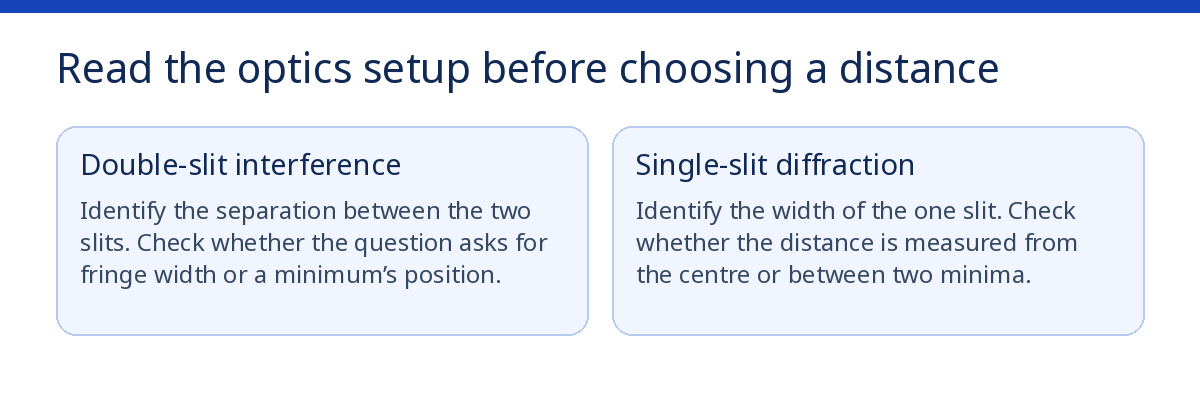
On the wave-optics side, the paper uses both double-slit interference and single-slit diffraction. Label slit separation and slit width separately in your sketch: they describe different features of the apparatus. Also check whether the question asks for fringe width, the distance from the centre to a minimum, or the distance between two minima. Those are different measurements, even when all are taken on the same screen.
Electrostatics and circuits: let the diagram guide you
The electrostatics questions move from forces and fields due to point charges to the field of a uniformly charged spherical shell and a case study on dielectric-filled capacitor gaps. For field superposition, record component directions before adding them. For electric potential, add the contributions as scalars while retaining the signs of the charges. A condition on potential is not a condition on the electric field.
The circuit questions make the connections just as important as the component values. In the switched-bulb problem, redraw the conducting paths for each switch position before comparing power. In the battery question, distinguish the emf from the terminal voltage when current is drawn through a load. In the capacitor case study, start by marking which plates share a terminal so you can identify the potential difference across each gap.
Common mix-up: magnetic flux is not induced emf
The magnetism and induction questions ask you to switch between directions, magnitudes and graphs. For the magnetic force on a moving charge, note both the velocity direction and the sign of the charge: the right-hand cross product gives the direction for a positive charge. In induction, decide which way the flux is changing before using Lenz’s law to reason about the direction of the induced current.
The moving-loop question asks for separate flux and emf plots. Use a common time axis in your draft, but do not copy the shape of one graph onto the other. Faraday’s law relates emf to the rate of change of flux linkage, not to the value of the flux itself. The self-inductance question also rewards reading the graph axes before deciding what the plotted relationship tells you.
Modern physics and semiconductors: separate related quantities
The modern-physics questions include wave–particle duality, photoelectric emission and a hydrogen-atom case study. When reading a light question, distinguish energy per photon from the energy delivered per unit area per unit time. In the photoelectric questions, keep the threshold for emission separate from the maximum kinetic energy of electrons once emission occurs. For an atomic transition, distinguish the two energy levels from the energy difference between them; the latter is what determines the energy of an emitted photon.
The semiconductor questions test both carrier populations and the behaviour of a junction. Majority and minority describe which mobile carrier is more or less abundant; the labels do not describe the net charge of the material. At a p–n junction, distinguish diffusion driven by a carrier concentration gradient from drift driven by an electric field.
After the timed attempt: find the first step to fix
Use the question-number links to review the worked explanations after you finish. The file separates the formula, the concept and the steps, so compare your work in that order. If you chose the wrong model, correcting arithmetic will not fix the answer. If the model was sound, look for a missed direction, an incorrect unit conversion or a quantity read from the wrong graph axis.
For assertion–reason items, assess each statement independently before deciding whether the reason explains the assertion. For case studies, underline the shared setup first, then identify what each subpart asks you to extract from it. This guide leaves out individual answers where the supplied text drops signs or symbols, or where a direction depends on an unclear convention. Refer to the printed PDF for exact wording, notation and diagrams.
Spotted an error? Report a correction. Practise this in the app: notes, formula sheets and mind maps.













































































































































































Loading comments…