CBSE Class 12 Physics 2024 Previous Year Paper With Solutions
CBSEPhysics2024 Previous Year Paper
Paper code: 55/3/2 · 2024Practise with the full English version of the CBSE Class 12 Physics 2024 main examination paper, set 55/3/2. The worked solutions separate the formula, the concept and the steps, so you can review not just your result but the reasoning that led to it.
This set is one of the year's papers. See every set from 2024, grouped by series.
How the 70-mark paper is organised
This year-wise resource follows one complete exam paper rather than grouping questions by chapter. The paper allows three hours, contains 33 questions and does not permit calculators. All questions are compulsory in the sense that there is no overall choice: where an internal choice is printed, you attempt one of the alternatives. Section A has no internal choice.
Section A contains 16 one-mark multiple-choice questions, including four assertion–reason items. Section B has five two-mark very short answers, and Section C has seven three-mark short answers. Section D contains two four-mark case studies, while Section E has three five-mark long answers. The format matters when you compare your responses: choosing an option, explaining a distinction and deriving an expression with a labelled diagram require different kinds of work.

Physics 2024 | Class 12 | Previous Year Paper | Code 55/3/2
In the StudentCurio app
Complete CBSE Class 12 Physics 2024 question paper, set 55/3/2, with worked solutions. It covers topics across the syllabus, including electrostatics, current electricity, magnetism, optics, electromagnetic induction, atoms and nuclei, and semiconductors.
Fields, circuits and induction: identify the conditions
The electrostatics questions move between conductors, electric potential and capacitance. The parallel-plate case study specifies a uniform field between the plates, while the long-answer section includes a capacitor with a dielectric and an internal choice involving a conducting shell. These settings reward different starting points. In electrostatic equilibrium, the field vanishes within the conducting material; that statement alone does not describe the field in a cavity or outside the conductor.
In current electricity, the paper includes a battery circuit with the key open and closed, and a Wheatstone bridge as an internal choice. Keep the two setups distinct: the battery problem asks you to interpret readings under two circuit conditions, whereas bridge balance concerns zero current through the galvanometer branch. The magnetism and induction questions likewise distinguish torque on a current loop in a uniform field from emf produced when magnetic flux changes. For a circuit involving an ideal inductor, distinguish opposition to alternating current from energy dissipation: nonzero inductive reactance does not imply average power loss.
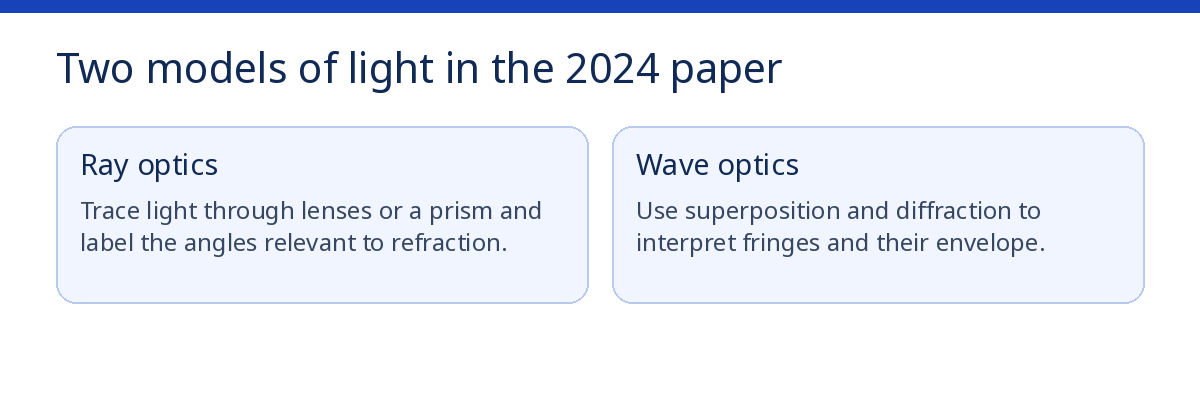
Optics: match the diagram to the model
Ray optics appears through an astronomical telescope in normal adjustment and a long-answer option on refraction through a prism. Normal adjustment is a condition on how the telescope is set up, not just a label for the instrument. For the prism, the paper calls for both a ray diagram and a graph of deviation against incidence. The diagram defines the angles used in the derivation; the graph represents how the deviation changes as the incidence angle varies.
Wave optics asks for a distinction between interference and diffraction and revisits them in a case study with two slits of finite width. In that setup, the interference fringes lie within a broader diffraction envelope. Keep the roles of the slit separation and the individual slit width separate when reading the question. The long-answer alternative on superposition also makes coherence and phase difference explicit, so a ray diagram alone cannot supply the reasoning that question needs.
From electromagnetic waves to semiconductors
The paper asks learners to read wavelength and frequency information from the spatial and time dependence of an electromagnetic wave in vacuum, then relate its electric and magnetic fields. In the photoelectric questions, the relevant distinctions are instead between photon energy, the work function and the maximum kinetic energy of emitted electrons. A stopping-potential graph lets you check whether you can connect the frequency-axis intercept to the threshold for emission rather than treating the graph as a numerical substitution exercise.
The atoms and nuclei questions use different meanings of energy: hydrogen energy levels organise spectral transitions, while the deuteron question concerns the energy required to separate a nucleus into its constituents. Semiconductor questions move between doping, carrier concentrations, energy bands and diode characteristics. A band diagram represents allowed electron energies; a diode characteristic plots current against applied voltage. Practise reading each representation on its own terms.
Quick self-check: separate claims, quantities and units
For assertion–reason items, judge the assertion and the reason separately before asking whether the reason explains the assertion. Can you identify the law or physical condition needed to test each statement? Two statements on the same topic do not necessarily form an explanation.
In induction, check whether the requested quantity is a rate of charge flow or the total charge transferred over an interval. The former has units of amperes, equivalent to coulombs per second; the latter is measured in coulombs. This guide leaves out the ambiguous work and magnetic-loop rotation examples and does not reproduce disputed options or numerical passages whose symbols or units are unclear in the extracted text.
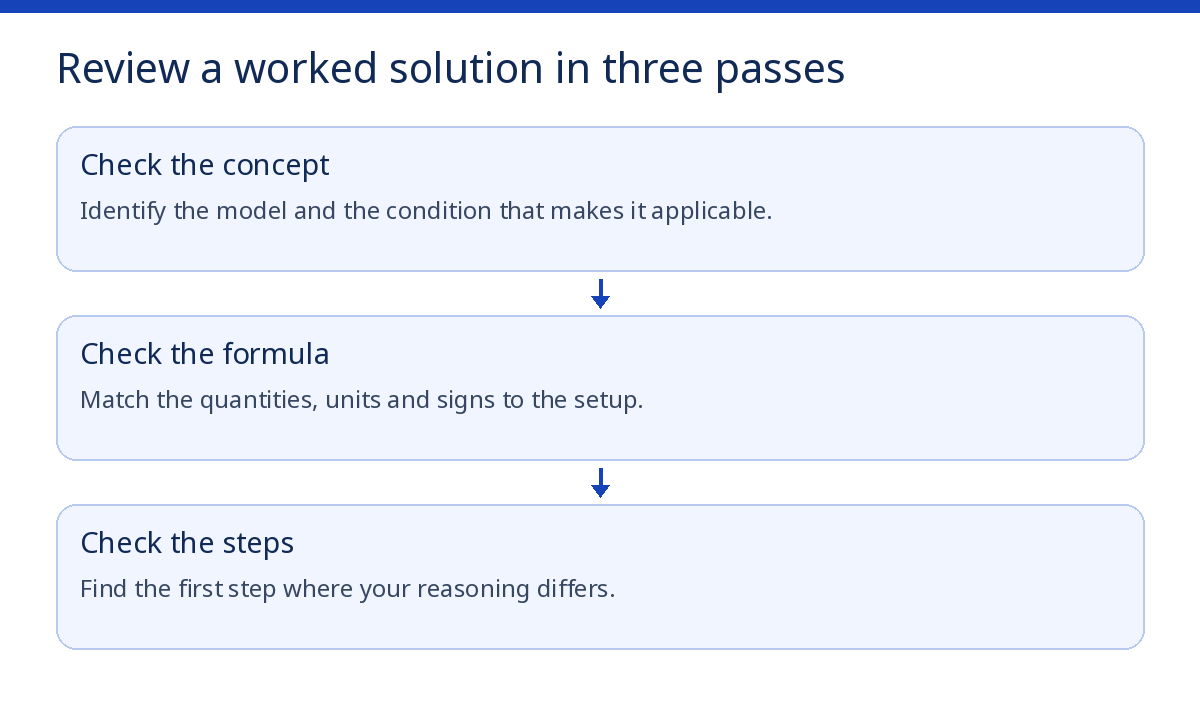
Use the worked solutions to find the first missed step
For a timed attempt, stay on the question pages, select only one branch of each internal choice and work without a calculator. Use the printed diagrams where the field direction, circuit connection or ray path depends on the figure. Once you finish, the question-number index and question-to-solution links let you review individual items without having to read the explanations in sequence.
Compare your work with the resource’s three solution labels: Formula used, Concept used and Explanation in steps. If your result differs, find the first point where the reasoning diverges: the model you chose, a sign or direction, a unit conversion, or a missing step in a derivation. After reviewing your timed attempt, use the printed alternatives as separate practice. The resource includes worked explanations for both branches, even though the exam requires only one.
Spotted an error? Report a correction. Practise this in the app: notes, formula sheets and mind maps.













































































































































































Loading comments…