CBSE Class 12 Physics 2024 Paper With Solutions: Set 55/5/3
CBSEPhysics2024 Previous Year Paper
Paper code: 55/5/3 · 2024Practise with the complete English-language CBSE Class 12 Physics 2024 main examination paper, Set 55/5/3. Use the three-hour, 70-mark paper for a timed attempt, then review the worked solutions to check your choice of method as well as your final answer.
This set is one of the year's papers. See every set from 2024, grouped by series.
What this year-wise paper contains
This file presents one complete examination set, not a chapter-wise collection. It retains the original English questions, answer options and diagrams. The companion explanations cover the printed internal choices, and the opening page provides question-number navigation for targeted review.
The paper brings together electrostatics, current electricity, magnetism and induction, optics, atomic and nuclear physics, and electronic devices. That mix matters because the paper does not tell you which chapter to think of before each question. A full attempt lets you practise identifying the governing idea from the wording, diagram or graph. Afterward, you can use the same file to revisit a specific question without redoing the whole paper.

Physics 2024 | Class 12 | Previous Year Paper | Code 55/5/3
In the StudentCurio app
Complete CBSE Class 12 Physics 2024 examination paper, set 55/5/3, with worked solutions. It includes questions across optics, electricity and magnetism, electrostatics, atomic and nuclear physics, and electronic devices, supporting full-paper practice and solution review.
Use the three hours as a paper attempt
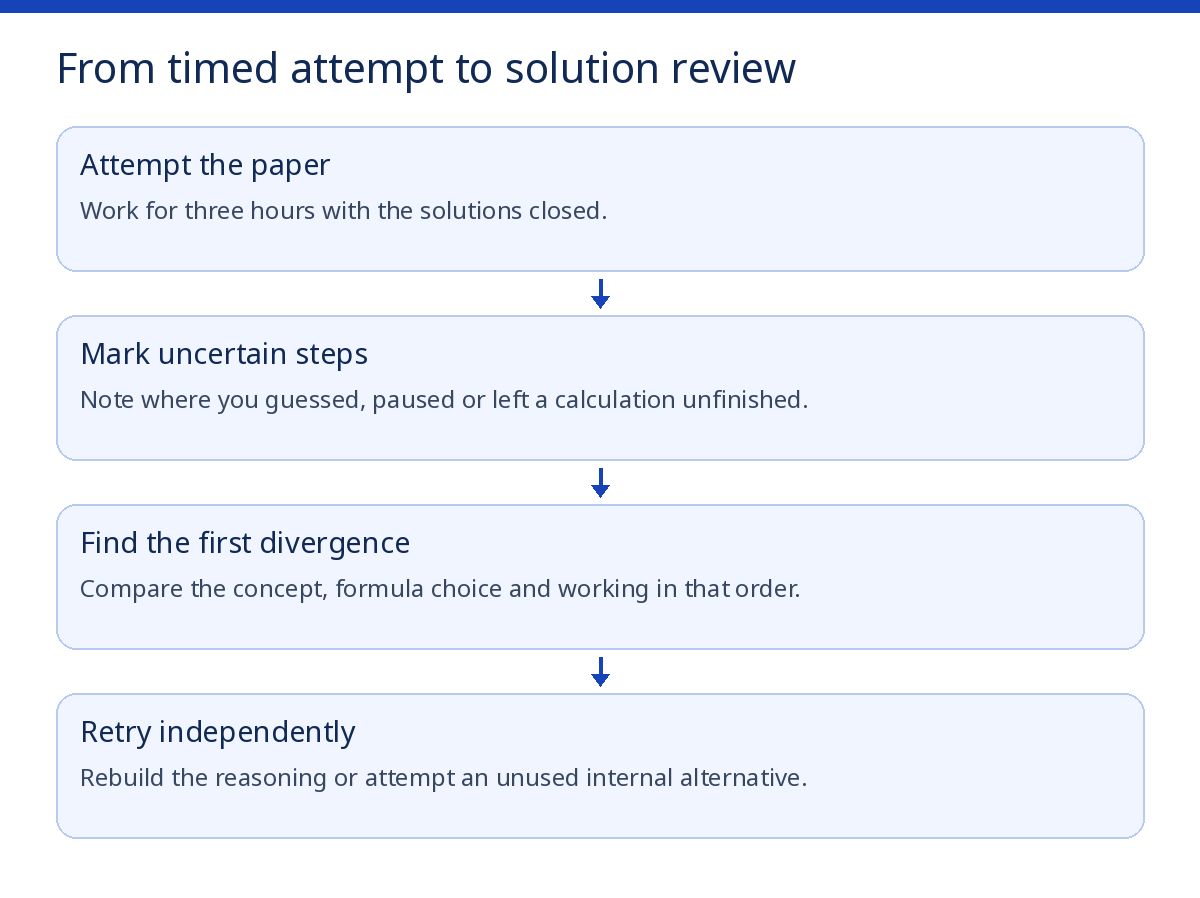
On a first sitting, keep the worked solutions closed and follow the instructions printed on the question paper. Where an internal choice is offered, attempt the required alternative rather than treating both as compulsory. Save the other alternative for review: it gives you a second prompt to try without extending the timed sitting.
Keep enough reasoning on the page to diagnose an error later. For a calculation, record the relation you selected and the quantities you substituted. For a graph or diagram, note the feature that guided your interpretation. If you leave a question unfinished, mark where you stopped. That distinction helps you tell whether you ran short of time, could not choose a method, or chose a sound method but did not complete it.
Check the first step that changed your reasoning
The worked explanations separate Formula used, Concept used and Explanation in steps. Use those labels to locate the first point where your reasoning differs. If you selected a different relation, ask what condition justified each one. If you selected the same relation but obtained a different result, check the substitution, signs and units before assuming you misunderstood the concept.
For assertion–reason items, judge the assertion and the reason separately before asking whether the reason explains the assertion. The explanation is a separate test: related statements do not necessarily have the required logical connection. After reviewing a question, close the solution and reconstruct the deciding step in your own words. That is a better check of understanding than recognising the printed answer.
A useful distinction: scalars and vectors in electricity and magnetism
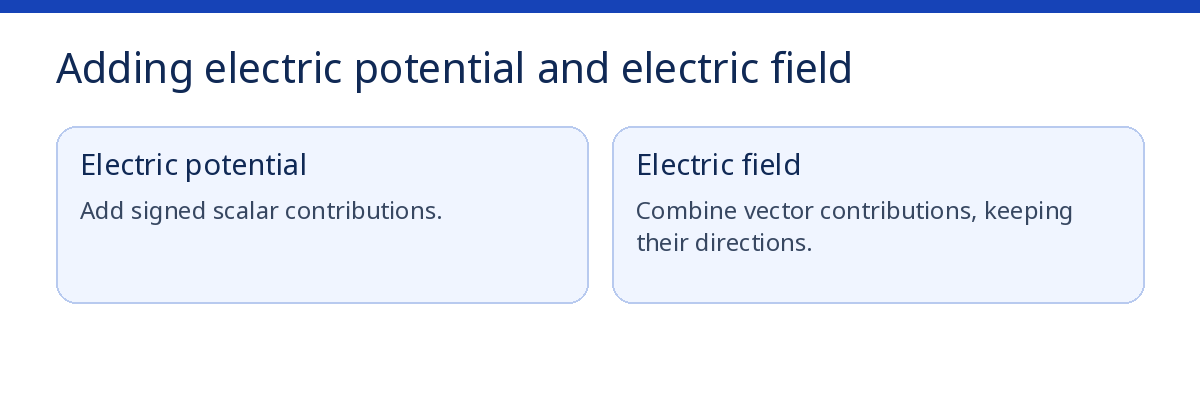
In electrostatics, potential is a scalar, so charge contributions are added algebraically. Electric field is a vector, so each contribution needs a direction before you can decide whether terms reinforce or cancel. The same need to track direction appears when combining magnetic fields from current loops. Adding field magnitudes directly is valid only for contributions pointing in the same direction; perpendicular contributions instead combine through the sum of their squares followed by a square root.
Current-electricity questions call for a different kind of check: identify what stays fixed. For a uniform wire of unchanged material and cross-sectional area, resistance scales with length. The power relation helps compare resistive heating when the voltage across the resistance is held fixed. A comparison at fixed current instead uses .
Common optics mistakes: ignoring signs and limits
A refraction question at a spherical surface calls for signed distances. Set the Cartesian direction first, then assign the signs of object distance and radius of curvature from the geometry. Interpret the image distance using that same convention. In microscope questions, distinguish the magnitude of magnification from its sign, which carries information about image orientation. Also check the viewing condition: the relaxed-eye treatment places the final image at infinity.
In wave optics, the standard double-slit fringe-spacing relation describes the dependence on wavelength, screen distance and slit separation in the usual small-angle arrangement with two distinct slits. It can describe how spacing changes as the separation decreases within that model; substituting zero separation into the formula is not valid.
Read graphs, energy terms and carrier data carefully
In a stopping-potential graph, identify which axis you are reading before comparing lines. The frequency-axis intercept represents the threshold frequency, whereas a vertical reading at a specified frequency gives the stopping potential. These readings answer different questions. The photoelectric relation applies in the photoemission regime, with stopping potential expressed as a magnitude.
For hydrogen energy levels, distinguish the total energy of the bound state from its kinetic and electrostatic potential energies. A negative total energy does not make the kinetic energy negative. In semiconductor questions, distinguish donor concentration from electron and hole concentrations. Treat the electron concentration as approximately equal to the donor concentration only when the donors are essentially ionised and their contribution dominates the intrinsic carriers.
Quick self-check before you revisit the paper
Choose one question you got wrong and one you got right without being sure of the reasoning. For each, can you name the detail that determined the method: a fixed quantity, a direction in the diagram, an axis intercept or a modelling assumption? If you cannot, revisit the relevant explanation rather than merely recording the answer.
Then try an unused internal alternative where available. Check whether you can recognise its governing idea without seeing the formula label first. This separates what you remember from the solution review from what you can independently identify in a new prompt.
Spotted an error? Report a correction. Practise this in the app: notes, formula sheets and mind maps.













































































































































































Loading comments…