CBSE Class 12 Physics 2024 Previous Year Paper with Solutions
CBSEPhysics2024 Previous Year Paper
Paper code: 55/3/1 · 2024Use the full English-language 2024 CBSE Class 12 Physics main examination paper (55/3/1) for a three-hour practice attempt. Then use the worked solutions to check where your reasoning diverged, from reading a diagram to choosing a principle or carrying out a calculation.
This set is one of the year's papers. See every set from 2024, grouped by series.
Know the format before you start
This is a year-wise board paper, not a chapter worksheet. The paper has 33 compulsory questions across five sections for a total of 70 marks. There is no overall choice, but some questions in Sections B to E offer an internal choice. On a timed attempt, answer one alternative where a choice is offered and save the other for review.
- Section A: Questions 1–16 are worth 1 mark each. Questions 13–16 are assertion–reason items.
- Section B: Questions 17–21 are very short answers worth 2 marks each.
- Section C: Questions 22–28 are short answers worth 3 marks each.
- Section D: Questions 29 and 30 are case studies worth 4 marks each.
- Section E: Questions 31–33 are long answers worth 5 marks each.
Keep to the printed three-hour limit and work without a calculator. Use the constants supplied in the paper where needed, just as the printed instructions allow.

Physics 2024 | Class 12 | Previous Year Paper | Code 55/3/1
In the StudentCurio app
The complete 2024 CBSE Class 12 Physics paper (code 55/3/1) with worked solutions, covering topics across the Class 12 syllabus, including electrostatics, circuits, magnetism, optics, atomic and nuclear physics, and semiconductors. Useful for practising the board examination and reviewing solution methods.
Fields, circuits and induction: identify what changes
The electricity questions move between electric potential, field direction, capacitance and current in circuit branches. In a circuit diagram, identify the junctions before writing equations, then mark a reference direction for each unknown branch current. A negative result means the current runs opposite to your assigned direction. For the Wheatstone bridge alternative, distinguish zero current through the galvanometer at balance from zero current throughout the network.
The induction questions require a different distinction: magnetic flux is not itself an induced emf. In one setup, the current in a coil changes; in another, the magnetic flux is given as a function of time. A rotating coil adds a third possibility: even in a steady, uniform field, the flux can change because the coil’s orientation changes. Identify the cause of the change before choosing a formula.
Optics: when a ray diagram helps
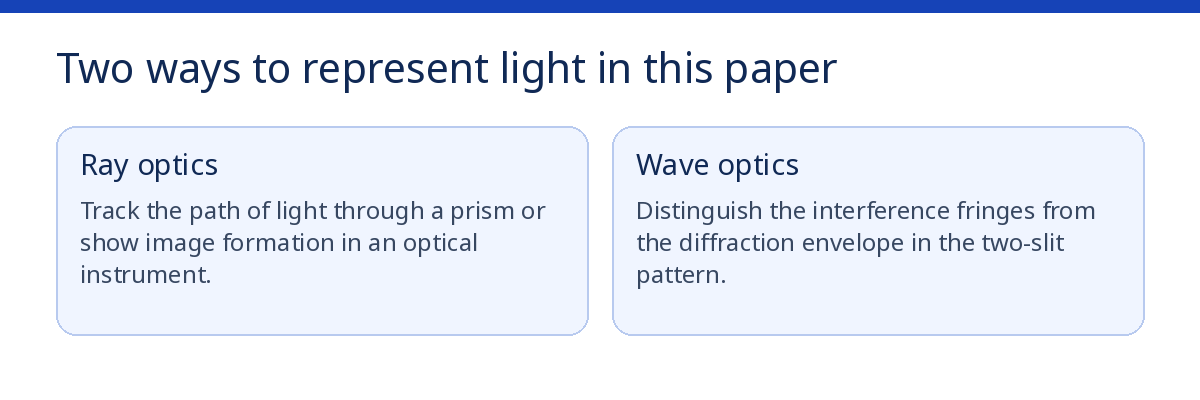
The paper asks about telescopes, microscopes, mirrors and prisms, as well as interference and diffraction. For the telescope question, normal adjustment means the final image is at infinity. In that arrangement, the objective and eyepiece of an astronomical telescope are separated by the sum of their focal lengths. For a prism diagram, draw a normal at each refracting face so that the incidence and emergence angles are measured from the correct lines.
In wave optics, distinguish the spacing of the interference fringes from the width of the diffraction envelope. The two-slit case study uses both features in the same pattern. Before comparing its subparts, note whether the slit width, the slit separation or the wavelength changes. A change in how many fringes fit within the envelope is not, by itself, evidence that the fringes have moved farther apart.
Waves, atoms and semiconductors: keep the quantities distinct
In the electromagnetic-wave expression, the coefficient of position describes spatial variation, while the coefficient of time describes temporal variation. Check the units before deciding which coefficient to use for wavelength and which to use for frequency. In the photoelectric questions, keep the maximum kinetic energy of emitted electrons separate from the photoelectric current: one describes the energy of the fastest emitted electrons, while the other measures charge flow.
The Bohr-model questions use the orbit number to describe an electron’s motion in hydrogen. The nuclear question instead compares the mass of a bound system with the masses used for its separated constituents. The semiconductor questions move between energy-band diagrams, electron and hole concentrations, and diode characteristics. Before starting a semiconductor answer, decide whether you need to describe available energy levels, identify charge carriers or explain the response to an applied voltage.
Quick self-check: what does the question ask you to show?
For an assertion–reason item, first judge whether each statement is true. If both are true, ask whether the reason actually explains the assertion. Two true statements about the same topic need not form a valid explanation. Use the response codes printed in this paper rather than relying on letters remembered from another test.
For a case study, separate the shared setup from what a particular subpart changes. For a written answer, underline the verbs: draw, derive, explain and calculate ask for different kinds of work. If the question asks for both a graph and an explanation, label the axes on the graph and use the prose to say why the relationship has that form.
Use the worked solutions to find your first error
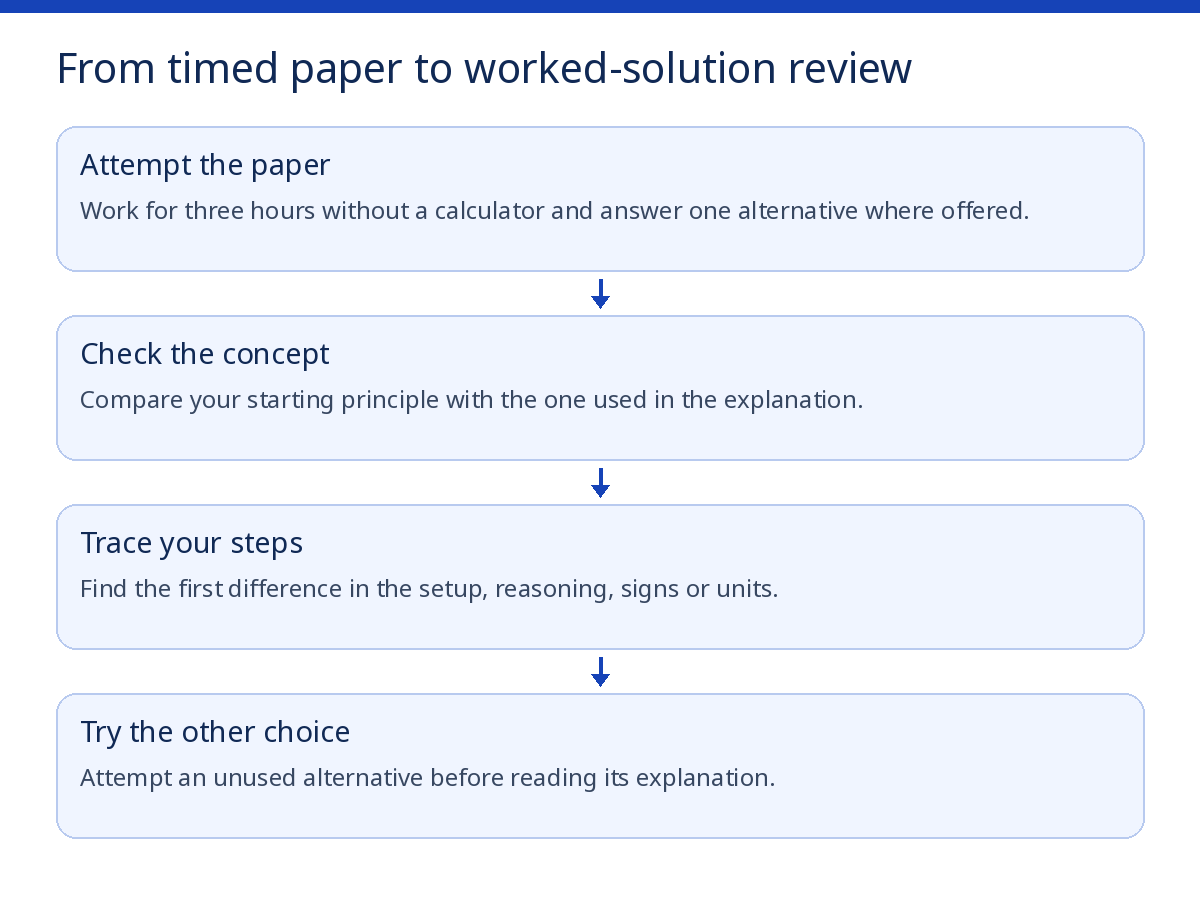
The PDF retains the original English questions, options and diagrams. Its question-number index takes you to worked explanations, including those for the printed internal choices. After the timed attempt, check the concept first, then the formula and the intermediate steps. If you chose a suitable principle but made a sign or unit error, redo the step where it occurred. If you chose the wrong principle, return to the wording or diagram and identify the condition you overlooked. Then try an unused internal alternative before reading its explanation.
Read exact symbols and units on the original question page rather than relying on extracted text. This guide omits the worked interpretations of the ambiguous proton-work and loop-rotation items, as well as the numerical fringe-count answers and the broad claim about interference and diffraction in the optics case study.
Spotted an error? Report a correction. Practise this in the app: notes, formula sheets and mind maps.













































































































































































Loading comments…