CBSE Class 12 Physics 2023 Paper 55/1/1 With Solutions
CBSEPhysics2023 Previous Year Paper
Paper code: 55/1/1 · 2023Use the complete 2023 CBSE Class 12 Physics main-examination paper (55/1/1) for a three-hour practice attempt, then review your reasoning with the worked solutions. The English-language paper combines objective questions, written responses and case studies on a circuit and a prism.
This set is one of the year's papers. See every set from 2023, grouped by series.
How the 70-mark paper is organised
The paper contains 35 compulsory questions across five sections. Section A has 18 one-mark questions, including three assertion–reason items. Section B has seven two-mark very short answers, Section C has five three-mark short answers, and Section D has three five-mark long answers. Section E has two four-mark case-based questions. Calculators are not allowed.
There is no overall choice. Internal choices appear in two questions each in Sections B and C, all three questions in Section D, and both case-based questions in Section E. In a timed attempt, answer only one alternative wherever the paper prints an OR. In review, use the unattempted alternative as a fresh question rather than counting both toward the same paper total.

Physics 2023 | Class 12 | Previous Year Paper | Code 55/1/1
In the StudentCurio app
The complete 2023 CBSE Class 12 Physics paper (code 55/1/1) includes worked solutions and questions across topics such as electrostatics, current electricity, optics, semiconductors, atomic physics and nuclear physics. Useful for board-exam practice and reviewing solution methods.
Electric fields and circuits: start with the diagram
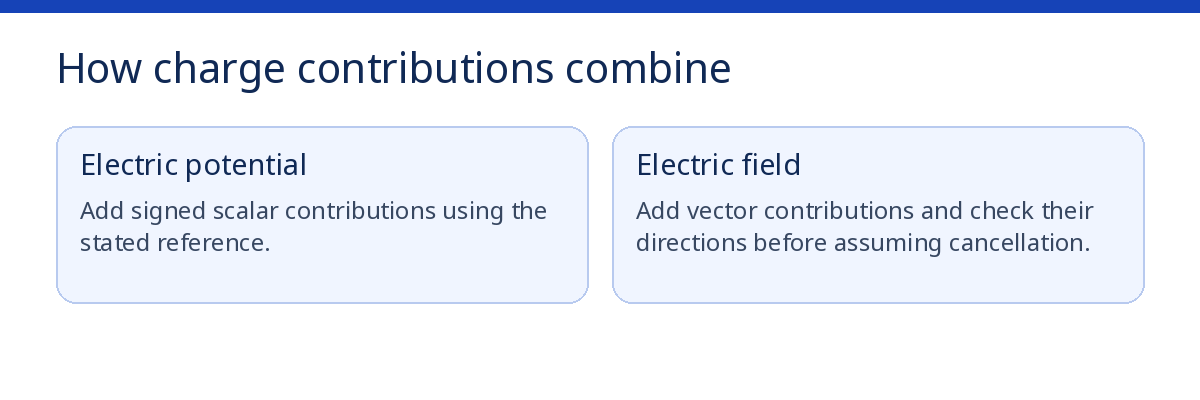
The charge arrangements in Section C make a useful comparison between electric potential and electric field. Potential is a scalar: add the contributions with their signs, using the reference specified in the question. Electric field is a vector: the direction of each contribution matters. Before writing an expression, mark which distances are equal and ask whether the arrangement has the symmetry needed for any vector contributions to cancel. Equal distances alone do not establish cancellation.
In current electricity, the paper moves from interpreting a cell’s terminal voltage to reading a circuit in the case-based section. For that case, trace which points are connected and mark branch currents before applying Kirchhoff’s rules. This separates the task of reading the connections from the algebra that follows.
The series LCR question gives you a different way to read a circuit. In the phasor diagram, use the current as the common reference and show how the resistor, inductor and capacitor voltages differ in phase. When sketching current against frequency for a fixed applied voltage amplitude, connect the peak to cancellation of the inductive and capacitive reactances. That cancellation does not remove the resistance.
Common mistakes in magnetism and induction
Do not replace a cross product with a product of magnitudes without checking the angle. In the charged-particle question, velocity and magnetic field are given in components. The field component parallel to the velocity contributes no magnetic force. For a given speed and charge magnitude, the perpendicular component determines the magnitude of that force; the cross product and the sign of the charge determine its direction. The long-answer question on a current-carrying conductor likewise asks you to pay attention to orientation.
Also distinguish induced emf from induced current. With a moving conductor, identify the geometry that produces charge separation before applying a motional-emf relation. A current calculation additionally depends on the circuit. The rotating-coil calculation is not discussed here because the angular speed is unclear in the extracted question text.
Optics: decide what to draw before calculating
The optics questions use several representations. A wavefront construction shows how a wave propagates across a boundary. A ray diagram tracks the direction of light at an interface, while a fringe calculation describes the positions of maxima or minima in an interference pattern. Choose the representation that matches the task rather than trying to use one sketch for all three.
For the spherical-surface question and the prism case, label the normal and the media before assigning angles or distances. For total internal reflection, the ray must travel from a higher to a lower refractive index, and the angle of incidence at that interface, measured from the normal, must exceed the critical angle. Use the prism case for its ray optics; its broader claims about equivalence to diamond are not used here.
Atoms, nuclei and semiconductors: keep the models apart
The atomic questions move between the Bohr model and hydrogen’s spectrum. An orbital radius describes a single state; a photon wavelength is related to an energy difference between two states. An energy-level sketch helps you distinguish absorption from emission before converting an energy gap to a wavelength. The nuclear question on binding energy per nucleon uses a different representation: its horizontal axis is mass number, not the energy-level index of an electron in hydrogen.
The semiconductor questions move from doping and energy bands to junction behaviour and rectification. Separate a statement about the majority carriers in a doped material from a statement about how a junction behaves under a particular bias. The first describes the material; the second depends on how the diode is connected. When checking a current–voltage sketch, compare its forward- and reverse-bias regions with the corresponding circuit diagrams so that the plotted signs agree with your voltage and current conventions.
After the attempt: find where your reasoning changed
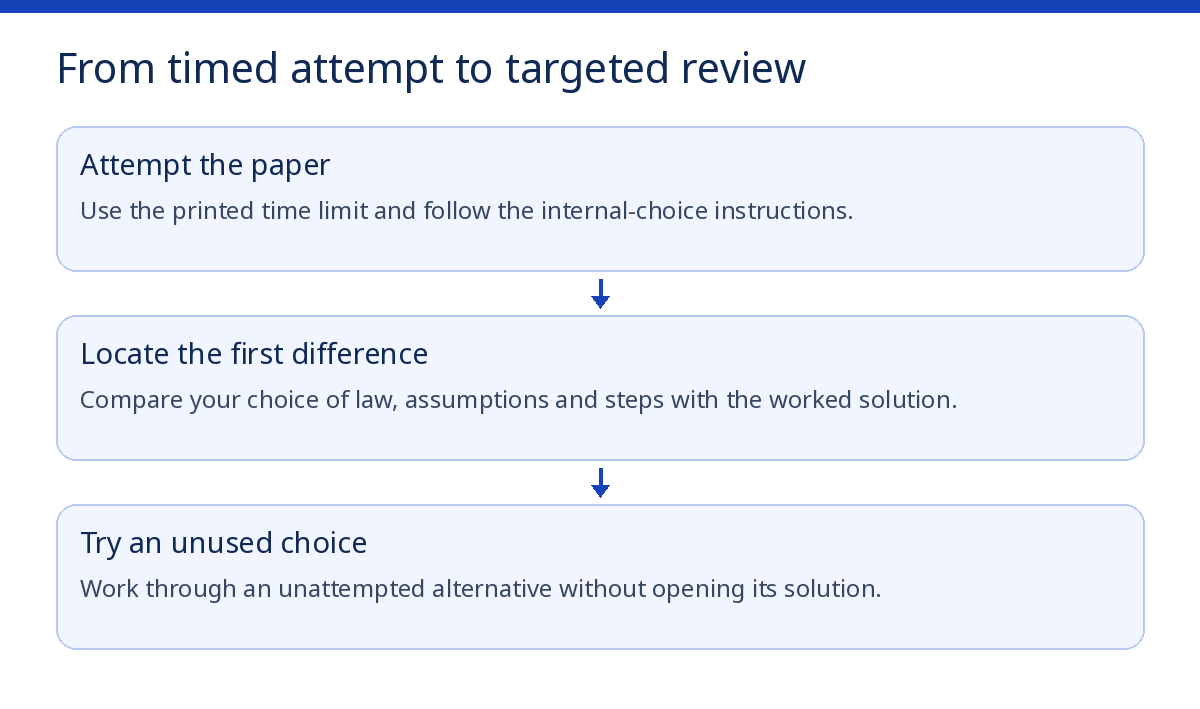
The file has a question-number index and separates the question paper from the worked solutions. Keep the solutions closed during the three-hour attempt. Afterwards, use the Formula used, Concept used and Explanation in steps labels to compare your approach with the one shown. Start at the first point where your reasoning diverged: the choice of physical law, an assumption about the diagram, or a calculation step. Do this for guesses you got right, too: the selected option alone tells you little about your reasoning.
For assertion–reason items, judge the two statements independently before deciding whether one explains the other. For a longer answer, check whether you supplied the requested derivation, graph or direction as well as any numerical result. Then try an unused internal alternative to see whether you can make those decisions without following a worked example.
Spotted an error? Report a correction. Practise this in the app: notes, formula sheets and mind maps.













































































































































































Loading comments…