CBSE Class 12 Physics 2023 Paper With Worked Solutions
CBSEPhysics2023 Previous Year Paper
Paper code: 55/3/3 · 2023Practise with the full 2023 CBSE Class 12 Physics main examination paper, set 55/3/3. The English-language file pairs the original questions and diagrams with worked solutions so you can review how to choose a method, set up a calculation, or explain a physical idea.
This set is one of the year's papers. See every set from 2023, grouped by series.
The 2023 paper at a glance
This is a year-wise previous year paper, not a chapter worksheet. It gives you a single sitting in which to move between different areas of Class 12 Physics and different kinds of tasks: choosing an option, drawing a graph, explaining a device, deriving a relation, or applying a model to a situation described in a case.
The original paper allows 3 hours for 70 marks, and calculators are not allowed. For a timed attempt, keep the question pages open and leave the worked explanations until afterward. Because this file represents one specific set, use its topic mix to see how concepts were tested in this sitting, not to predict which chapters or formats will appear in another paper.

Physics 2023 | Class 12 | Previous Year Paper | Code 55/3/3
In the StudentCurio app
The complete 2023 CBSE Class 12 Physics paper, set 55/3/3, with worked solutions covering questions across the syllabus. It helps students practise the board-exam format and review problem-solving methods across multiple chapters.
Five sections and where choice applies
The paper has 35 numbered questions across five sections. The marks below are per question, not per section:
- Section A: Questions 1–18, multiple choice, 1 mark each. The last three use the assertion–reason format.
- Section B: Questions 19–25, very short answer, 2 marks each.
- Section C: Questions 26–30, short answer, 3 marks each.
- Section D: Questions 31–33, long answer, 5 marks each.
- Section E: Questions 34–35, case-based, 4 marks each.
There is no overall choice: every numbered question is compulsory, subject to its printed alternatives. Internal choices occur in two questions in Section B, two in Section C, all three in Section D, and both in Section E. Read the placement of each OR carefully. In the two case-based questions, it applies to part (c), not to the whole case.
What the questions ask you to do
The paper links familiar topics to different ways of showing understanding. In semiconductors, for instance, you encounter junction behaviour in an objective question, then have to explain rectification or represent diode biasing with circuit diagrams and current–voltage characteristics. Knowing the name of a device is not the same as being able to explain how it works or show its behaviour on a graph.
Alternating current appears through waveform interpretation, reactance, and a derivation involving an ideal capacitor or average power in a series circuit. Elsewhere, the paper moves through current electricity, electromagnetic induction, atomic and nuclear physics, and matter waves. Some questions ask you to draw a graph and state what it shows; others supply a figure and ask you to extract information from it.
Good to remember: Check the model before using a rule
In electrostatics, distinguish electric field from electric flux. Flux depends on the field component normal to a surface. For a closed surface, Gauss’s law relates the net outward flux to the enclosed charge. If the field varies with position, compare the field and outward normal at each relevant face instead of assuming that opposite faces make equal and opposite contributions.
In optics, decide whether the task calls for a ray model or a wave model. A ray diagram represents the path of light through a prism or image formation by a lens. Single-slit diffraction instead calls for wave reasoning: the size of the opening relative to the wavelength matters when judging whether spreading is appreciable.
Make the diagrams and case passages part of your working
The case-based section uses two settings: an electron beam entering the space between plates, and a single-slit diffraction arrangement. Before starting a subpart, identify what information belongs to the shared setup and what that subpart changes or asks you to explain. In the beam case, trace the directions shown in the figure before deciding how to describe the motion. In the diffraction case, note which feature of the setup is being varied and which feature of the pattern you are asked about.
Apply the same care to figures elsewhere in the paper. For a graph, read both axis labels before interpreting a slope or a trend. For a circuit, trace the connections and polarities rather than guessing them from the positions of symbols on the page.
Use the worked solutions to locate your first error
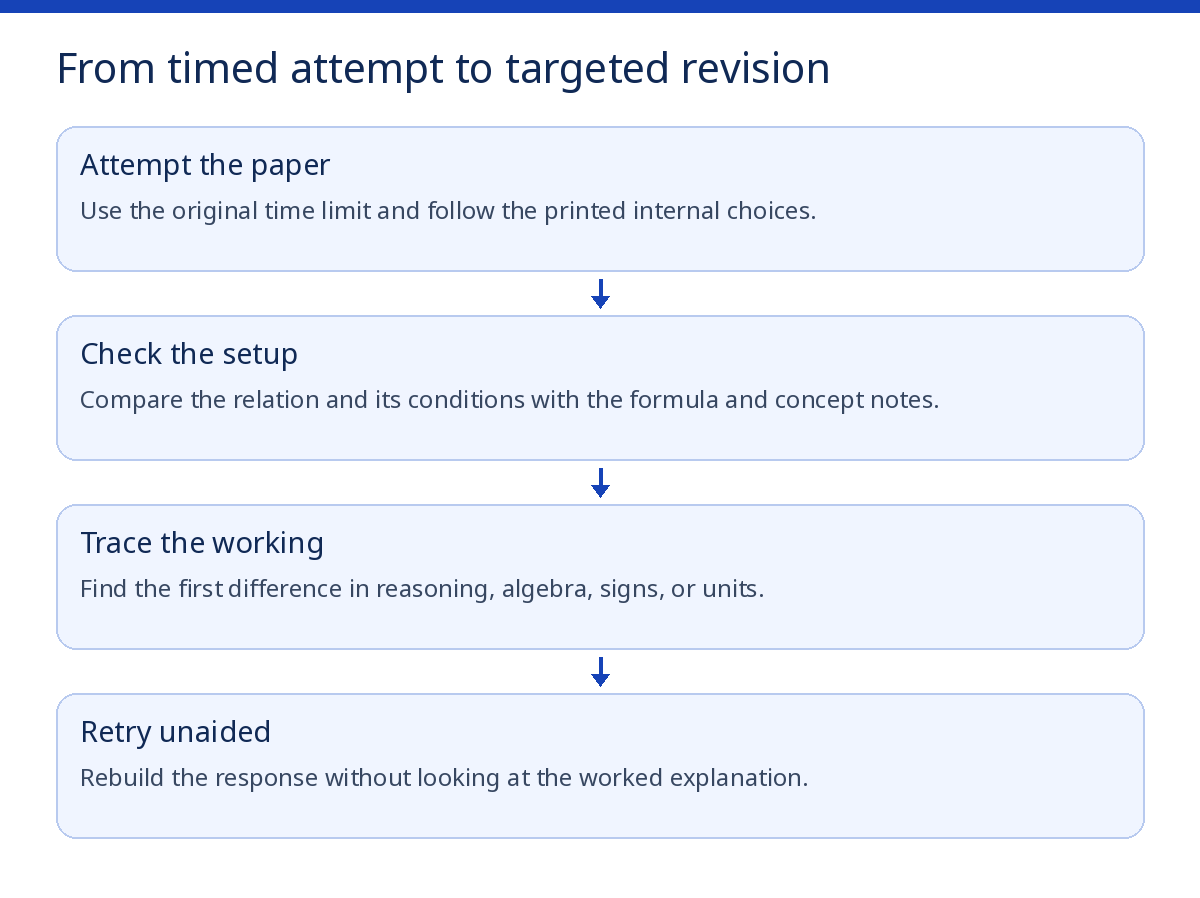
The file provides question-number navigation and organizes explanations under Formula used, Concept used, and Explanation in steps. It also includes explanations for the printed internal choices. After your attempt, compare your reasoning in that order. If you chose a different relation, check whether it fits the conditions in the question. If your setup matched but your result did not, look for the first difference in the algebra, signs, or unit conversions.
Return to the unused alternatives after the timed attempt. This lets you use both branches for revision without counting both as part of your mock. The Balmer-series item’s option and worked result are omitted from this guide because the supplied text does not clearly preserve the option layout.
Quick self-check before a second attempt
For an assertion–reason item, can you judge the truth of each statement separately before deciding whether the reason explains the assertion? For a graph or diagram question, could another reader tell from your labels what each axis, direction, or component represents?
Choose one response to redo without looking at the explanation. If the question asks for a derivation, check that you can connect the starting principle to the final relation. If it asks for an explanation, check that you have given the physical reason rather than simply restating the observation.
Spotted an error? Report a correction. Practise this in the app: notes, formula sheets and mind maps.













































































































































































Loading comments…