CBSE Class 12 Physics 2023 Previous Year Paper: Set 55/1/2
CBSEPhysics2023 Previous Year Paper
Paper code: 55/1/2 · 2023Practise the full English-language CBSE Class 12 Physics main examination paper from 2023, set 55/1/2. Use the worked solutions after your attempt to check how you chose a law, set up a diagram or justified a result.
This set is one of the year's papers. See every set from 2023, grouped by series.
Know the paper before you set the timer
This year-wise resource contains one complete paper, not a chapter-wise question bank. The examination allowed three hours for 70 marks, with no calculator. It contains 35 compulsory questions across five sections. There is no overall choice: where an internal choice is printed, you select one alternative rather than skip the question.
- Section A: 18 one-mark multiple-choice questions, including assertion–reason items.
- Section B: Seven two-mark very short answers, with internal choice in two questions.
- Section C: Five three-mark short answers, with internal choice in two questions.
- Section D: Three five-mark long answers, each with an internal choice.
- Section E: Two four-mark case-based questions, each with an internal choice.
For a timed attempt, follow those choice rules and leave the solution links unopened. Save the unattempted alternatives for later practice: a choice can test a different topic, not just a different version of the same calculation.

Physics 2023 | Class 12 | Previous Year Paper | Code 55/1/2
In the StudentCurio app
Complete CBSE Class 12 Physics 2023 paper, set 55/1/2, with worked solutions covering topics across the syllabus, including electricity, magnetism, optics, photoelectric effect, atoms, nuclei, semiconductors and total internal reflection in a prism.
Electricity and magnetism: identify the model first
The paper moves between electric fields, current in conductors, capacitor charging, magnetic forces, induction and alternating-current circuits. These topics use some of the same quantities in different roles. For instance, the area of a wire’s cross-section is not the area used to describe magnetic flux through a coil. Before substituting values, identify the physical object and what the quantity describes.
Watch for a change in conditions. One capacitor problem moves from a battery-connected stage to a stage in which the capacitor is disconnected and joined to another capacitor. Mark that break in your working rather than carrying a fixed-voltage assumption into the new arrangement. Elsewhere, the series LCR question distinguishes resistance from impedance: for sinusoidal operation, impedance includes the effects of inductance and capacitance as well as resistance. A phasor diagram helps you track those contributions without treating all the voltage amplitudes as quantities to add directly.
Optics: distinguish a ray path from a wave pattern
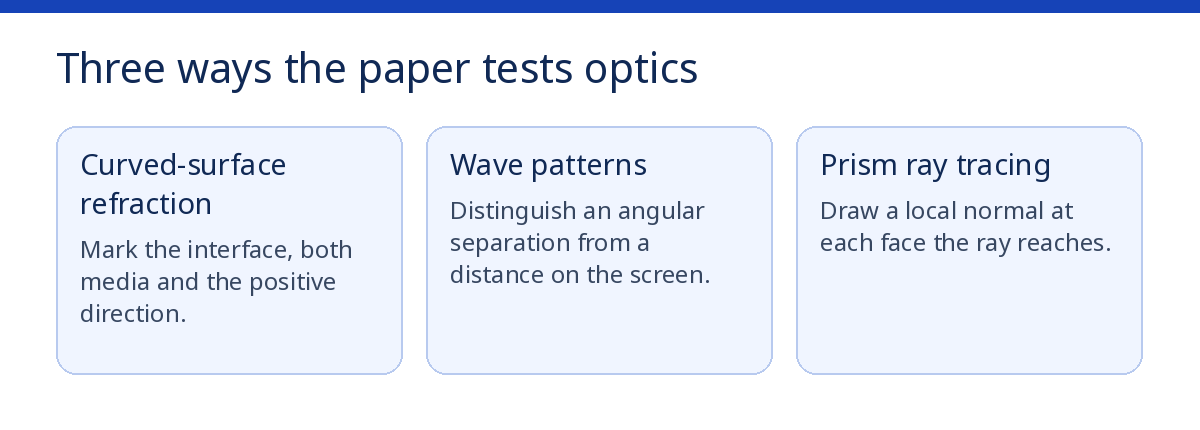
The optics questions ask for several kinds of reasoning. Lens power and refraction at a spherical surface call for a geometrical model. In the spherical-surface problem, mark the interface, the media and your positive direction before assigning signs to distances. A distance read from a diagram is not automatically the signed quantity needed in a formula.
Wave optics instead asks you to compare interference and diffraction and connect Young’s double-slit arrangement to fringe spacing. Keep an angular separation distinct from a distance on the screen: the first describes a difference in direction, while the second depends on the screen geometry. The prism case returns to ray optics. Track the ray one face at a time, and measure the angle of incidence from the local normal rather than from the prism face.
Modern physics and semiconductors: read the quantities precisely
The photoelectric-effect and hydrogen-spectrum questions both involve photons, but the energy bookkeeping differs. In photoemission, the work function is the minimum energy needed to remove an electron from the metal. In a hydrogen transition, the photon energy corresponds to a gap between allowed levels. An energy-level diagram is useful here because it keeps the initial and final states visible and helps distinguish absorption from emission.
Unit check: an electronvolt measures energy, while a volt measures potential difference. In nuclei, make a similar distinction between total binding energy and binding energy per nucleon; the latter is the quantity plotted against mass number in the paper. The semiconductor questions move from doping and donor levels to junction formation, bias and rectification. When reviewing a diode graph, check whether the axes describe current versus voltage or a load voltage changing with time. The two graphs describe different aspects of diode behaviour.
Case-based questions: use the figure as evidence
The two case-based questions use a resistor network and a triangular prism. In the circuit case, redraw the network if it helps you see which points are directly connected and where branches meet. Base your reasoning on electrical connections, not on whether two points look close together on the page. In the prism case, the orientation of each face matters, so look back at the diagram when you move from one interface to the next.
Quick self-check: Before calculating, can you point to the branch, component or surface named in each subpart? Label it on the figure and write down the quantity the question asks for. This separates what you read from the diagram from what you still need to infer.
Use the worked solutions to find your first error
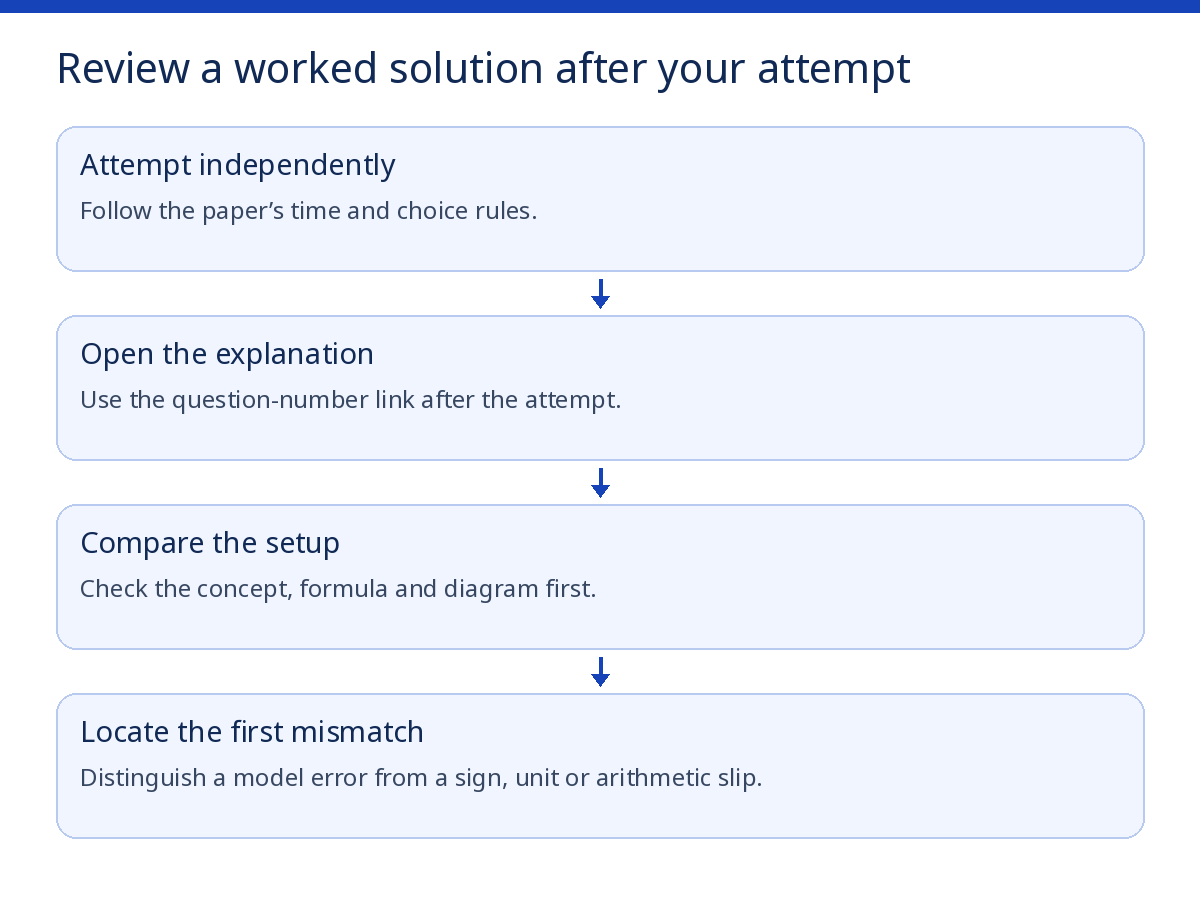
The file provides question-number links and worked explanations organised around the formula, the concept and the steps. It also covers the printed internal alternatives. After your attempt, compare your setup before checking the final line. A mismatch in the first governing equation calls for a different kind of revision from a mistake in arithmetic, units or a sign. For assertion–reason items, check each statement independently before asking whether the reason explains the assertion.
Use the PDF page view rather than extracted text when an exponent, unit, label or diagram is unclear. This guide leaves out the disputed stopping-potential option and copper-wire resistance-ratio options, as well as the prism passage’s broader claims about resemblance to diamond.
Spotted an error? Report a correction. Practise this in the app: notes, formula sheets and mind maps.













































































































































































Loading comments…