CBSE Class 12 Physics 2023 Paper (55/5/1) With Solutions
CBSEPhysics2023 Previous Year Paper
Paper code: 55/5/1 · 2023Attempt the full English-language 2023 CBSE Class 12 Physics main examination paper, set 55/5/1, under its original three-hour, 70-mark format. Then use the worked solutions to check not just what you got wrong, but whether you chose the right model, read the diagram correctly and applied the formula under the right conditions.
This set is one of the year's papers. See every set from 2023, grouped by series.
What the 2023 paper gives you
This is a year-wise CBSE board paper, not a chapter worksheet. The file retains the original English questions, options and diagrams, and its worked explanations cover the printed internal choices. The question-number index lets you go directly to an explanation when reviewing a particular attempt. For a timed sitting, stay in the question paper and use those links only after you finish.
The paper lets you practise recognising which idea a question calls for without a chapter heading to point you towards it. The available solution pages show the range of that task: electrostatics, current electricity, magnetism, induction, alternating current, optics, atomic physics and semiconductors all appear. Use this set to see how you handle those shifts in context, not as a checklist of everything a future board paper might test.

Physics 2023 | Class 12 | Previous Year Paper | Code 55/5/1
In the StudentCurio app
The complete 2023 CBSE Class 12 Physics paper (set 55/5/1) with worked solutions, covering topics across the syllabus. It helps students practise the board-exam format and review solution methods.
Use the three hours as a board-paper rehearsal
Read the original paper instructions before starting, especially where internal choices are offered. During the timed attempt, answer only what the paper asks you to attempt. Afterward, you can try the alternatives as extra practice. The file provides explanations for them, but doing both alternatives during the rehearsal would change the workload you are trying to simulate.
For an option-based item, jot down a brief reason for your selection on rough paper if time allows. That note makes a correct guess distinguishable from a correct application of physics when you come back to it. In an assertion–reason item, judge the assertion and reason separately before asking whether the reason explains the assertion. A true statement can still fail to explain another true statement.
Common mistake: reading diagrams by appearance
In a circuit diagram, components are in parallel only if their terminals connect to the same two nodes. Resistors drawn side by side do not necessarily meet that condition. Likewise, a bridge branch can be treated as carrying no current when its endpoints are at equal potential; you cannot discard it simply because it sits across the middle of the drawing. Mark the nodes before reducing the circuit so that each simplification follows from the connections.
For a current loop in a magnetic field, distinguish the plane of the loop from its normal. The magnetic dipole moment points along the normal, with its sense set by the current direction. In the torque magnitude , the angle is between the magnetic moment and the field, not between the plane and the field. Sketching the normal before choosing the angle prevents a diagram-reading error from becoming a substitution error.
When the shortcut formula applies
In electromagnetic induction, start with changing magnetic flux rather than assuming that only the field strength can change. For a coil with fixed area and orientation in a spatially uniform field normal to its plane, the induced emf magnitude can be written as . If the angle changes, this shortcut no longer describes the full flux change. State what stays fixed before substituting into the shorter expression.
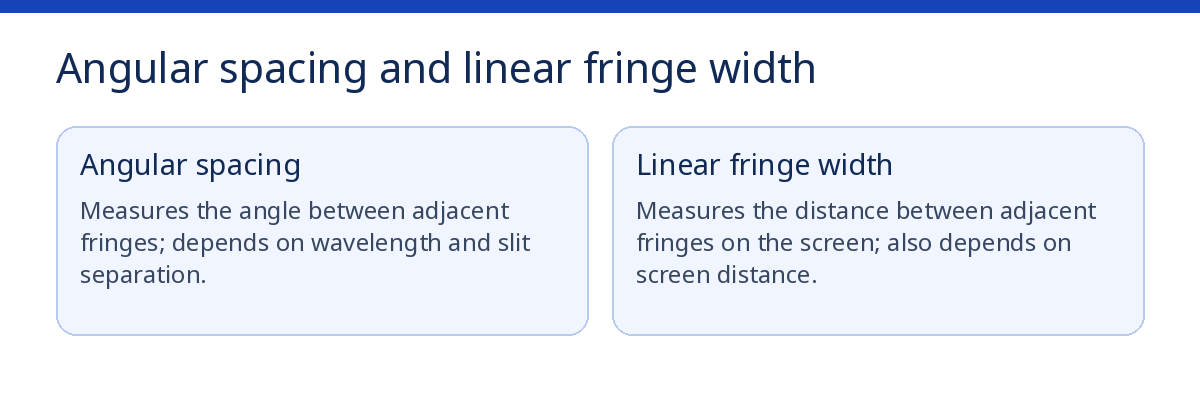
In double-slit interference, ask whether the quantity is an angle or a distance on the screen. In the small-angle approximation, the angular spacing is approximately , while the linear fringe width is , where is the slit separation and is the screen distance. The same pattern can be described in both ways, but the quantities are not interchangeable. Marking the requested quantity first helps you select the relation for the right reason.
Review the worked solutions one decision at a time
The explanations separate the formula used, the concept used and the steps. Compare your work in that order only if the formula was your first point of uncertainty. If you had already misread the diagram or identified the wrong physical process, begin there instead. A later arithmetic check cannot fix an incorrect starting model.
It is also worth reviewing an answer you got right if your explanation was vague. For a graph item, name the variables and decide whether the relationship is a direct proportionality, an inverse proportionality or neither before comparing the plotted shapes. For a semiconductor item, distinguish what happens while a junction forms from what holds at equilibrium. The dependable equilibrium statement is that drift and diffusion currents balance; it does not require treating diffusion as constant throughout junction formation. This guide omits the nuclear-density worked comparison because its stated mass ratio does not match the mass numbers cited in the explanation.
Quick self-check before a second attempt
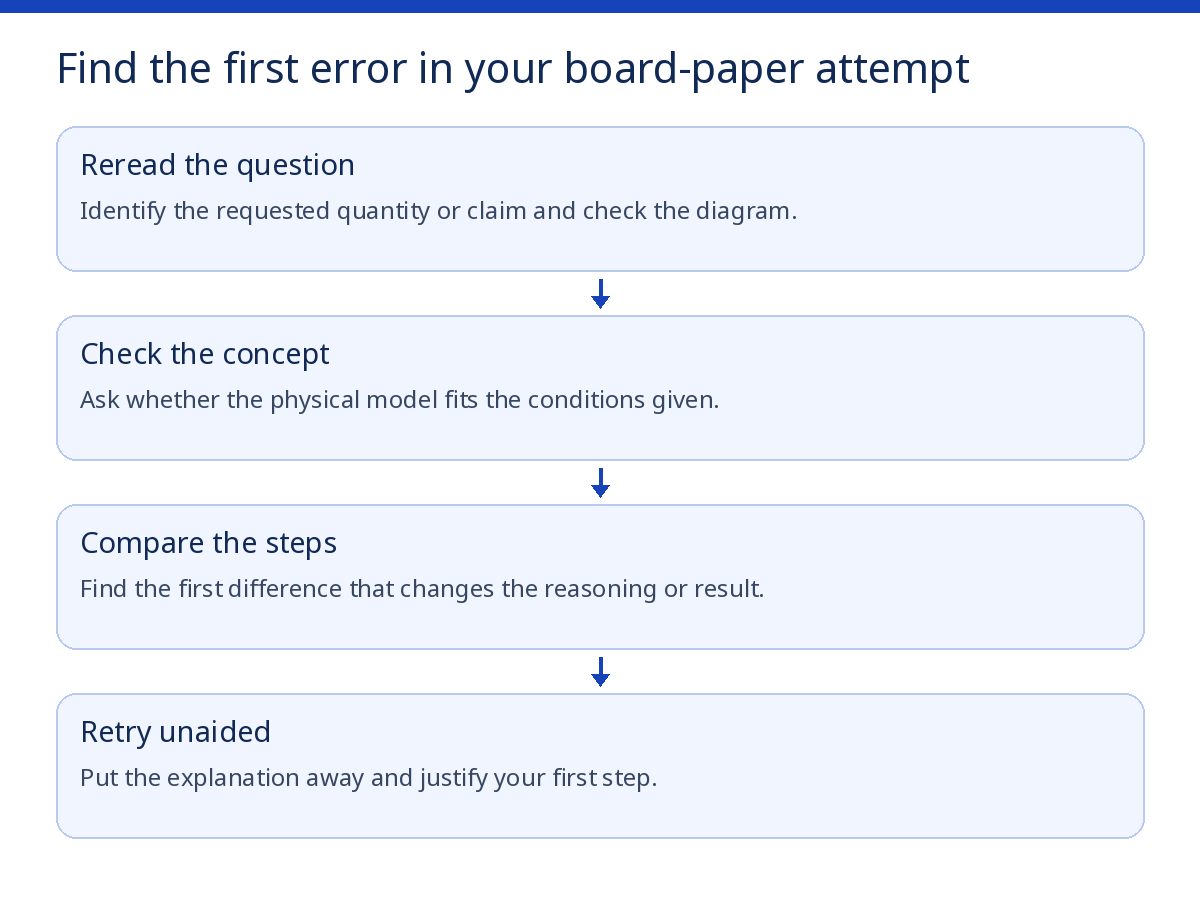
Choose a question you missed and return to its original wording without opening the explanation. Can you identify what is given, what is being asked and what must be true for your chosen rule to apply? Then redo the question from that starting point. If you can recall the final option but cannot justify the first step, you have remembered the result rather than repaired the reasoning.
Spotted an error? Report a correction. Practise this in the app: notes, formula sheets and mind maps.













































































































































































Loading comments…