CBSE Class 12 Physics 2022 Term 2 Paper with Solutions
CBSEPhysics2022 Previous Year Paper
Paper code: 55/5/2 · 2022Use the complete English-language CBSE Class 12 Physics Term 2 paper from 2022 (55/5/2) for a two-hour practice attempt, then use the worked solutions to check why each method applies.
This set is one of the year's papers. See every set from 2022, grouped by series.
What’s in the 2022 Term 2 paper
This year-wise file contains the full CBSE Class 12 Physics main examination paper for 2022 Term 2, set 55/5/2. The paper carries 35 marks and has a two-hour time limit. The file retains the original English questions, options and diagrams, and provides worked solutions for all 12 questions, including the printed internal choices.
The solutions separate the formula, the concept and the explanation in steps. That structure is useful because recognising a formula and knowing when to apply it are different skills. The paper brings together optics, semiconductors, electromagnetic waves, the photoelectric effect, matter waves, and atomic and nuclear physics. Use it to practise moving between those topics in one sitting, not as a checklist of the entire Class 12 syllabus.

Physics 2022 | Class 12 | Previous Year Paper | Code 55/5/2
In the StudentCurio app
Complete CBSE Class 12 Physics Term 2 question paper 55/5/2 from 2022, with worked solutions for all 12 questions. It includes questions across optics, semiconductors, photoelectric effect, atomic and nuclear physics, and electromagnetic waves.
Wave optics: distinguish spacing, shift and brightness
In Young’s double-slit setup, the usual small-angle expression for fringe width is , where is the slit-to-screen distance and is the slit separation. Before using it, identify which distance the question changes. The distance from the source to the slits is not the same as the distance from the slits to the screen. Also distinguish a change in fringe spacing from a change in visibility or a shift in the pattern’s position. A fixed relative phase offset can shift the pattern without changing its spacing.
The numerical diffraction alternative in Question 6 is not discussed here: the solution notes a mismatch between the single-slit wording and a two-slit interpretation. Keep the distinction when you review the paper: the rule for bright-fringe orders in two-slit interference does not locate secondary maxima in single-slit diffraction.
Ray optics: identify the path before calculating
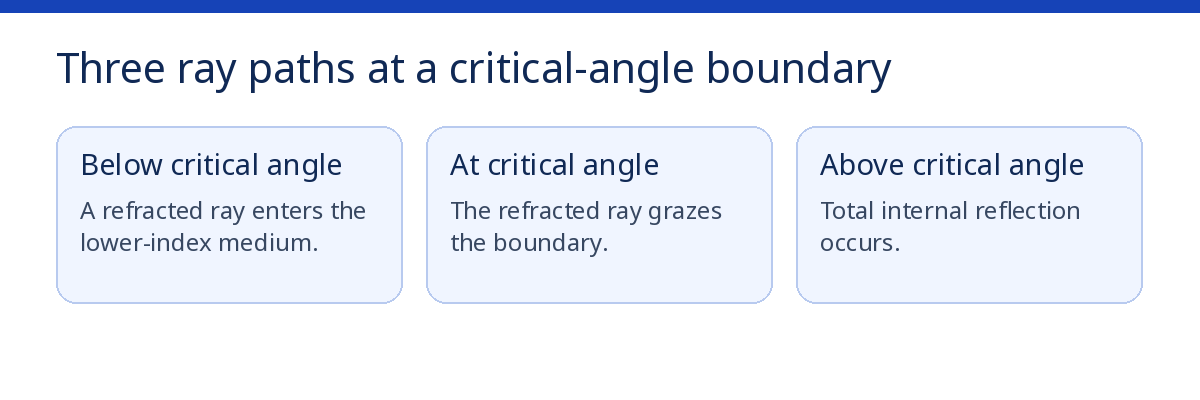
The prism material tests whether you can distinguish grazing emergence from minimum deviation. Grazing emergence means the refracted ray runs along the interface. It occurs when a ray travelling from a higher refractive index to a lower one meets the boundary at the critical angle. For the same pair of media, incidence above that angle gives total internal reflection; incidence below it allows a refracted ray. Measure the incidence angle from the normal to the interface, not from the surface.
Minimum deviation, by contrast, refers to the symmetric path through the prism. Do not carry the angles from a grazing-emergence sketch into a minimum-deviation calculation. On review, label the normals and state the condition imposed on each ray path before writing any equations.
Semiconductors: connect charge carriers to device behaviour
The semiconductor questions move from doping to device operation. Start by distinguishing a donor from an acceptor and linking that distinction to which carriers are in the majority. Then ask how an applied bias affects the junction. In a photodiode, the current due to illumination must be distinguished from the dark current, which is present even without illumination. This is a more useful way to review the device than memorising its bias in isolation.
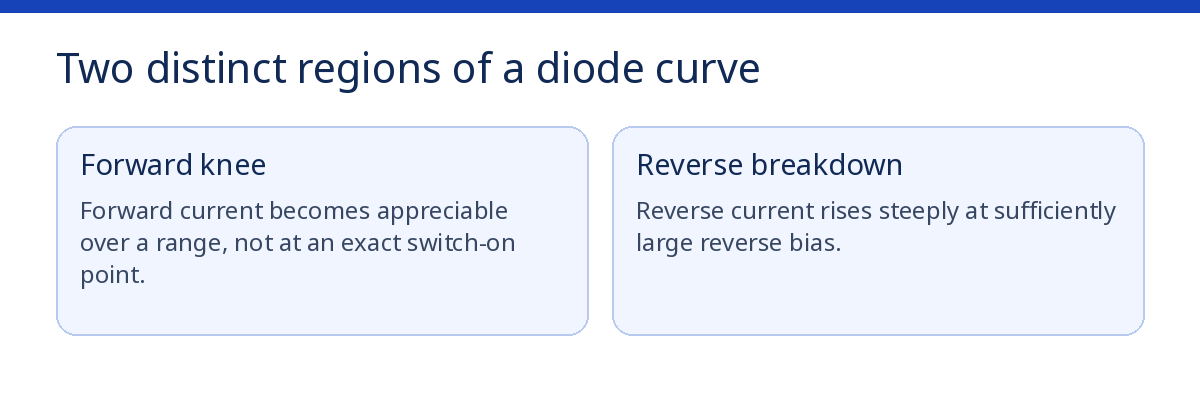
When reading a diode current–voltage graph, check the bias region before naming a voltage. The forward knee marks the region where forward current becomes appreciable; it is not an exact switch-on point. Reverse breakdown is a steep increase in current under sufficiently large reverse bias, not another name for the forward knee.
Quick self-check: which quantity controls the outcome?
For the photoelectric effect, can you distinguish the energy carried by each photon from the number of photons arriving per second? In the ordinary one-photon model, the threshold is set by the work function and the energy per photon, . Increasing intensity at a fixed frequency does not make each photon more energetic. For matter waves, ask instead what determines the particle’s momentum: the de Broglie relation uses momentum, not kinetic energy directly.
Make a similar distinction in atomic and nuclear physics. In the Bohr model of hydrogen, compare a bound-state energy with the zero-energy limit before deciding what a negative sign means. For a nuclear energy calculation, list the initial and final particles before taking a mass difference. Both habits help you interpret the sign of a result rather than treating it as a detail to check last.
Electromagnetic waves and telescopes: explain the link
The electromagnetic-wave material asks you to do more than recall band names. When arranging bands, write down whether the requested order is by frequency or wavelength. In vacuum, those quantities vary inversely, so switching the ordering variable reverses the sequence. When reviewing applications, connect each use to the correct band rather than treating the uses as a list detached from the spectrum.
The reflecting-telescope material calls for a different kind of explanation. Trace the light from a distant object to the primary mirror, then identify where the intermediate image forms and what the eyepiece does. This separates the role of the objective in forming an image from the role of the eyepiece in viewing it.
Before you move on: audit the first wrong step
For a timed attempt, follow the printed choices and leave the worked solutions closed. Afterwards, use the question-number links to open the explanations you need. Start with the concept and formula labels, and see whether you can repair your method before reading the full sequence of steps. Compare the setup as well as the final result: an incorrect angle reference or a misidentified bias region can undermine an otherwise tidy calculation.
Save unattempted internal alternatives for a separate review. After correcting an error, write one sentence naming the condition you missed. Then retry from the original wording or diagram to check whether you can recognise that condition without the solution in front of you.
Spotted an error? Report a correction. Practise this in the app: notes, formula sheets and mind maps.













































































































































































Loading comments…