CBSE Class 12 Physics 2022 Term 2 Paper and Solutions
CBSEPhysics2022 Previous Year Paper
Paper code: 55/1/2 · 2022Practise with the full English-language CBSE Class 12 Physics 2022 Term 2 paper, set 55/1/2. Use the worked solutions to check not just your calculations but also the assumptions, diagrams and sign conventions behind them.
This set is one of the year's papers. See every set from 2022, grouped by series.
What this 2022 paper contains
This year-wise resource contains the CBSE Class 12 Physics main examination paper for 2022 Term 2. The cover specifies two hours and 35 marks. Those figures describe this particular paper, not a general pattern to assume for other years. The file retains the original English questions, options and diagrams, and includes worked explanations for all printed internal choices.
Use the question paper on its own for a timed attempt, following the printed choices rather than treating every alternative as compulsory. Afterwards, use the question-number links to move straight to an explanation. The solutions separate the formula, the concept and the steps, so you can locate where your reasoning diverged before reading the full method.

Physics 2022 | Class 12 | Previous Year Paper | Code 55/1/2
In the StudentCurio app
Complete CBSE Class 12 Physics 2022 Term 2 question paper with worked solutions, covering semiconductor electronics, photoelectric effect, optics, atomic and nuclear physics, and wave optics. Useful for exam practice and reviewing step-by-step solutions to the paper’s questions.
Semiconductors: separate mobile carriers from fixed ions
The semiconductor material connects doping, junction formation and light emission. On an energy-band sketch, distinguish an impurity level from the band that carries current: a donor level is close to the conduction band, while an acceptor level is close to the valence band. The small energy separation helps explain why doping changes the carrier concentration without requiring excitation across the full band gap.
A junction sketch serves a different purpose. It shows where diffusion and recombination remove mobile carriers near the boundary, leaving fixed ion charges behind. When you review the equilibrium explanation, check that you can distinguish zero net current from an absence of carrier motion: drift and diffusion currents balance. The LED discussion then changes the operating condition to forward bias, under which injected electrons and holes can recombine radiatively.
Read photoelectric graphs by intercept and plateau
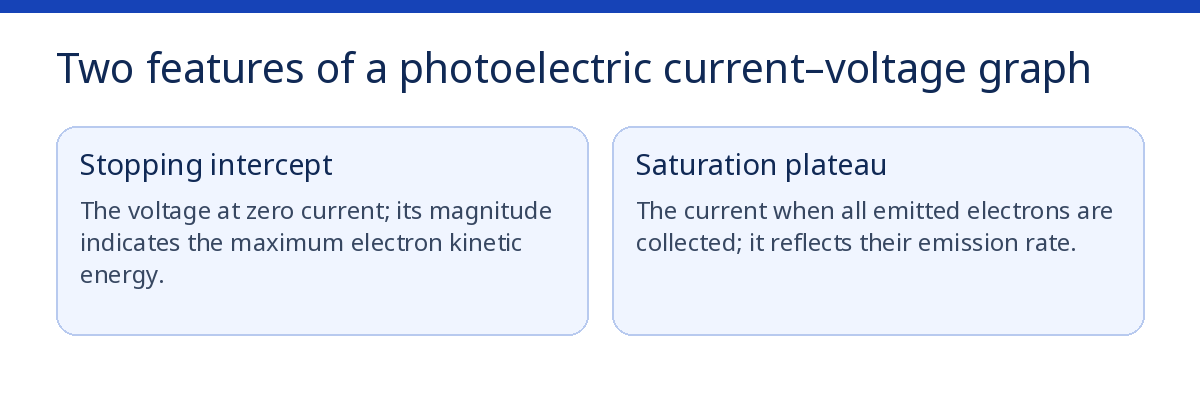
A photoelectric current–voltage graph contains two different pieces of evidence. The magnitude of the stopping potential measures the maximum photoelectron kinetic energy through , while saturation current reflects the rate at which emitted electrons are collected when collection is complete. If the stopping intercept is drawn on the negative voltage axis, use its magnitude in the energy equation.
When comparing curves, identify what is held fixed before deciding what changes. At fixed frequency above threshold, greater intensity can raise the saturation current without shifting the stopping intercept. At fixed radiant intensity, an equal-plateau comparison across frequencies assumes equal emission rates; equal intensity alone does not guarantee them. The threshold is a separate condition: in the ordinary single-photon model, increasing intensity cannot make up for photon energy below the work function.
Ray optics: check the condition before using the shortcut
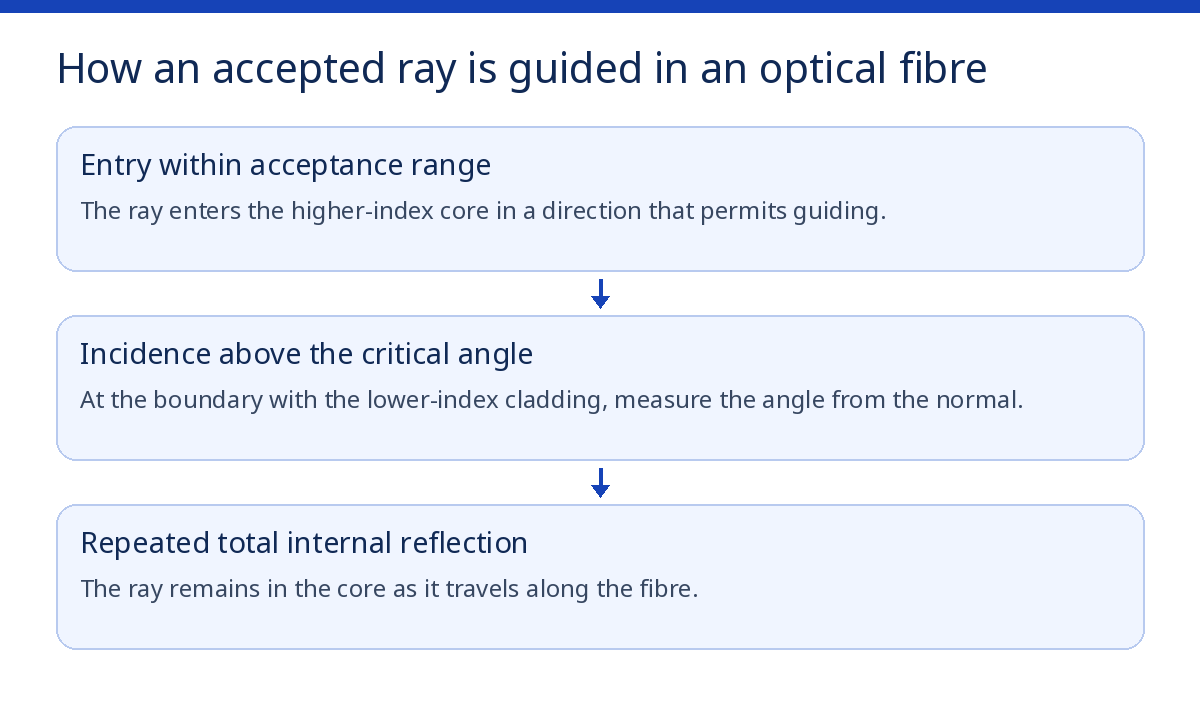
For optical fibres, distinguish the ray’s entry into the fibre from its later incidence at the core–cladding boundary. Total internal reflection requires light travelling from higher to lower refractive index and an incidence angle greater than the critical angle, measured from the normal. A higher-index core is therefore necessary but does not mean every entering ray will be guided.
Make the same distinction between a general rule and a special case in prism problems. The deviation relation follows from the turns at the two faces; setting the angles of incidence and emergence equal applies to the symmetric minimum-deviation path. In lens work, keep the signs of focal length, power and magnification. A stated image size fixes the magnitude of magnification, but does not by itself tell you whether the image is erect or inverted. Likewise, powers of thin lenses in contact add algebraically, not as unsigned magnitudes.
Wave optics: distinguish a minimum from a maximum
The paper uses two different wave models: single-slit diffraction and two-source interference. In the small-angle single-slit model, the formula for dark minima locates the zeros of intensity. A secondary maximum lies between adjacent minima, but placing it halfway between them is an approximation. When reviewing the solution, mark which positions come from the minimum condition and which use an estimate.
For a stable interference pattern, check that the waves have the same frequency and a constant phase difference. Then distinguish the linear spacing you measure on a screen from the angular spacing you infer from the geometry. In the small-angle double-slit model, gives the linear fringe width, where is the screen distance and is the slit separation. Moving the screen can change that width without changing the angular spacing.
Atomic spectra and nuclear reactions use different energy ideas
The atomic material asks you to interpret two kinds of evidence. A scattering distribution shows how common small and large deflections are; even rare large deflections matter when judging where charge and mass are concentrated. A hydrogen spectrum instead links a photon to the energy difference between two levels. In the Lyman series, transitions end at the ground level. Label that common endpoint before comparing wavelengths, and distinguish a finite transition from the limit approached as the initial level rises.
For a nuclear reaction, organise the calculation around total initial and final masses, not around electronic energy levels. The sign in matters: positive means energy is released. If using atomic masses, first check whether the electron counts cancel between the two sides.
Quick self-check before opening a worked solution
Choose a response that depends on a graph, a sketch or a special condition. Can you explain what each axis or angle represents, which quantity is held fixed, and where the chosen rule stops applying? Then compare against the concept and steps in the file. If your reasoning differs, revise the first unsupported step before checking the final line.
Spotted an error? Report a correction. Practise this in the app: notes, formula sheets and mind maps.













































































































































































Loading comments…