CBSE Class 12 Physics 2022 Term 2 Paper with Solutions
CBSEPhysics2022 Previous Year Paper
Paper code: 55/2/2 · 2022Practise the full 2022 CBSE Class 12 Physics Term 2 paper, set 55/2/2, in its original two-hour, 35-mark format. Use the worked solutions after your attempt to check how you chose a physical model, drew a diagram or justified a calculation.
This set is one of the year's papers. See every set from 2022, grouped by series.
How the 2022 Term 2 paper is organised
This year-wise resource contains the English version of the main examination paper. It retains the original questions, options and diagrams, and the worked explanations cover the printed internal choices. Section A has three two-mark questions, Section B has eight three-mark questions, and Section C has one five-mark case study based on Young’s double-slit experiment.
All 12 questions are compulsory, but where an internal choice appears, you attempt only one alternative. That distinction matters in a timed attempt: the other branch is useful practice later, not extra work to complete during the two hours. The instructions permit log tables if needed but prohibit calculators. Use the paper’s own instructions to recreate this historical Term 2 sitting rather than assuming that its structure applies to other years.

Physics 2022 | Class 12 | Previous Year Paper | Code 55/2/2
In the StudentCurio app
The 2022 CBSE Class 12 Physics Term 2 examination paper with worked solutions. It covers questions across the syllabus, including optics, semiconductors, de Broglie wavelengths and nuclear physics, helping students practise the board-paper format and review solutions.
What to show in a semiconductor explanation
The semiconductor questions ask for three different kinds of reasoning: explaining light emission in an LED, describing how a depletion region forms, and tracing a full-wave rectifier. For the LED, connect forward bias to carrier recombination and explain why that recombination can produce light in a suitable semiconductor. For the junction, distinguish the mobile electrons and holes from the fixed ions left near the boundary. That distinction helps explain how carrier diffusion leads to a built-in electric field.
For the centre-tapped rectifier, review the circuit and waveforms together. Trace a complete current path for each half-cycle, then use those paths to check the polarity you drew across the load. Naming the conducting diode is not a substitute for tracing the current through the load.
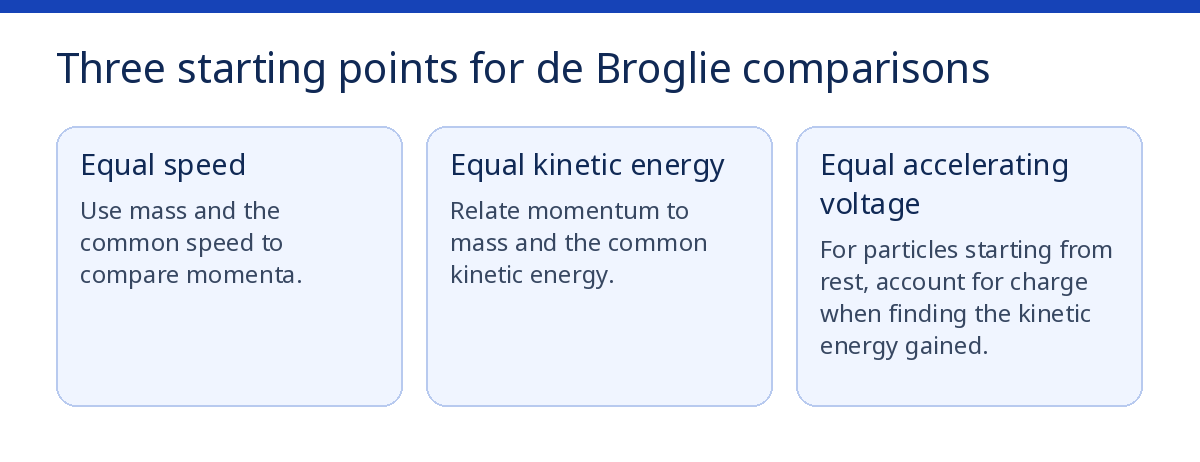
Before you compare wavelengths, identify what is equal
The de Broglie question compares an alpha particle with a proton under three different conditions. Start from and ask what the question tells you about momentum in each case. Equal speed and equal kinetic energy are not interchangeable for particles of different masses. In the nonrelativistic treatment used here, is convenient when speed is specified, while is convenient when kinetic energy is specified.
An equal accelerating potential difference does not itself imply equal kinetic energy. For particles starting from rest, the energy gained depends on charge magnitude as well as the magnitude of the accelerating potential difference. When reviewing your attempt, check that you used the stated condition before forming the ratio; also check that you kept the particle order consistent.
Read axes, arrows and energy levels before calculating
In the nuclear physics question, the potential-energy graph describes how a pair of nucleons interacts as their separation changes. Read the vertical axis as potential energy, not force: the radial force is related to the negative slope of that graph. The separate fission calculation compares initial and final rest masses. Keep the order of subtraction explicit and explain what the sign of the resulting energy change means, rather than presenting a magnitude alone.
The atomic transition diagram calls for another kind of reading. Follow the arrows between levels and identify the energy drop for each emitted photon before using . When comparing a direct transition with a sequence of transitions, work in energy first. Wavelength is inversely related to photon energy, so adding wavelength labels as though they were energy intervals is not valid.
Match the optics rule to the setup
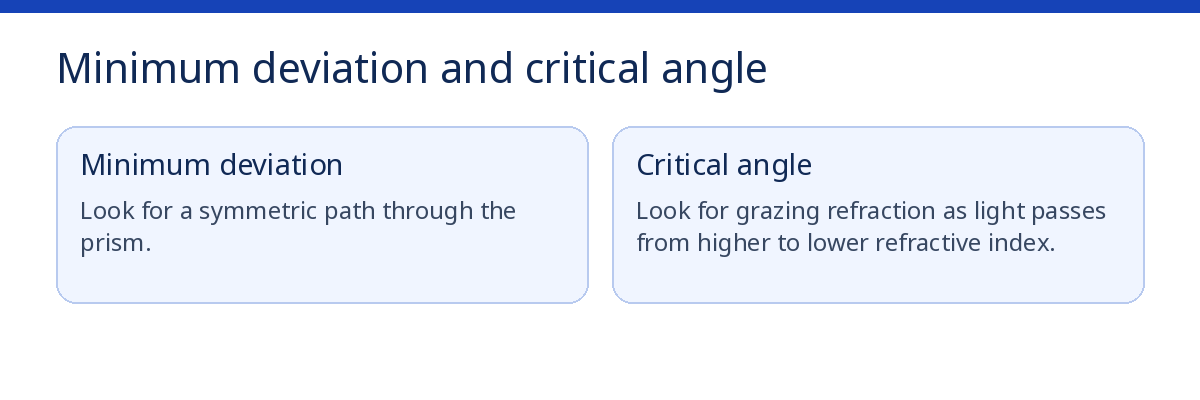
The optics questions move between ray diagrams and wave patterns. In the telescope alternative, normal adjustment is the condition that fixes the focal-plane arrangement. Label that arrangement before relating the angles at the objective and eyepiece; magnifying power here compares angles, not image heights. In the refraction questions, distinguish minimum deviation, which uses a symmetric ray path through the prism, from the critical-angle condition, which concerns a ray travelling from higher to lower refractive index with grazing refraction at the boundary.
For wave optics, keep single-slit diffraction separate from the double-slit case study. In a diffraction sketch, distinguish the broad central maximum from the weaker side maxima. When reviewing the worked explanation, notice that a midpoint estimate for a side maximum is an approximation, not the exact condition for a peak.
Quick self-check for the double-slit case study
The case study brings together fringe spacing, source coherence, immersion in a liquid and path difference. Before checking the worked page, ask which feature each part changes: the geometry, the wavelength in the medium or the phase relationship between the waves. In the usual small-angle treatment, the fringe-spacing formula uses the wavelength in the medium that fills the setup. For a particular point on the screen, phase and path difference are the relevant quantities; fringe width describes spacing across the pattern, not the brightness at that point.
The case study’s bright-fringe intensity option for a moved screen is not evaluated here: the worked explanation invokes a particular illumination model, and the spacing relation alone does not establish the intensity change.
Use the worked pages to diagnose your attempt
Each worked page separates the formula used, the concept used and the explanation in steps. Compare those layers with your own work in that order: did you choose an applicable relation, identify why it applied and carry the reasoning through? For a diagram question, check labels and directions as well as the final sketch. In the electromagnetic-wave alternative, for example, check whether your field directions agree with the propagation direction you drew.
After reviewing the timed attempt, try any internal-choice branch you skipped without first reading its solution. That lets you use both alternatives while keeping your original attempt faithful to the paper’s rules.
Spotted an error? Report a correction. Practise this in the app: notes, formula sheets and mind maps.













































































































































































Loading comments…