CBSE Class 12 Physics 2022 Term 2 Paper with Solutions
CBSEPhysics2022 Previous Year Paper
Paper code: 55/4/3 · 2022Use the full English-language CBSE Class 12 Physics 2022 Term 2 paper (55/4/3) for a two-hour practice attempt. Then use the worked solutions to check how you chose a formula, drew a diagram or justified a conclusion.
This set is one of the year's papers. See every set from 2022, grouped by series.
How this 35-mark Term 2 paper is organised
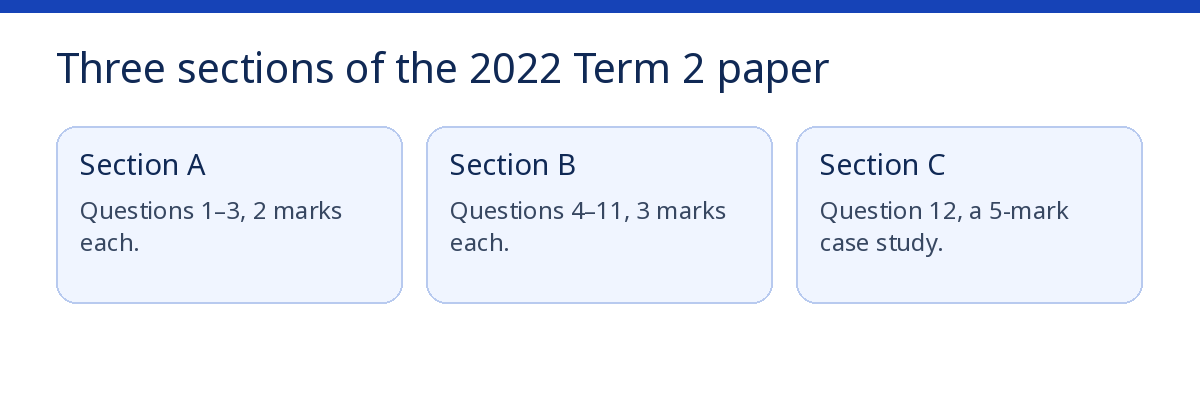
This year-wise resource contains the 2022 main examination paper for Term 2. Its 12 numbered questions are grouped into three sections: Section A has three 2-mark questions, Section B has eight 3-mark questions, and Section C has one 5-mark case study. The two-hour duration and 35-mark total belong to this particular paper; use them to reproduce its conditions, not to infer the format of another CBSE examination.
There is no overall choice. All numbered questions are compulsory, but where an internal choice is printed, attempt only one alternative. The worked solutions cover both alternatives, so you can return to the unused one after the timed attempt. The printed instructions allow log tables if needed but do not permit a calculator.

Physics 2022 | Class 12 | Previous Year Paper | Code 55/4/3
In the StudentCurio app
CBSE Class 12 Physics Term 2 previous-year paper, code 55/4/3, with worked solutions. It includes questions across optics, matter waves, atomic and nuclear physics, electromagnetic waves, and semiconductors.
Use the worked solutions to diagnose your first mistake
Start with the question pages and keep the solutions closed. For each calculation, write the physical relation before substituting values. For a diagram, label the features your explanation refers to. This gives you something concrete to compare with the solution even when you do not reach a final result.
After the attempt, use the question-number navigation to find the corresponding worked solution. The file separates formula used, concept used and explanation in steps. Read the concept first if you chose the wrong approach; read the steps if your approach was sound but your signs, units or algebra went wrong. For an internal choice, try the other branch before reading its explanation so it remains a fresh practice question.
Distinguish spectra, matter waves and nuclear energy
An atomic spectral wavelength is linked to the energy difference between two levels; a de Broglie wavelength is linked to a particle’s momentum by . The paper uses both ideas, so identifying what has the wavelength—a photon or a material particle—is a useful first step. For nonrelativistic particles accelerated from rest, equal accelerating voltages do not imply equal momenta: the kinetic energy gained depends on the magnitude of the charge, and the momentum also depends on the mass.
The nuclear physics questions distinguish fission from fusion and connect energy released per reaction to total energy and power. In the closest-approach question, the head-on condition matters: it lets you model the turning point using the initial kinetic energy and electrostatic potential energy. Do not apply the same stopping argument unchanged to an off-centre trajectory.
Keep energy bands separate from the junction barrier
The paper asks you to move from energy-band diagrams to explanations of semiconductor devices. The band gap is the energy interval between the top of the valence band and the bottom of the conduction band. Compare the band edges in your sketches: a semiconductor or an insulator has a gap, while a conductor can have a partially filled band or overlapping bands.
The barrier potential, by contrast, is a potential difference across the depletion region of a p–n junction. In the device questions, distinguish the effect of doping on carrier type and concentration from the effect of applied bias on the junction barrier and depletion width. When comparing forward and reverse behaviour, keep the reverse-bias explanation within the regime below breakdown. For the photodiode, connect the discussion of bias to the collection of light-generated carriers.
Choose a wave model that fits the question
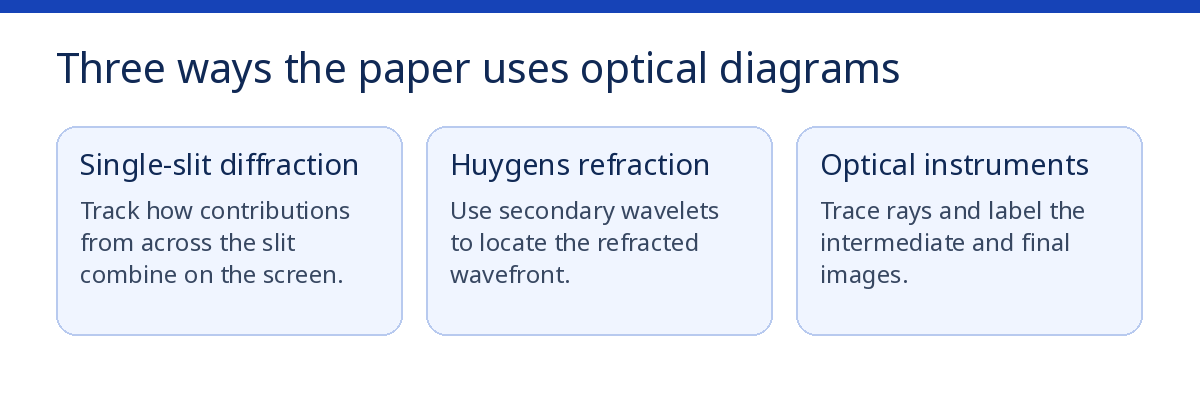
Single-slit diffraction and Huygens’ construction both use wave ideas, but the diagrams serve different purposes. For diffraction, think about how contributions from different parts of the same slit combine at a point on the screen. For refraction, Huygens’ construction uses secondary wavelets to locate the new wavefront after propagation into the second medium. A ray shows the direction of propagation; it is not itself the wavefront.
Common mistake: The single-slit relation , with slit width and nonzero integer order , locates minima in the far-field pattern. Do not use it to label the side bright fringes. The paper also tests electromagnetic waves through applications and frequency ranges. This guide leaves out the worked band identifications and numerical ranges: the photographic-plate clue is not unique, and band boundaries depend on convention.
Check the image condition before choosing an optics formula
The instrument questions distinguish an astronomical telescope adjusted for a final image at infinity from a compound microscope adjusted for a final image at the least distance of distinct vision. Mark the final-image condition on your sketch before choosing a formula. Also distinguish an instrument’s angular magnifying power from the linear magnification requested for a separate magnifier calculation.
The final case study shifts between refraction at one spherical boundary and imaging by lenses. For a spherical boundary, identify the incident and outgoing media from the actual figure before assigning signed distances. For two thin lenses in contact, powers add algebraically; with focal lengths in metres, their reciprocals give signed powers in dioptres. Quick self-check: Can you tell from your diagram whether you are modelling one refracting surface or a complete lens? This guide leaves out numerical substitutions and case-study option selections where the extracted text loses signs, diagram details or parts of the prompt. Consult the printed figures and wording in the file for those items.
Spotted an error? Report a correction. Practise this in the app: notes, formula sheets and mind maps.













































































































































































Loading comments…