CBSE Class 12 Physics 2022 Term 2 Paper with Solutions
CBSEPhysics2022 Previous Year Paper
Paper code: 55/5/3 · 2022Practise the full 2022 CBSE Class 12 Physics Term 2 main examination paper (55/5/3) in its original two-hour, 35-mark format. Use the worked explanations to check not just your calculations, but also why a particular model, formula or diagram applies.
This set is one of the year's papers. See every set from 2022, grouped by series.
What this 2022 paper contains
This year-wise resource contains the English version of the CBSE Class 12 Physics 2022 Term 2 main examination. It retains the original questions, options and diagrams, and the worked solutions cover the printed internal choices. The opening page lets you navigate by question number. Each explanation separates the formula used, the concept behind it and the reasoning in steps, so you can go straight to the part you need to review.
For a timed attempt, use the printed instructions to decide which branches to answer and leave the solutions closed. Afterward, use the alternative branches as extra practice. The two-hour limit and 35-mark total describe this particular paper; they are not a guide to the format of a different CBSE session.

Physics 2022 | Class 12 | Previous Year Paper | Code 55/5/3
In the StudentCurio app
CBSE Class 12 Physics question paper code 55/5/3 from 2022 with worked solutions. It helps students practise the board examination and review solution methods across the paper.
Semiconductors: read the circuit and the graph together
The semiconductor questions connect a diode’s current–voltage characteristic with rectification and photodetection. When reviewing an I–V graph, first identify the forward- and reverse-bias regions. The forward knee marks the region where current becomes appreciable; it is not an exact switch-on point. Reverse breakdown occurs under sufficiently large reverse bias and should not be confused with the small reverse current used when discussing photodiode operation.
For rectification, trace the current through the load during each half-cycle instead of assuming that the output changes sign whenever the input does. Use one complete input cycle as your reference when comparing the output patterns. For the photodiode, keep the dark current separate from the additional current due to illumination. That distinction explains why detecting a light signal is a different task from simply making a diode conduct.
Photons, hydrogen spectra and nuclear models
The paper uses energy in several different ways. In the ordinary one-photon photoelectric model, separate the energy needed for an electron to escape from the maximum kinetic energy it can have afterward. Before using the photoelectric equation, check that emission is possible and that the photon energy, work function and kinetic energy are expressed in consistent units. This also helps distinguish a threshold question from one that asks about electrons already being emitted.
For hydrogen emission, identify the final level before comparing lines within a series. The wavelength and the transition energy vary inversely, and a series limit is not an ordinary transition from a particular finite starting level. The nuclear questions require different checks: for scattering, ask whether target recoil can be neglected; for energy release, identify which particles belong on each side of the mass balance and follow the question’s stated mass assumptions.
Optical instruments: follow the intermediate image
The compound microscope and reflecting telescope both reward a ray-by-ray account of image formation. In the microscope, distinguish the objective’s linear magnification from the eyepiece’s angular magnification. The intermediate image is the object for the eyepiece, so its position matters when deciding where the final virtual image forms. A near-point expression applies when that final image is at the near point; a tube-length approximation should not be treated as an exact identity. Also distinguish magnifying-power magnitude from the sign associated with image orientation.
For the reflecting telescope, label which mirror collects and converges the incoming light, which redirects it in the layout shown, and where the eyepiece acts. This is more informative than memorising component names without knowing what each one does.
Good to remember: name the optical condition first
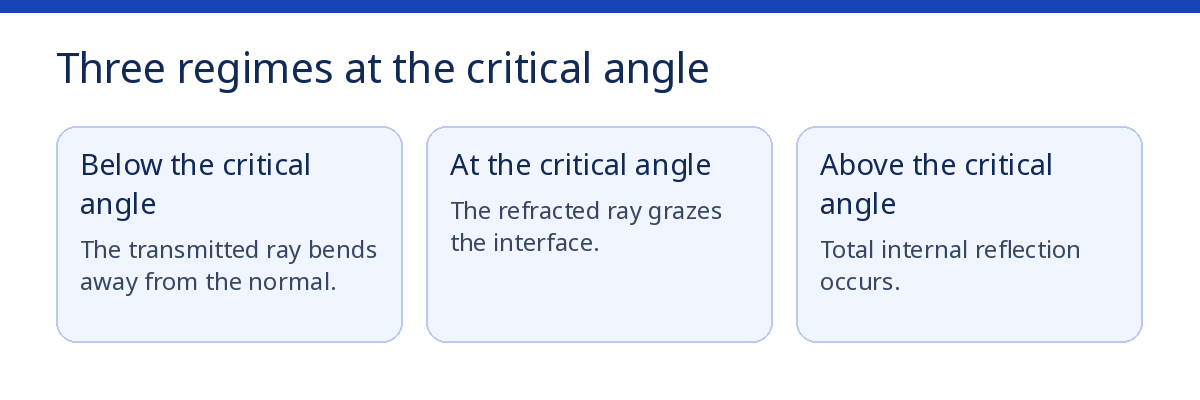
A ray that grazes an interface and a ray that undergoes total internal reflection are not in the same situation. For light travelling from a higher- to a lower-index medium, incidence at the critical angle gives grazing refraction; total internal reflection requires incidence above that angle. Measure incidence from the normal, not from the surface. When an escape-cone problem asks for an area, sketch the cone and identify the radius where it meets the surface before working with the area.
The prism material calls for a separate distinction. Grazing emergence sets a condition at the second face. Minimum deviation, by contrast, uses the symmetric path through the prism. Before substituting, decide which path the question refers to rather than carrying an angle from one condition into the other.
Common mistake: mixing diffraction and interference rules
Identify the arrangement before applying a bright-fringe rule. The conditions for bright fringes in Young’s two-slit interference do not locate secondary maxima of a single-slit diffraction pattern. In particular, an integer-order position that marks a minimum in the single-slit model cannot be treated as a bright point just because an interference calculation gives the same position.
The worked notes flag one printed optics alternative whose wording refers to single-slit diffraction while the familiar coincidence calculation belongs to two-slit interference. This guide omits that alternative’s numerical results rather than treating either reading as an unambiguous answer. You can review the distinction independently and use the other printed branch for timed practice.
Quick self-check after your attempt
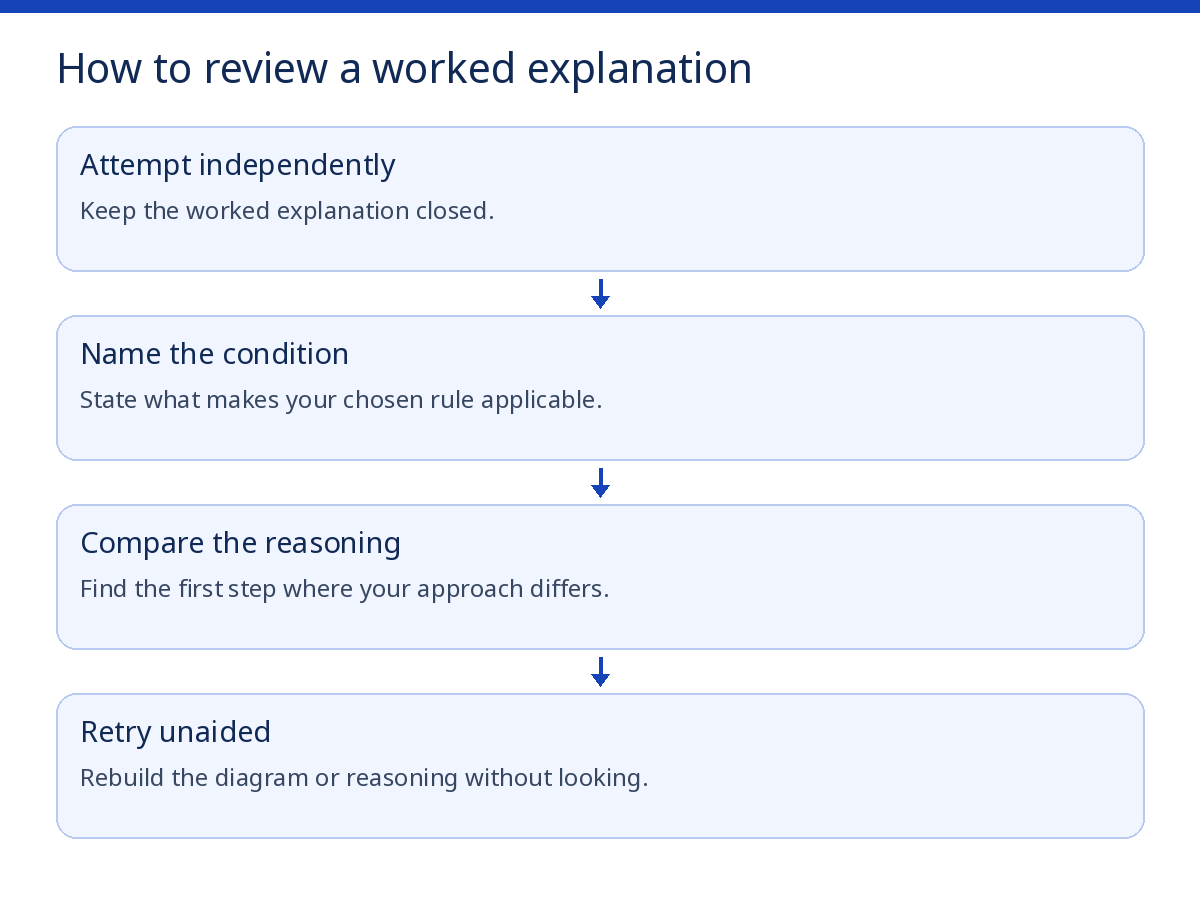
Before opening a worked explanation, write one sentence naming the condition you used: for example, where the final image forms or what the ray does at the interface. Compare that sentence with the resource’s Concept used note before reading the calculation. If they differ, locate the first step at which your reasoning took a different path. A numerical mismatch alone will not tell you whether you chose the wrong model or made a unit conversion error.
Then close the explanation and redraw the relevant ray diagram or I–V graph from memory, labelling the feature that justified your choice. Use an unattempted internal choice for a second check: can you identify its governing condition without borrowing the setup from the branch you already reviewed?
Spotted an error? Report a correction. Practise this in the app: notes, formula sheets and mind maps.













































































































































































Loading comments…