CBSE Class 12 Physics 2022 Term 2 Paper With Solutions
CBSEPhysics2022 Previous Year Paper
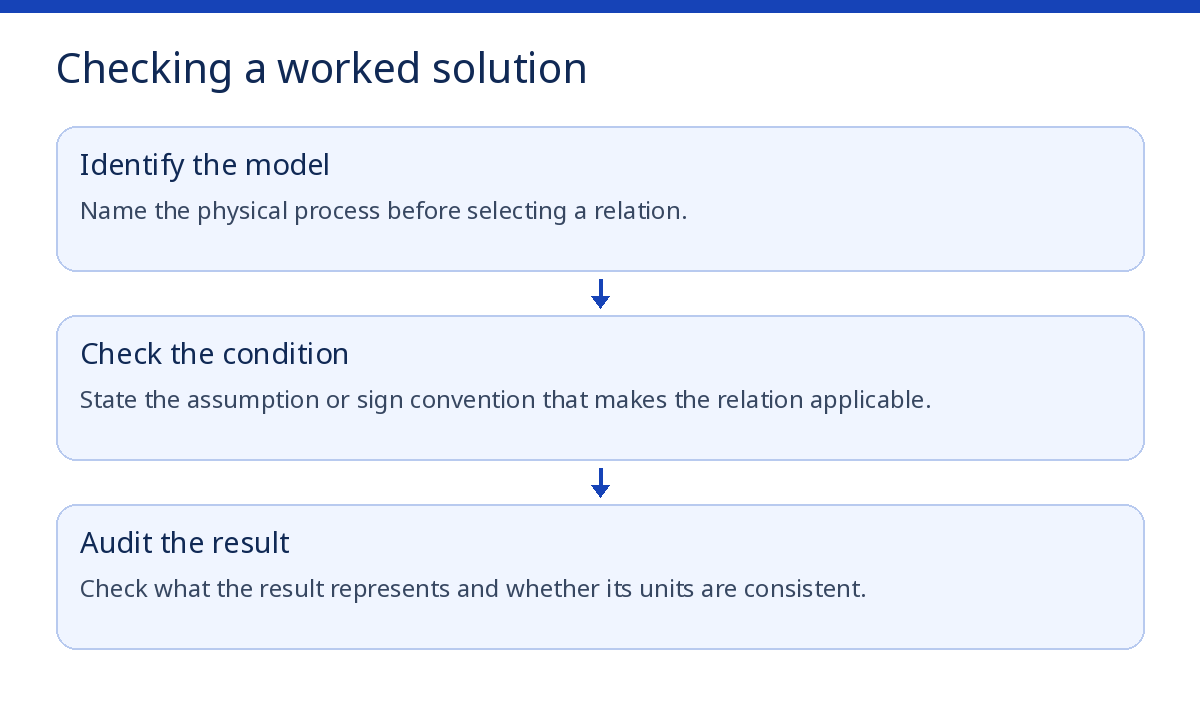
Paper code: 55/3/1 · 2022Practise with the full 2022 CBSE Class 12 Physics Term 2 board paper, set 55/3/1. Use the worked solutions to check not only your final result but also the physical model, sign convention and assumptions behind it.
This set is one of the year's papers. See every set from 2022, grouped by series.
What this 2022 paper contains
This year-wise file contains the English version of the 2022 main examination, Term 2, with a printed duration of two hours and a maximum of 35 marks. Those details belong to this historical paper. The file retains the original questions, options and diagrams and includes worked explanations for the printed internal choices.
The solution pages separate the formula, the concept and the explanation in steps. That structure helps you identify whether you remembered a relation but chose the wrong one, understood the model but made a calculation error, or reached a result without explaining the physics. The paper spans semiconductors, atomic and nuclear ideas, the photoelectric effect and matter waves, electromagnetic waves, wave optics and ray optics.

Physics 2022 | Class 12 | Previous Year Paper | Code 55/3/1
In the StudentCurio app
CBSE Class 12 Physics Term 2 board paper, set 55/3/1, with worked solutions. It covers questions across several topics, including semiconductor devices, atomic and nuclear physics, electromagnetic waves, wave optics, and optics.
Semiconductors: distinguish mobile carriers from fixed ions
The semiconductor questions connect three scales of explanation: what doping does to the material, what happens where the two regions meet, and how an illuminated junction can supply power. Doping changes which mobile carriers are in the majority. A junction explanation then has to distinguish those mobile electrons and holes from the fixed ionised dopants left behind near the boundary.
When you review the junction, separate the origin of the electric field from what it does once established. Diffusion and recombination leave a region of fixed charge; the resulting field drives drift. At equilibrium, zero net current means the drift and diffusion currents balance, not that both processes have stopped. In the solar-cell explanation, keep photon absorption, carrier separation and collection distinct: creating a pair is not the same as collecting charge through a circuit.
Atomic and nuclear physics: name the model first
For nuclear notation, compare atomic number and mass number separately. The proton number identifies the element; the mass number counts protons and neutrons together. That is why comparing mass numbers alone cannot tell you whether two nuclei belong to the same element.
The paper also uses the Bohr model and a head-on Coulomb closest-approach calculation. In the Bohr treatment, angular-momentum quantisation restricts the allowed orbits, while electrostatic attraction supplies the centripetal force. These are different ingredients of the same model. For closest approach, the energy argument used in the solution is for a head-on encounter, with the incoming particle's kinetic energy converted into electrostatic potential energy at the turning point. Do not carry that stopping-point argument over unchanged to a trajectory with nonzero impact parameter.
Common mix-ups: photon energy, electron energy and wavebands
In the ordinary one-photon photoelectric model, compare the energy of a photon with the work function of the emitting surface. Increasing intensity does not make individual photons more energetic at a fixed frequency. Also distinguish emission at the surface from collection at the electrode: a collecting potential can affect the measured current without changing the incident photon energy.
An electron accelerated through a potential difference is a different problem. If it starts from rest and the field supplies the energy gain, use , with the magnitude of the electron charge. The classical relation assumes non-relativistic motion; the de Broglie relation uses the particle's momentum. For the electromagnetic-spectrum material, keep three labels separate when revising: the waveband, the device that produces it and the application.
Wave optics: check what kind of width is being measured
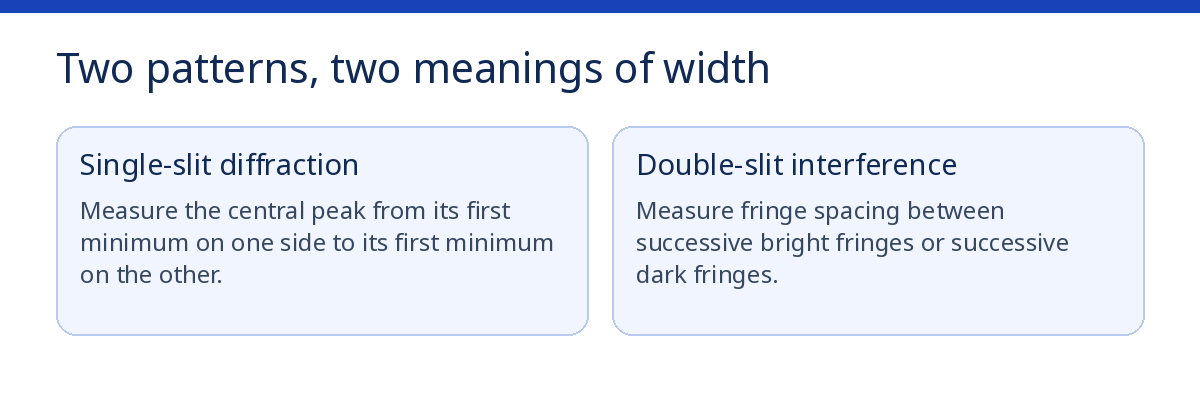
Single-slit diffraction and double-slit interference both give bright and dark regions, but the spacing rules describe different patterns. In single-slit diffraction, the central angular width is measured between the first minima on either side. Its small-angle approximation is , where is the slit width. The corresponding width on a distant screen is a length, approximately , where is the screen distance.
In the paraxial double-slit pattern, gives the spacing between successive bright fringes or successive dark fringes, with the slit separation. It is not the distance from a bright fringe to its nearest dark neighbour. When checking a fringe position, mark the centre first and distinguish a fringe's order from its distance on the screen. A stable pattern also requires a fixed relative phase between the sources.
Ray optics: check the condition at each surface
In a prism diagram, measure the incidence angle from the local normal, not from the face. Total internal reflection requires both travel from higher to lower refractive index and an incidence angle greater than the critical angle. At normal incidence a transmitted ray does not change direction. Checking one surface at a time is more reliable than guessing the overall path from the outline of the prism.
For a compound microscope, distinguish the real intermediate image formed by the objective from the virtual final image viewed through the eyepiece. The eyepiece factor , where is the least distance of distinct vision, applies when the final image is at infinity. The numerical glass-sphere example is omitted here because its result uses an assumed refractive index not specified in the figure.
Quick self-check before opening the solutions
For a timed attempt, use the printed duration and keep the worked pages closed. Follow the paper's internal choices on that attempt, then try the alternatives separately so they serve as additional revision rather than changing the conditions of your first run.
Before reading a solution, ask: Can I explain why this relation applies here, and can I identify the quantity my result represents? Use the solution's concept label to check the argument before comparing the calculation. If a ray goes astray, locate the first interface where your reasoning differs. If a numerical result differs, check whether the issue is the model, the sign convention or a unit conversion before redoing the arithmetic.
Spotted an error? Report a correction. Practise this in the app: notes, formula sheets and mind maps.













































































































































































Loading comments…