Nuclei: Class 12 CBSE Physics Practice Questions and Key Ideas
CBSEPhysicsNuclear Physics
This guide to the Class 12 CBSE chapter Nuclei (NCERT Chapter 13) explains the ideas behind a 100-question StudentCurio assessment: nuclear composition, size and density, mass defect and binding energy, the nuclear force, and fission and fusion. It shows how each question group is framed and what reasoning a strong board answer displays, without giving away the solutions.
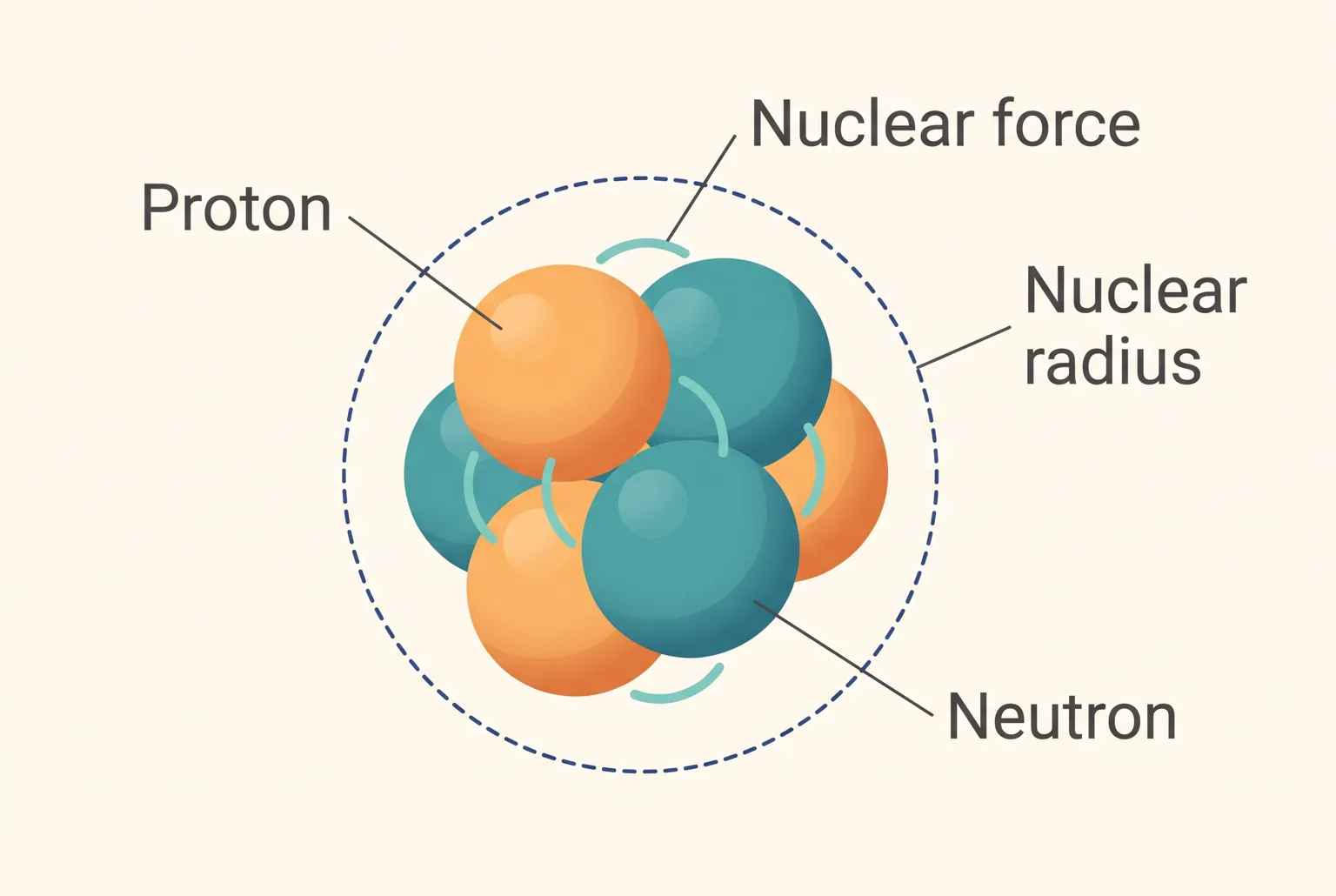
Counting nucleons: Z, N, A and the three 'iso' families
Every NCERT 13.2 question starts from one relation, . Here is the atomic number (protons), is the neutron number and is the mass number. A neutral atom also carries electrons. That is why questions comparing two isotopes of oxygen test whether you can tell extra neutrons apart from extra electrons.
The classification items rely on three definitions:
- Isotopes have the same but different .
- Isobars have the same but different .
- Isotones have the same .
A reliable method is to write beside every nuclide before you sort them.
The atomic mass unit is defined as one-twelfth of the mass of a neutral atom, about kg. Average atomic mass is the abundance-weighted sum of the isotope masses. The reverse problem, finding abundances from a known average, sets fractional abundances and and solves one linear equation.

Nuclear Physics | Class 12 | CBSE Assessment
In the StudentCurio app
100 Class 12 Physics questions on nuclei, arranged by NCERT topic and matched to the 2025-26 CBSE syllabus, with step-by-step worked solutions. Covers atomic masses and composition of the nucleus, nuclear size and density, mass defect and binding energy, nuclear force, fission and fusion, with MCQs, assertion-reason items, 2-, 3- and 5-mark questions and 4-mark case-based questions.
Why R = R₀A^(1/3) makes nuclear density the same
The 13.3 questions build on scattering evidence. In the Geiger–Marsden experiment, a few alpha particles bounced back from gold foil. This showed that the positive charge and almost all the mass of an atom sit in a tiny nucleus, roughly – times smaller than the atom. Later fast-electron scattering established , with fm.
The key reasoning step is to treat the nucleus as a uniform sphere. Its volume then grows in proportion to , and so does its mass. When you divide mass by volume, cancels. A strong answer shows this cancellation explicitly rather than just quoting the conclusion.
For ratio questions, take cube roots of mass-number ratios to compare radii. Working the other way, a change in radius must be cubed before you read off a change in . Distance-of-closest-approach problems use the supplied constant MeV fm. With it, you can compare a Coulomb estimate against the nuclear radius.
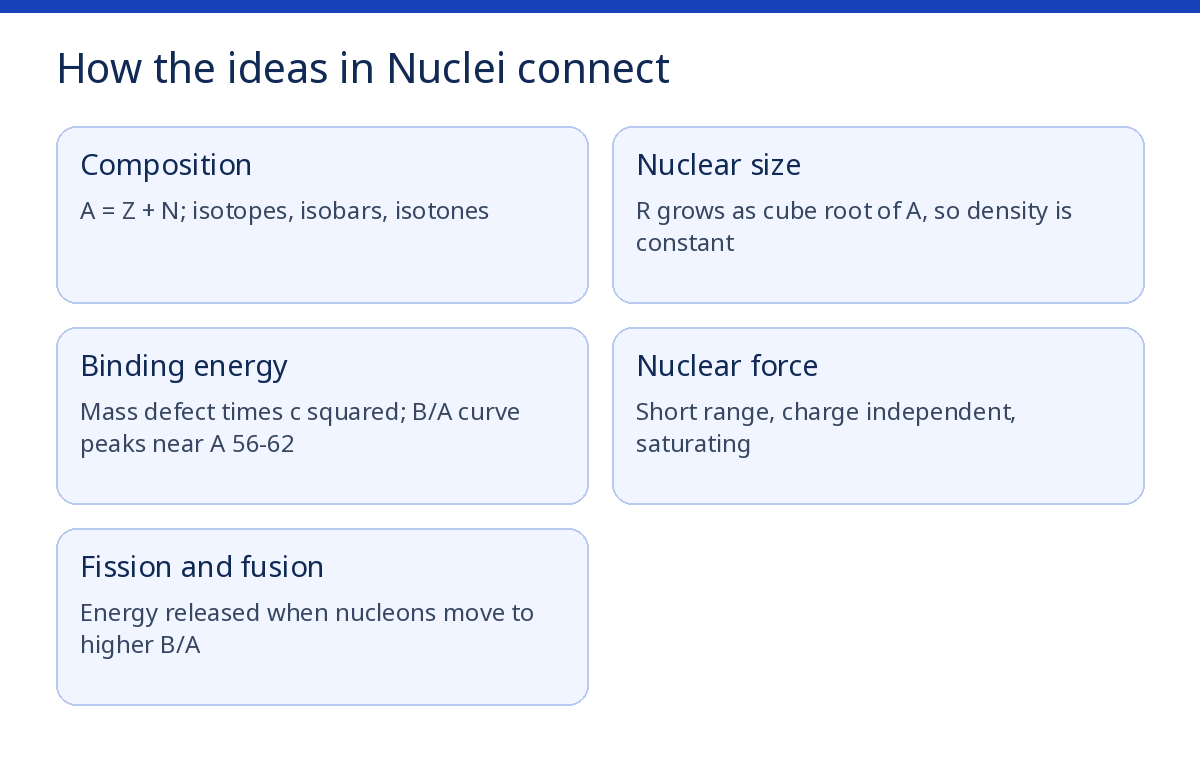
Mass defect and binding energy from atomic masses
A stable nucleus has less mass than its free protons and neutrons. This mass defect corresponds to the binding energy . Binding energy is the energy needed to pull the nucleus apart into separate nucleons.
The data box gives atomic masses together with u for the hydrogen atom and u. So the working form is , which lets the electron masses cancel. Convert using , then divide by to get .
The set extends this idea in several directions:
- Separation energies. The neutron separation energy is , and is defined in the same way using . These link to the magic numbers 2, 8, 20, 28, 50, 82 and .
- Mass ratios. Some questions ask why a ratio of atomic masses is not an exact whole number. The answer always returns to binding energy.
- Mass–energy conversion. Questions that convert grams of matter or power-plant output into energy test with careful unit handling.
Reading the B/A curve to explain fission and fusion
The source describes the shape of the binding-energy-per-nucleon curve. It rises steeply for light nuclei, peaks at about 8.75 MeV near –, and falls slowly to about 7.6 MeV for uranium.
Long-answer questions ask you to draw this curve and use it to explain energy release. The governing idea is this: energy is released whenever a process moves nucleons towards higher . Fusing very light nuclei moves up the steep left side of the curve. Splitting a heavy nucleus moves from the uranium end towards the peak.
Numerical versions give and for the parent and the products. You find total binding energy as for each side. The energy released is the gain in total binding energy.
Topic Practice 2 covers NCERT 13.6: nuclear fission, nuclear fusion and controlled thermonuclear fusion. The same curve-based reasoning underpins both halves.
Properties of the nuclear force and its potential-energy graph
The 13.5 set asks how protons stay together despite their electrostatic repulsion at about m. According to the source, the strong nuclear force has these properties:
- it is much stronger than the Coulomb force at short distances;
- it acts only over a few femtometres;
- it becomes strongly repulsive below about 0.8 fm;
- it is nearly the same for pp, nn and np pairs (charge independence);
- it saturates, so each nucleon interacts only with its close neighbours.
Questions connect each property to evidence. Saturation links to the near-constant of medium-mass nuclei. Proton–proton repulsion links to why heavy stable nuclei have .
The potential-energy sketch is a recurring 3- and 5-mark task. Mark where the potential energy is positive and where it is negative. Separately, mark where the force is attractive and where it is repulsive. Remember that force follows from the slope of the curve, not from the sign of the potential energy.
Assertion–reason items use the standard four options. Judge each statement's truth first, then decide whether the reason actually explains the assertion.
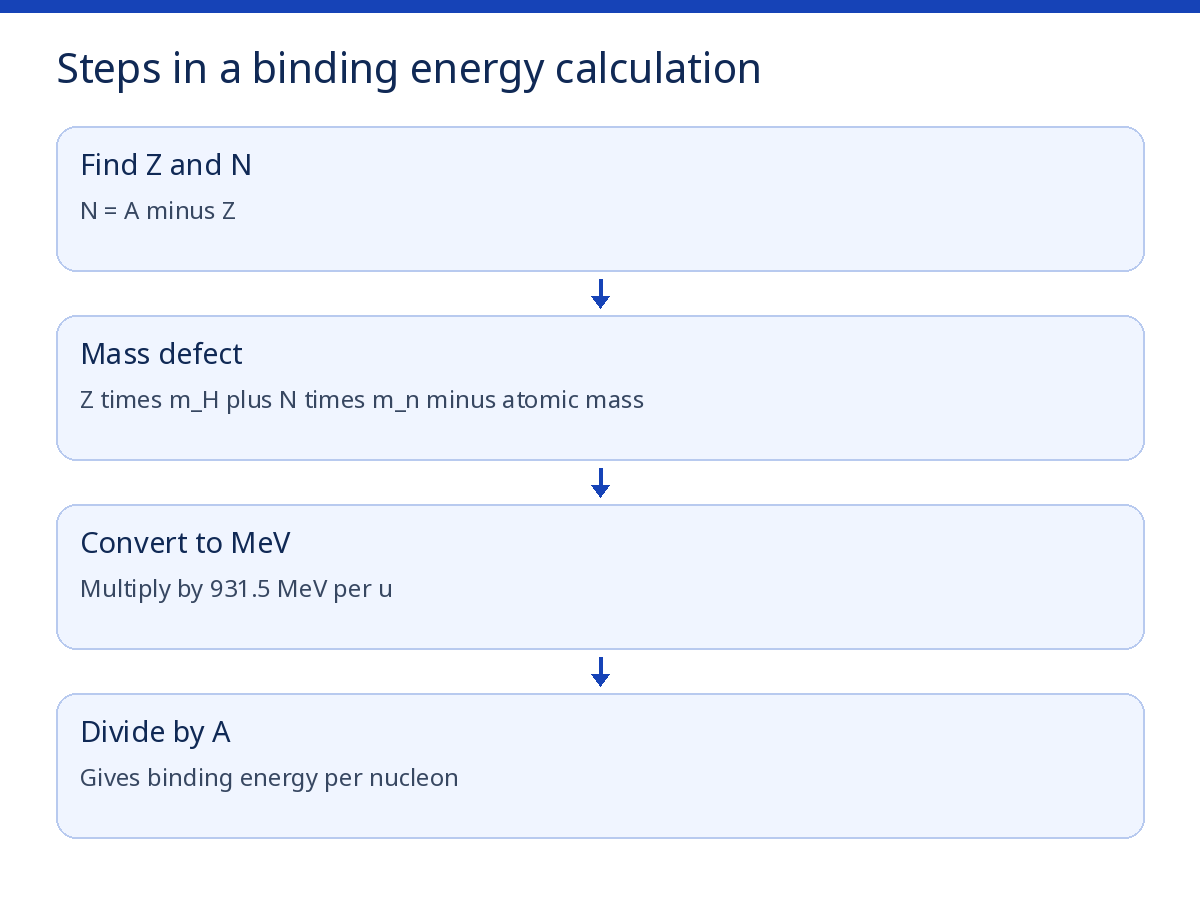
Common mistakes in Nuclei answers
- Mixing nuclear and atomic masses. If you use with an atomic mass, unbalanced electron masses enter the result. Pair atomic masses with .
- Swapping and . In , the lower number is , not .
- Treating density as growing with size. Because , density does not scale with .
- Calling the mass defect negative. For a stable nucleus, the free nucleons are heavier than the nucleus.
- Assuming an inverse-square law. That describes the Coulomb force. The nuclear force is short-ranged.
- Dropping the in femtometres when you substitute into SI formulas.
Working through the topic sets before mixed chapter practice
The assessment follows the NCERT section order.
- Topic Practice 1 has 51 questions on 13.2–13.5.
- Topic Practice 2 has 25 questions on 13.6.
- Chapter Practice has 24 mixed questions across 13.2–13.6.
Each sub-topic carries 1-mark MCQs (including assertion–reason), 2-mark very short answers, 3-mark short answers, 4-mark case-based questions and 5-mark long answers. Each case has five subparts, of which candidates attempt any four. The worked solutions cover all five. Question numbering restarts at 1 in each set, and a useful-data box precedes the first set.
A sensible order is to finish each sub-topic and check your reasoning against the step-by-step solutions. After that, attempt the mixed set without the index, which tests whether you can recognise the idea a question needs.
Frequently asked questions
Which sections of NCERT Chapter 13 does this assessment cover?
It covers atomic masses and composition (13.2), nuclear size (13.3), mass–energy and binding energy (13.4), nuclear force (13.5), and fission, fusion and controlled thermonuclear fusion (13.6), plus a mixed chapter set.
How are the case-based questions marked?
Each 4-mark case has five 1-mark subparts, and you attempt any four. The worked solutions explain all five.
Spotted an error? Report a correction. Practise this in the app: notes, formula sheets and mind maps.













































































































































































Loading comments…