Moving Charges and Magnetism: Class 12 NCERT Solutions
CBSEPhysicsMoving Charges and Magnetism
This CBSE Class 12 Physics solutions file walks through the NCERT exercises on magnetic fields, forces, electron motion and coil torque. Use it to check not just your arithmetic, but also why a formula applies and how the geometry determines the direction.
Start with what the exercise asks for
The file pairs the Chapter 4 exercise questions with step-by-step solutions. Its exercise index lets you return to a particular problem, and diagrams accompany several explanations where the position of a wire, the direction of a current or the orientation of a coil matters.
Before opening a solution, name the quantity you are trying to find. Some questions ask for the magnetic field produced by a current; others give you a field and ask what it does to a wire, a charged particle or a coil. That distinction tells you where to start. A field strength in tesla might be the final result in one exercise and an input to a force calculation in the next.

Moving Charges and Magnetism | Class 12 | NCERT Solutions
In the StudentCurio app
Step-by-step NCERT solutions cover magnetic fields due to currents, Lorentz force and electron motion in a magnetic field, forces on current-carrying wires, and torque on a current loop. Helps Class 12 students practise applying magnetic-field and magnetic-force concepts in numerical problems.
When each magnetic-field formula applies
For a circular coil, the file uses at the centre, where is the radius of each turn and is the number of turns. The cover graph illustrates how the central field varies with current when the radius and turn count stay fixed. It is not a graph of how the field changes as you move away from the centre.
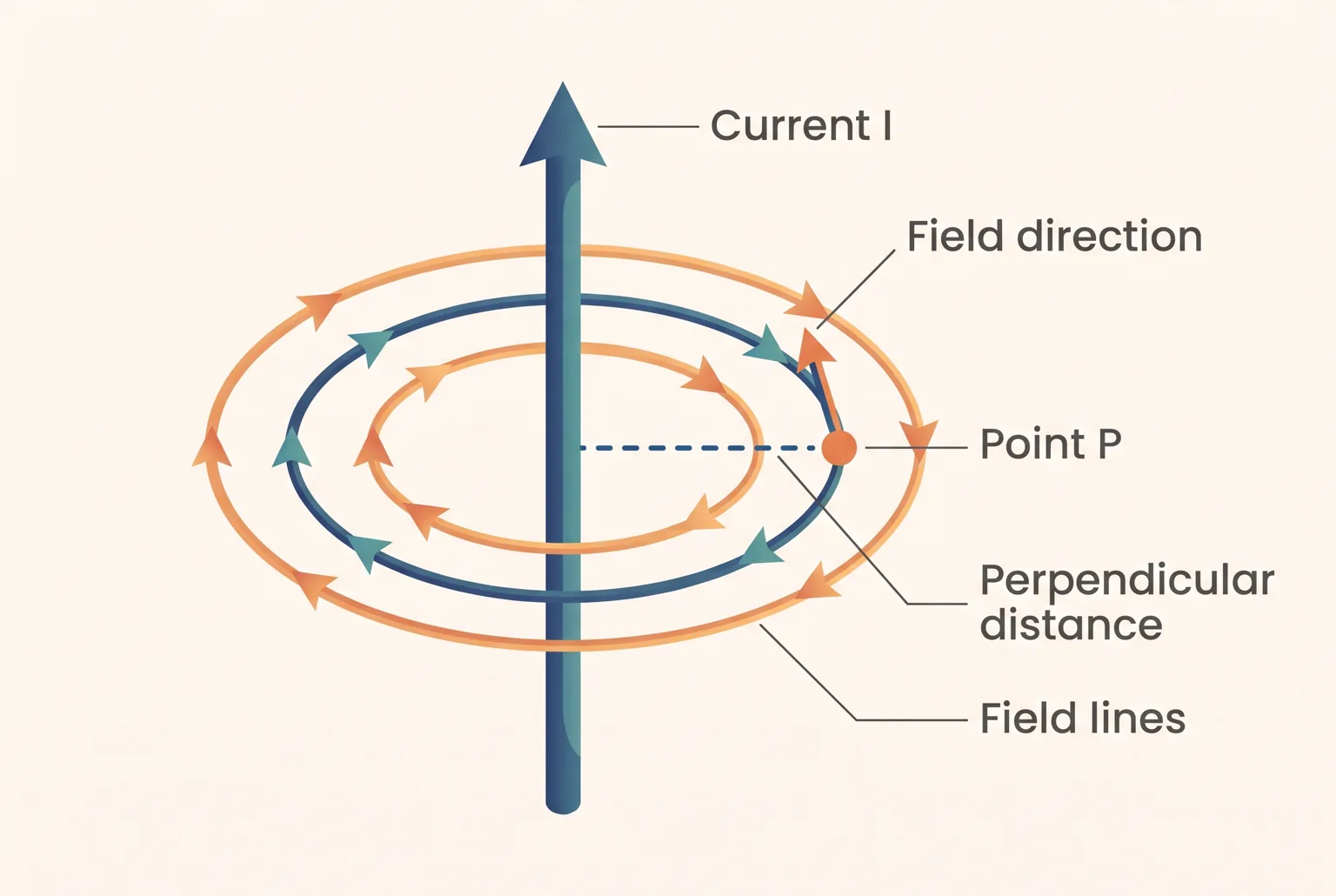
For a long straight wire, uses the perpendicular distance from the wire to the observation point. For a closely wound solenoid that is much longer than its diameter, estimates the field inside near the centre. Here the relevant ratio is the total number of turns divided by the solenoid length. If the winding has several layers, count all their turns before forming that ratio.
Read field direction from the geometry
The field formulas give magnitudes; the direction needs a separate check. For a straight wire, point your right thumb along the current. Your fingers curl around the wire, so you must check which way they point at the specified location, not just which way they seem to curl on the page. A point to one side of a horizontal wire and a point directly below it call for different views of the same rule.
For a circular coil, curl your right-hand fingers in the direction of the current. Your thumb gives the field direction at the centre. Reversing the current reverses that direction without changing the magnitude if the current's size stays the same.
Common mix-ups in force and torque calculations
For a straight wire segment in a uniform field, uses the angle between the current direction and the field. When the wire is inside a solenoid, work from the field direction along the solenoid axis. Also check whether the question asks for the force on a stated length, measured in newtons, or the force per unit length, measured in newtons per metre.
For a planar coil in a uniform field, uses the angle between the field and the normal to the coil, not the angle to its plane. The area is the area enclosed by one turn, measured in square metres. With parallel wires, there is a different distinction to make: identify which wire produces the field and which wire experiences the force on the specified segment.
Connect magnetic force to electron motion
The electron exercises use the magnetic part of the Lorentz force, . The electron's negative charge reverses the direction given by , but the force magnitude uses the positive charge magnitude. If the electron enters perpendicular to a uniform magnetic field and only the magnetic force acts, that force keeps changing the direction of the velocity without changing its speed. It provides the centripetal force for circular motion.
The follow-up exercise uses the same orbit to shift from radius to frequency. Keep the quantities distinct: angular frequency is measured in radians per second, while frequency counts revolutions per second. Before comparing your setup with the file, check that you converted the field from gauss to tesla and kept the motion within the nonrelativistic treatment used there.
Distinguish meter deflection from coil torque
The coil exercises apply torque in two settings. For a suspended coil held at a fixed orientation, an applied counter-torque must balance the magnetic torque: equal in magnitude and opposite in direction. In a moving-coil meter, the restoring torque instead comes from the spring as the coil deflects.
The meter exercise compares current sensitivity, or deflection per unit current, with voltage sensitivity, or deflection per unit voltage. The radial field lets the magnetic torque be written as , and equilibrium relates it to the spring's restoring torque. To go from current sensitivity to voltage sensitivity, divide by the meter resistance. A comparison based only on turns, field, area and spring constant therefore leaves out a factor needed for voltage sensitivity.
Before you move on: check the choice you made
When your result differs from the file, find the first step where the setups diverge. Check the model before the arithmetic: did you treat a distance as a coil radius when it was actually the separation between wires? Did you use the angle marked on a diagram without checking what its two sides represent? Once those choices agree, compare the conversions and substitutions.
Try sketching a fresh straight-wire example with a point marked beside the wire. Move the point to the opposite side while keeping its perpendicular distance fixed. Can you explain which part of your original reasoning you would reuse and which part you would need to redo?
Spotted an error? Report a correction. Practise this in the app: notes, formula sheets and mind maps.













































































































































































Loading comments…