Analyzing Motion in a Straight Line: CBSE Case-Based Guide
CBSEPhysicsKinematics 1D
Master core kinematics concepts including displacement, free fall, and variable acceleration through this specialized assessment resource for Class 11 Physics.
Core Kinematics through Practical Application
This StudentCurio assessment resource focuses on Chapter 2 of the Class 11 CBSE Physics curriculum: Motion in a Straight Line. Unlike standard textbook exercises, this material uses case-based scenarios to test a learner's ability to apply theoretical definitions to dynamic situations. It covers three primary thematic areas: the fundamental distinctions between distance and displacement, the specific conditions governing free fall under gravity, and the transition from constant to variable acceleration models using calculus.
The resource contains 13 subquestions organized into three case studies. Each case begins with a descriptive passage that sets the physical context, followed by multiple-choice, short-answer, and assertion-reason questions. This format aligns with modern CBSE assessment patterns that prioritize conceptual understanding over rote memorization. Learners can use the document to verify their grasp of how mathematical functions, such as cubic time-proportionality, translate into physical motion characteristics like non-uniform acceleration.

Motion in a Straight Line Class 11 |Physics | CBSE Case Based Assessment
In the StudentCurio app
Collection of case-based assessment questions and solutions for Class 11 Physics, covering topics like free fall, displacement, and non-uniform acceleration.
Path Length and Displacement in Geometry
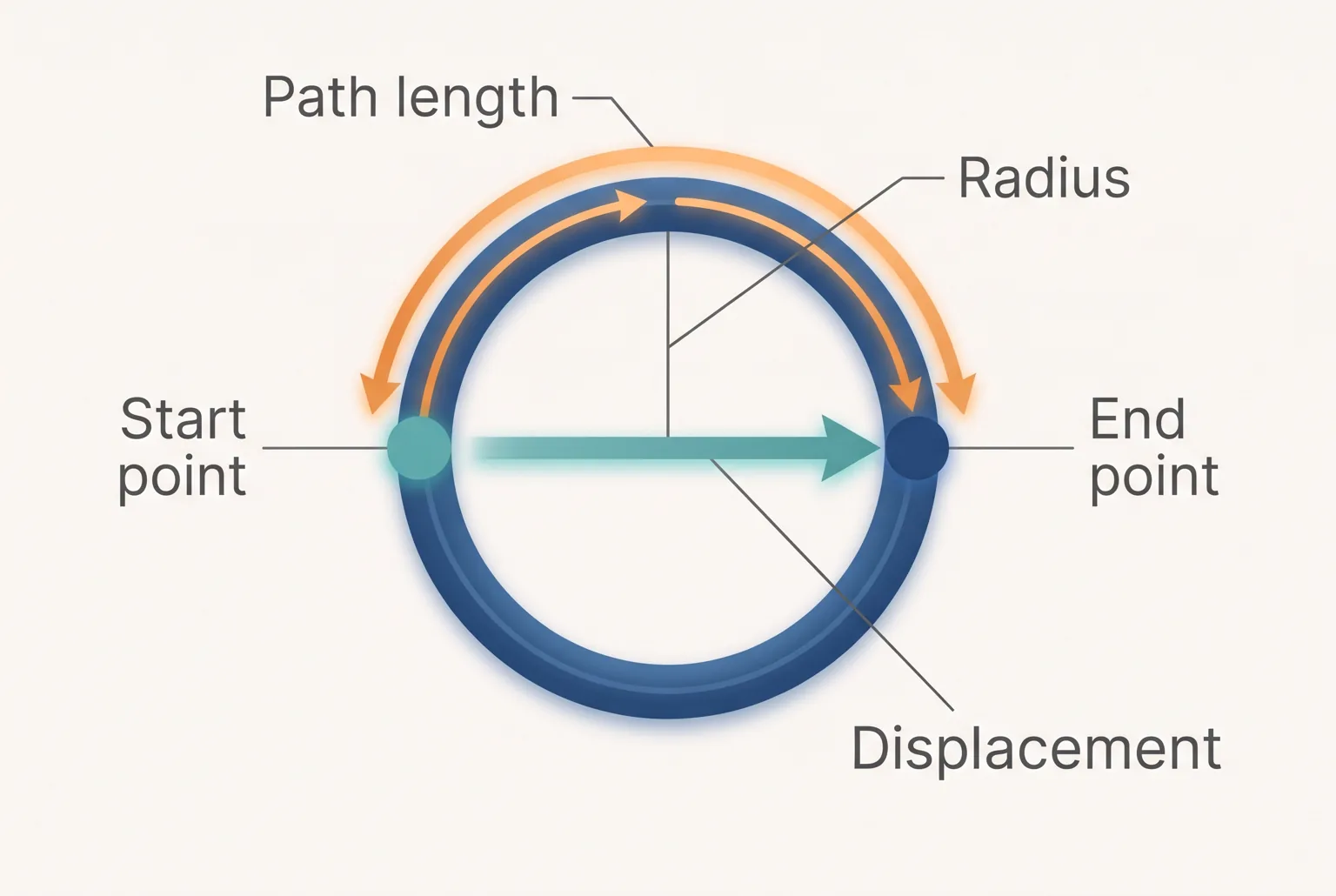
The first section of the resource challenges the learner to differentiate between the total path length (distance) and the change in position (displacement). A central example involves a bike rider on a circular path of radius . The material demonstrates how to calculate these values over a specific time interval ( minutes and seconds) when the period of one revolution is known ( seconds).
This exercise highlights a critical kinematic rule: while distance always accumulates, displacement depends only on the starting and ending points. In this case, three and a half revolutions result in a distance of , but the displacement magnitude is simply the diameter of the circle, . The resource further explores proportionality, showing that if distance is proportional to , the body moves with uniform acceleration. However, if displacement is proportional to , the acceleration is no longer constant but varies linearly with time (), requiring the use of second-order differentiation to define the motion.
The Dynamics of Free Fall and Sign Conventions
Case Study 2 examines motion near the Earth's surface where gravity is the dominant force. The material defines free fall as motion where air resistance is negligible. It provides a rigorous framework for sign conventions, which is often a source of confusion for Class 11 students. By choosing the upward direction as positive, the acceleration due to gravity is consistently represented as .
The resource uses the example of a book and a sheet of paper to illustrate why free fall is an idealization. While the book's weight makes air resistance negligible, the paper's large surface-area-to-mass ratio means it is significantly affected by the air, disqualifying it from being a 'good example' of free fall in standard atmospheric conditions. The material also covers the kinematics of objects thrown vertically upward, emphasizing that even at the highest point where velocity is zero, the acceleration remains downward. This distinction is vital for solving multi-stage motion problems.
Calculus in Non-Uniform Acceleration
The final section of the assessment transitions into variable acceleration, specifically using the function . This requires the learner to move beyond the standard three equations of motion (, etc.) and use integration to find velocity and position. The resource demonstrates how to derive the velocity function by integrating acceleration over time and accounting for the initial velocity .
One of the most valuable aspects of this section is the identification of maximum velocity. Learners are shown that maximum velocity occurs when the rate of change of velocity is zero (), which corresponds to the point where acceleration becomes zero. For the given function, this occurs at seconds. This case study also forces a distinction between 'position' and 'distance travelled,' reminding students that a milestone coordinate (like m) must be added to the displacement integral to find the final position, but excluded when calculating the total distance covered from the starting point.
Interpreting Graphical Slopes
The material concludes with a focus on graphical analysis, specifically the relationship between the slope of a displacement-time () graph and instantaneous velocity. It presents a comparison between two particles, A and B, whose displacement lines make angles of and with the time axis.
By applying the principle that velocity , the resource provides a mathematical proof for the ratio of their velocities. Using the values and , it demonstrates that the ratio simplifies to . This section reinforces the visual intuition needed for CBSE exams, where translating geometric slopes into physical quantities is a frequent requirement.
Common Mistakes to Avoid
- Confusing Position with Distance: When an object starts at a specific coordinate (e.g., m), its distance travelled after seconds is only the integral of velocity over that time. Do not include the initial coordinate in the distance calculation.
- Acceleration at the Peak: A common error is assuming acceleration is zero at the highest point of a vertical throw. In free fall, acceleration is a constant regardless of whether the velocity is positive, negative, or zero.
- Sign Inconsistency: When using , ensure your displacement () and velocity () also follow the upward-positive convention. If a stone falls m, its displacement in this system is m.
- Direct Proportionality Misinterpretation: If distance is proportional to time (), the speed is constant. If it is proportional to time squared (), the acceleration is constant. Do not use uniform motion formulas for accelerated systems.
Quick Self-Check
- Can you explain why a flat sheet of paper does not qualify as being in free fall when dropped in a typical classroom environment?
- If the displacement of an object is proportional to , how does its acceleration change as time increases?
- Given an acceleration function , what is the specific mathematical condition required to find the exact moment the object reaches its maximum velocity?
- How does the slope of a displacement-time graph change if an object is undergoing uniform acceleration versus uniform velocity?
Frequently asked questions
How does this resource handle the transition between questions and solutions?
The PDF features a clickable index and 'Back to question' or 'Solution' links on every page, allowing learners to navigate between the assessment and the worked answers efficiently.
What value of 'g' should be used for calculations in this assessment?
The material uses and treats it as a constant, assuming the height of the fall is small compared to the Earth's radius.
Does this cover variable acceleration?
Yes, Case Study 3 specifically covers motion where acceleration changes over time according to a linear function (), requiring integration to solve.
Spotted an error? Report a correction. Practise this in the app: notes, formula sheets and mind maps.








































Loading comments…