Matrices: Class 12 CBSE Assessment Guide and Key Ideas
CBSEMathematicsMatrices and Determinants
This guide to the Class 12 CBSE Matrices assessment explains what its practice sets test: order and types, equality, addition and scalar multiplication, multiplication and powers, transposes, and symmetric and skew-symmetric matrices. It also covers inverses by row transformation, case-based data matrices and a sensible order for practice.
Order, elements and building a matrix from a rule
Topic Practice 1, Matrix and Its Types, starts with order. A matrix with rows and columns has order and contains elements.
Some questions reverse this. You are given the number of elements and must list every possible order. Every factor pair counts, written both ways, so and are different orders.
Counting questions ask how many matrices of a given order can be filled from a few allowed entries. Each position is an independent choice.
Construction questions define each entry by a rule such as . Some rules are piecewise, with one value for and another for . Read as the row index and as the column index. Show the substitution for at least one entry.

Matrices | Class 12 | CBSE Assessment
In the StudentCurio app
A solved Class 12 assessment covering matrix types, operations, multiplication, transposes, inverses and matrix equations, with objective, short-answer, long-answer and case-based questions. It helps students practise matrix algebra and prepare for CBSE assessments.
Equality of matrices as a system of equations
Two matrices are equal only when they have the same order and every pair of corresponding entries is equal. One matrix equation therefore becomes several ordinary equations.
Topic 1 equates entries such as and with numbers, then solves the resulting system.
Sometimes one unknown appears in several positions, for example both and . A valid value must then satisfy every equation at once. Test each candidate against all the entries that contain it.
In written answers, state the corresponding-entry equations before you solve them.
When addition and scalar multiplication are defined
Topic Practice 2 checks one condition first: addition and subtraction need matrices of the same order. The result is then formed entry by entry.
A scalar multiple multiplies every entry by . So exists only when and share an order, and the result keeps that order.
Matrix equations are then handled like algebra: - Given and , isolate . - Given and , eliminate one unknown matrix, as you would with linear equations.
Other items use notation, or trigonometric entries that simplify with . When asked to verify a law such as , compute both sides separately and then compare them.
Conformability and order of factors in multiplication
Topic Practice 3 is about matrix multiplication. The product is defined only when the number of columns of equals the number of rows of . An matrix times an matrix gives an matrix. An item such as tests this rule directly.
and need not be equal, and one may exist without the other. So keep the factors in order. For example, expands to . It becomes only when , which one question asks you to show.
The longer items work with powers. You may need to show that a polynomial such as equals . Others ask you to prove a formula for for all by mathematical induction.
Rotation-type matrices with and entries need compound-angle identities. One of them states a domain condition: must be defined, so .
Transpose rules and symmetric or skew-symmetric parts
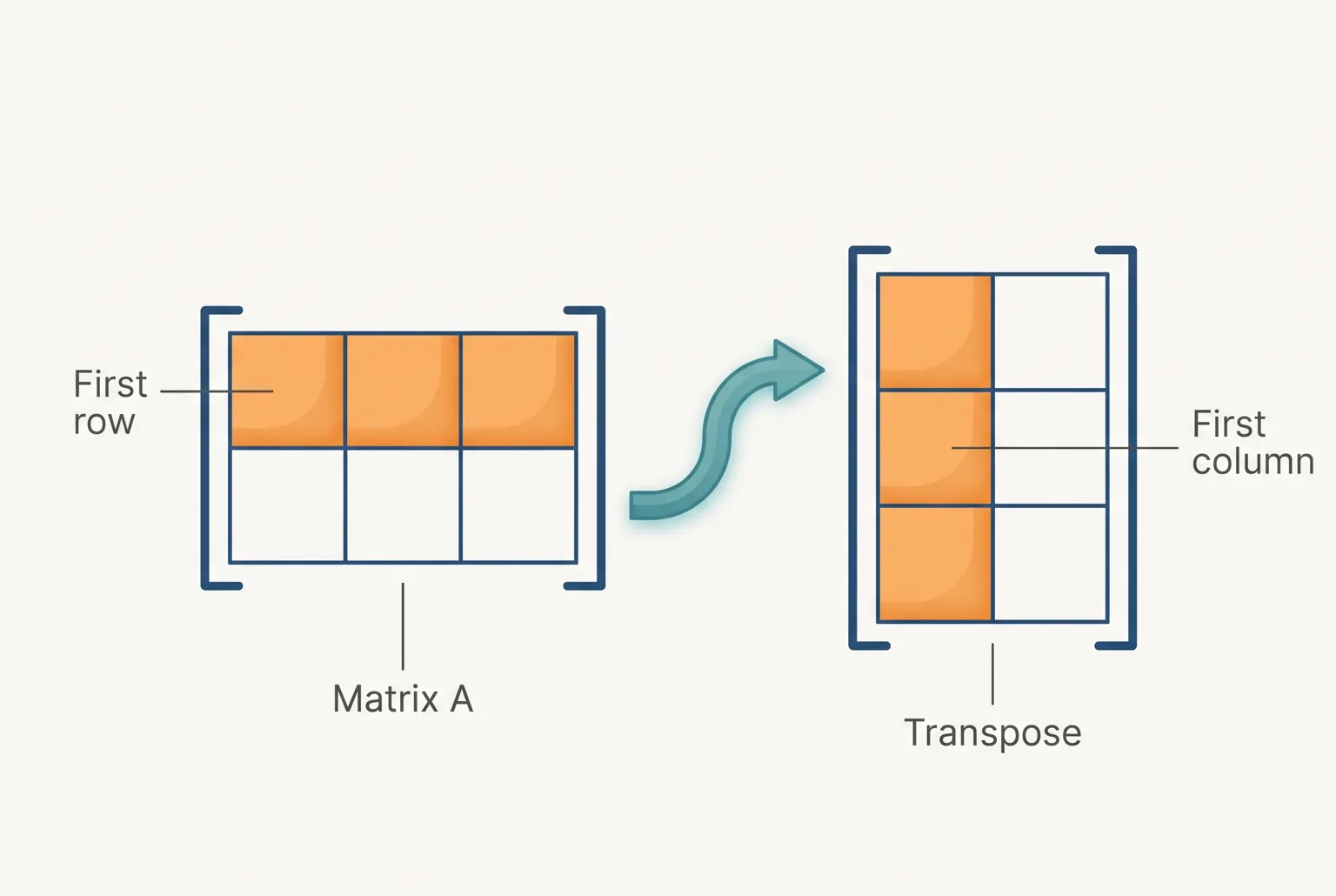
The cover shows the transpose: the first row of becomes the first column of . In general, the entry of is . A matrix therefore has a transpose.
Topic Practice 4 asks you to verify three rules on given matrices: - - - , where the order reverses
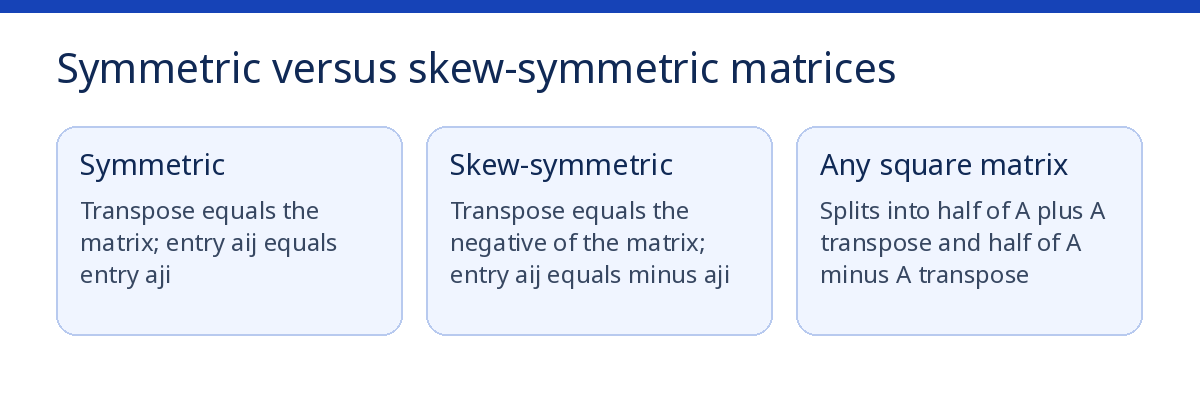
A matrix is symmetric if and skew-symmetric if . To find unknown entries, apply these conditions entry by entry. Proof items include showing that and are symmetric. Another shows that is symmetric when and are symmetric.
Several questions use the split of a square matrix into a symmetric part plus a skew-symmetric part. Check each part against its definition.
The set also asks for an inverse by elementary row transformations. Write , then apply identical row operations to and until the left side becomes .
Common mistakes the questions are designed to catch
- Adding matrices of different orders. Check the orders before any operation.
- Treating as automatically. Expand term by term, in order. The Chapter Practice asks you to show that these can differ.
- Writing . The order reverses.
- Assuming a square exists. In one Chapter Practice item, and are rectangular. The source notes that can be formed, but and cannot.
- Picking a true but weak option. Some objective items ask for the most precise conclusion. One asks you to select all correct options.
Case-based data matrices and a practice order
The Chapter Practice ends with three five-part case-based questions: - stationery sales in two markets - operations on three matrices - rice sales by farmer and variety
These extend a Topic 1 skill: arranging data, such as dealers' car sales, into a matrix. Decide what the rows and columns represent before you add or multiply.
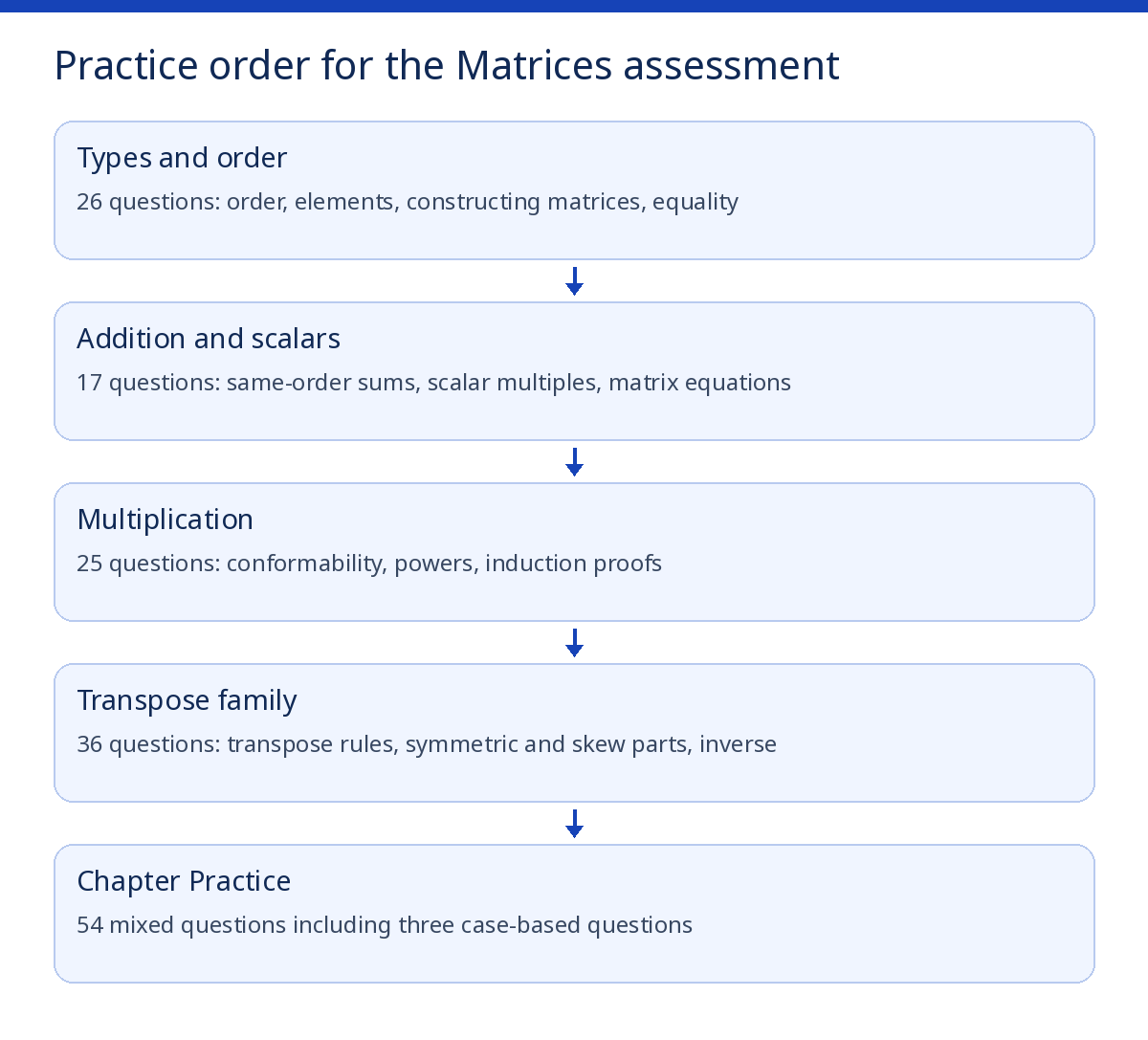
The 158 solved questions are split into five sets: - Matrix and Its Types (26) - Addition and Scalar Multiplication (17) - Multiplication (25) - Transpose and Related Matrices (36) - Chapter Practice (54)
The formats are objective, very short answer, short answer types I and II, long answer and case-based. Numbering restarts in each set.
Work through the topic sets in order, because each one relies on the previous skill. Keep the mixed Chapter Practice for last. Attempt each question before opening its worked solution, and compare your steps, not just your final values.
Quick self-check on transposes and data matrices
- Why does the transpose of a product reverse the order of and ?
- Why must a matrix be square before it can be symmetric or skew-symmetric?
- In a case-based question, how would swapping what the rows and columns represent change which products are defined?
Frequently asked questions
Does this assessment cover determinants?
No. The source is Chapter 03, Matrices. It covers matrix types, operations, multiplication, transposes, symmetric and skew-symmetric matrices, and finding an inverse by elementary row transformations.
Which question formats appear?
Objective, very short answer, short answer type I and II, long answer and case-based questions, all with worked solutions.
Spotted an error? Report a correction. Practise this in the app: notes, formula sheets and mind maps.





























































































































































Loading comments…