CBSE Class 12 Mathematics Supplementary Paper 2026
CBSEMathematics2026 Previous Year Paper
Paper code: 65/7/2 · 2026Practise the full 2026 CBSE Class 12 Mathematics supplementary paper (65/7/2) under its three-hour, no-calculator conditions. Then use the worked solutions to check where you chose a method, applied a condition or turned a description into a mathematical model.
This set is one of the year's papers. See every set from 2026, grouped by series.
Paper pattern and internal choices
This year-wise resource contains the English version of the 2026 supplementary examination. The paper carries 80 marks and has 38 questions across five sections. Section A has 18 multiple-choice questions and two assertion–reason questions, each worth one mark. Sections B, C and D contain very short, short and long answers worth two, three and five marks per question, respectively. Section E contains three four-mark case studies.
The instructions make all questions compulsory but provide internal choices in selected questions. Choose between alternatives only where they are printed; there is no overall choice of questions or sections. For a timed attempt, keep the worked solutions closed, follow the printed choices and work without a calculator.

Mathematics Supplementary 2026 | Class 12 | | Code 65/7/2
In the StudentCurio app
CBSE Class 12 Mathematics supplementary examination paper 65/7/2 for 2026, with worked solutions. It includes questions across the syllabus, including conditional probability and three-dimensional geometry, and helps students practise exam questions and review solution methods.
Calculus: distinguish a value, an area and a function
The paper moves from continuity and differentiation to extrema, definite integration, area and a differential equation with an initial condition. At a join in a piecewise function, continuity requires the left-hand limit, the right-hand limit and the assigned function value to agree. In a maximum or minimum problem on a closed interval, compare the values at the endpoints as well as at relevant interior candidates. A stationary point alone does not establish the greatest or least value on the interval.
An area question asks for more than an antiderivative. Use the curves and boundary lines to locate the region, then decide which expression gives its height or width over the chosen interval. With vertical slices, the height is the upper curve minus the lower curve. A differential equation asks for a function instead: once you have a general solution, use the given initial condition to determine its constant.
Before applying a rule: check the range, shape or set
For inverse trigonometric functions, distinguish the input of the inverse function from its principal output. An angle with the required cosine is not automatically the inverse-cosine value: that value must lie in . When differentiating a composition, check separately where the original expression is real and where the derivative formula is defined. Those domains need not be identical.
For a matrix product, a product entry uses a row from the first matrix and a column from the second, and the inner dimensions must agree. Determinant scaling is a separate rule for square matrices: the exponent on the scalar is the order of the matrix. For relations, test reflexivity, symmetry and transitivity on the stated set. For functions, keep the declared domain and codomain in view: checking that distinct inputs have distinct outputs does not show that every element of the codomain is reached.
Conditional probability: identify what is already known
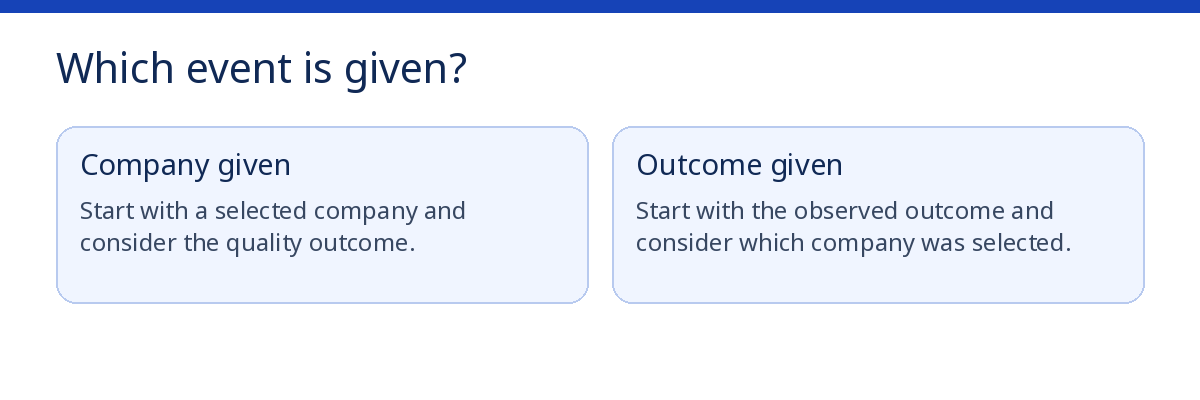
The probability questions distinguish conditional probability, independence and draws without replacement. In , the event after the bar is the given event, and it must have positive probability. Independence and mutual exclusivity are different ideas: if two events with positive probabilities are mutually exclusive, knowing that one occurred rules out the other. In a draw without replacement, the first draw changes what remains for the second, so do not assume independence.
The construction-company case study shows why the direction of conditioning matters. The setup gives company selection probabilities and quality information for each company, while the questions ask about the company after an outcome is observed. When reviewing your setup, label the observed outcome separately from the event whose probability you want. Reversing those labels changes the question you are answering.
Build the model before doing the calculation
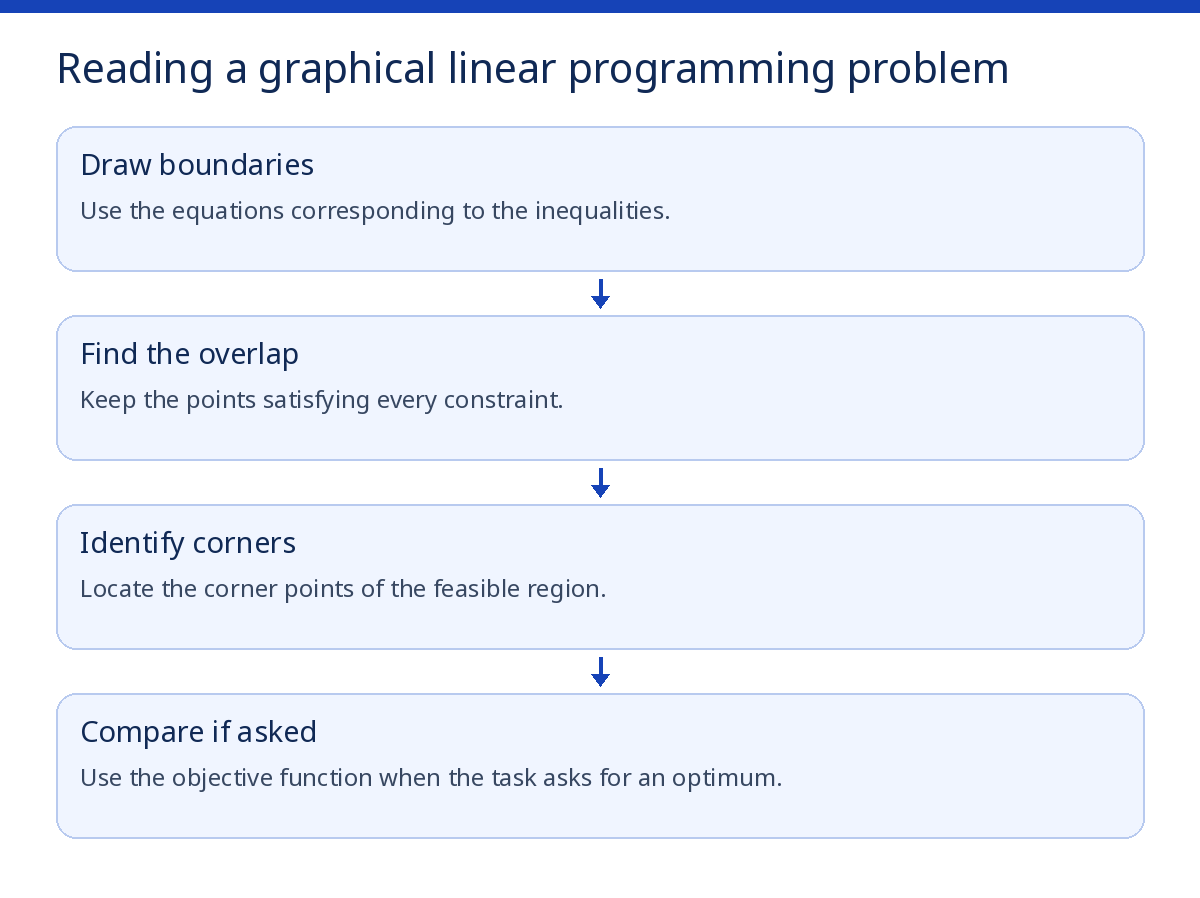
The graphical linear programming questions distinguish drawing a feasible region from finding an optimum. For each boundary line, select the side specified by its inequality. The feasible region is the overlap of all those sides, including the non-negativity constraints. Listing corner points identifies candidates; it does not tell you which gives the best objective value.
In the window case study, the perimeter constraint and the area expression have different jobs: one restricts the possible dimensions, while the other describes what is being maximised. Keep any expression in one variable tied to dimensions that are geometrically possible. In the swimming-pool case study, separate a point on a path from its direction vector. Parallelism tells you about the directions, but a direction alone does not locate a path in space. Finding the foot of a perpendicular adds another requirement: the foot must lie on the target line.
Quick self-check before opening a worked solution
For a question you found difficult, mark the first line you were unsure about. Was the uncertainty about which rule to use, or about whether the rule applied? If the question used an assertion and a reason, did you judge each statement separately before deciding whether the reason explained the assertion? In a case study, did you carry the right constraint or given information into the next part?
The file links question numbers to worked solutions and separates the formula used, the concept used and the explanation in steps. Compare your first uncertain line with the corresponding step rather than checking only the final answer. Then close the solution and retry from that point. This guide omits Q19’s conclusion and keyed choice because the printed question does not specify whether the library contains any non-mathematics books.
Spotted an error? Report a correction. Practise this in the app: notes, formula sheets and mind maps.





























































































































































Loading comments…