CBSE Class 12 Mathematics Supplementary Paper 2025
CBSEMathematics2025 Previous Year Paper
Paper code: 65/S/3 · 2025Practise with the complete English-language CBSE Class 12 Mathematics supplementary paper for 2025 (65/S/3). The three-hour, 80-mark paper and its indexed worked solutions let you attempt the board-paper format first, then review how each method is justified.
This set is one of the year's papers. See every set from 2025, grouped by series.
Read the five-section paper before you start
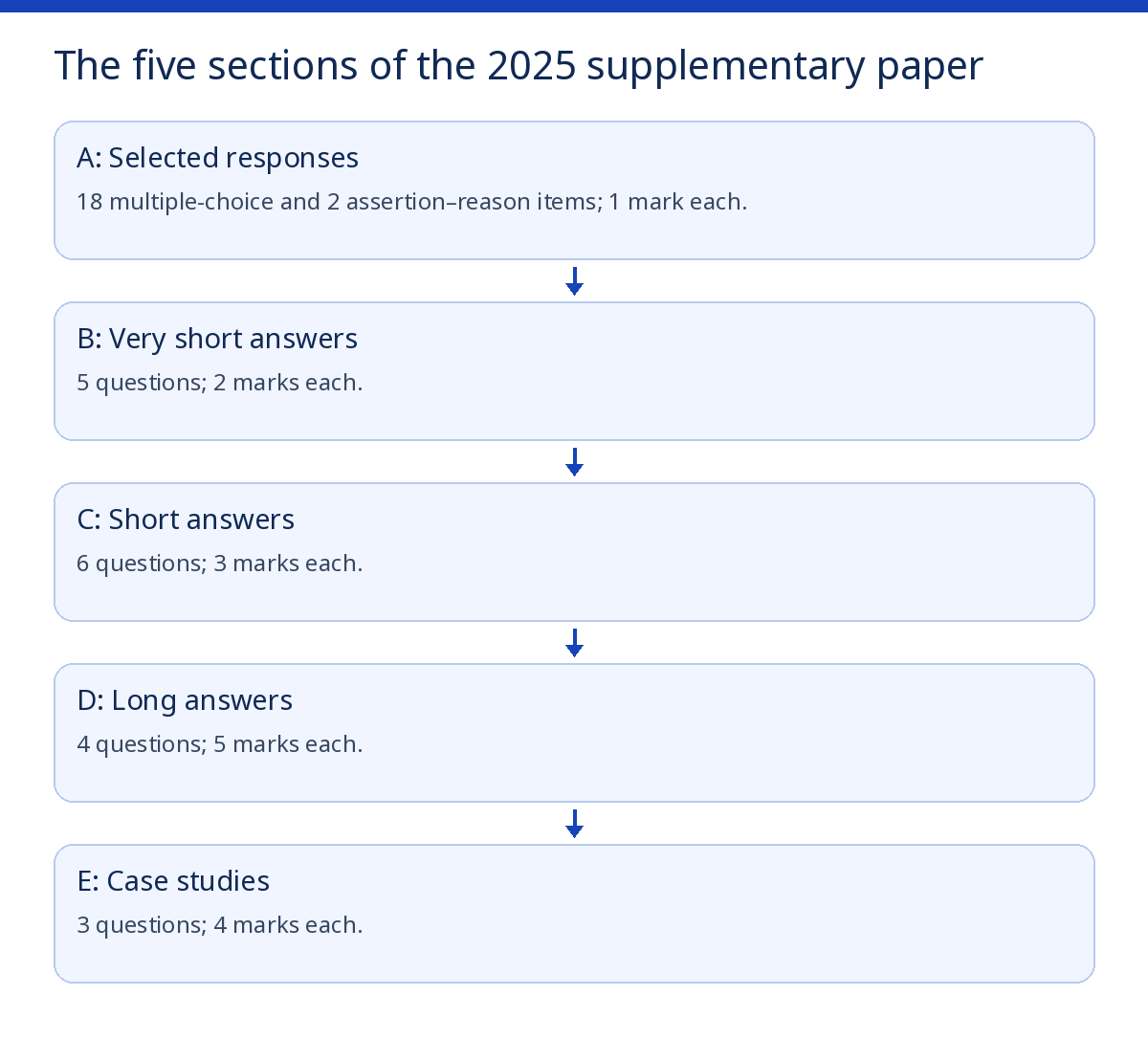
This year-wise file contains the full 2025 supplementary paper, not a chapter-wise question bank. Section A has 18 multiple-choice questions and two assertion–reason items, all worth one mark each. Section B has five two-mark very short answers, Section C has six three-mark short answers, and Section D has four five-mark long answers. Section E has three four-mark case studies. The original English question layout, options and diagrams are preserved.
There are 38 compulsory questions and no overall choice, but some questions in Sections B through E offer internal alternatives. In a timed attempt, choose one branch where an alternative is printed rather than treating the two branches as separate questions. Work without a calculator, as the paper requires, and save the unattempted alternatives for review.

Mathematics Supplementary 2025 | Class 12 | Previous Year Paper | Code 65/S/3
In the StudentCurio app
Complete CBSE Class 12 Mathematics supplementary examination paper 65/S/3, with questions and worked solutions covering the full examination. It helps students practise the board-paper format and review solution methods.
Matrices, determinants and the language of functions
The matrix questions range from recognising a matrix type to using matrix multiplication in a system of equations. Watch the difference between multiplying every entry of a matrix by a scalar and scaling its determinant. For a square matrix of order , multiplying the matrix by multiplies its determinant by . Matrix multiplication has a different kind of restriction: the inner dimensions must match, and reversing the order need not give the same product.
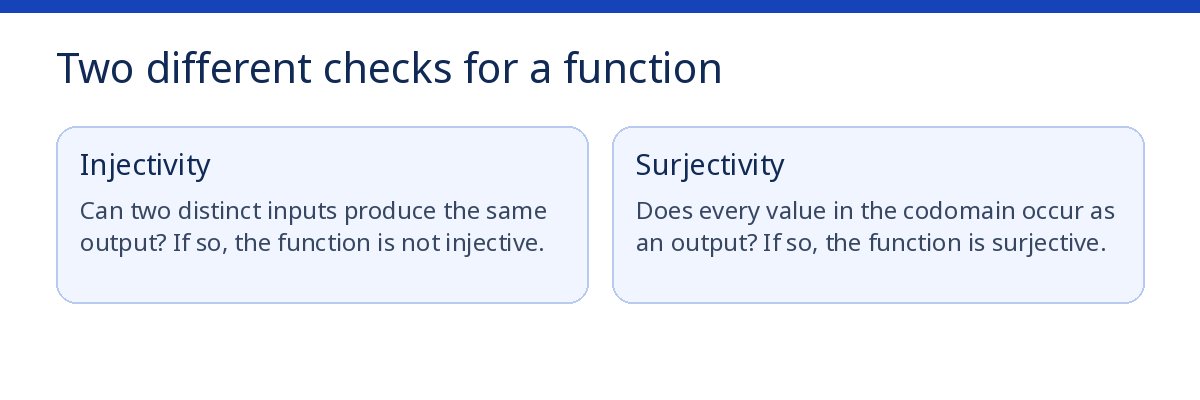
The functions questions reward attention to definitions. The range consists of the outputs actually attained; the codomain is the declared target set. Surjectivity asks whether those sets coincide, while injectivity asks whether distinct inputs can share an output. In an assertion–reason item, check the truth of each statement separately before deciding whether the reason explains the assertion.
Calculus: check the condition before applying the rule
The calculus questions ask you to move between derivatives, rates, integrals and graphs. In parametric differentiation, differentiating with respect to the parameter is not the same as differentiating with respect to the horizontal coordinate. The usual quotient for the first derivative requires the derivative of that coordinate with respect to the parameter to be nonzero. For the second derivative, apply the same conversion to the first derivative rather than taking a quotient of second derivatives.
For increasing and decreasing intervals, use the sign of the derivative on each interval, not just the locations where it vanishes. For an area problem, sketch the region before integrating: the choice of horizontal or vertical slices determines the width or height you integrate, and the active boundary may change along the way.
The paper also tests the order and degree of a differential equation and the integrating-factor method. Read degree from the power of the highest-order derivative when the equation is polynomial in its derivatives. For an integrating factor, rearrange into first-order linear form before identifying the coefficient of the dependent variable, and work on an interval where the coefficients are defined.
Vectors, lines and feasible regions
The vector and three-dimensional geometry questions distinguish a line’s position from its direction. For an angle between lines, identify their direction vectors. To test whether lines meet, check whether their parameter values give a common point. For shortest distance, first check whether the directions are parallel, since a method that divides by the magnitude of their cross product cannot be used when that cross product is zero.
Linear programming involves a different setup check: the feasible region must satisfy all the inequalities together. On a nonempty bounded feasible polygon, an optimum of a linear objective occurs at a corner, but that does not make it unique. If two corners give the same optimal value, the objective has that value all along the segment joining them.
Case studies: translate the context before calculating
The window case links geometry to optimisation. A perimeter condition can be used to express the area in terms of one variable, but only dimensions that fit the geometry belong in the model. The swing case makes a different point: even when the algebraic rule stays the same, changing the domain or codomain can change which claims about the function are true.
Elsewhere, the probability questions give you practice with repeated trials, independent events and a discrete distribution. Distinguish an event such as “at most” from one that asks for an exact count. When a table gives possible values and their probabilities, an expectation is a weighted average; an event probability instead adds the probabilities of the values that meet the event condition.
After the attempt, find the first step that went wrong
Open the worked solutions by question number after you have a written attempt. Compare the concept used first, then the formula and the explanation in steps. If you chose the right method, trace the first line where your work diverged: an incorrect bound, a sign error and a missed domain restriction call for different fixes. On a proof question, check whether your reasoning establishes the claim under the stated conditions rather than simply arriving at the expected expression.
This guide leaves out the disputed examples in Q31(b) and Q38 and does not use Q13’s printed answer choices as a general integration rule. No worked assessment answers are reproduced here.
Spotted an error? Report a correction. Practise this in the app: notes, formula sheets and mind maps.





























































































































































Loading comments…