CBSE Class 12 Maths: 2024 Supplementary Question Paper
CBSEMathematics2024 Previous Year Paper
Paper code: 65/S/2 · 2024Practise the full English-language 2024 CBSE Class 12 Mathematics supplementary paper, Set 2 (65/S/2). Use the question paper for a three-hour attempt, then use the linked worked solutions to check where your reasoning went off track.
This set is one of the year's papers. See every set from 2024, grouped by series.
What the paper asks you to do
This year-wise resource contains the full 80-mark supplementary paper, with 38 numbered questions across Sections A to E. Section A has 18 multiple-choice questions followed by two assertion–reason questions, all worth one mark each. Sections B, C and D contain two-mark very short answers, three-mark short answers and five-mark long answers respectively. Section E has three four-mark case studies.
There is no overall choice: answer every numbered question, choosing one alternative where an internal OR is printed. The paper does not allow calculators. For a timed attempt, keep the solution pages closed and follow those rules. In Section A, treat the truth of the assertion, the truth of the reason and whether the reason explains the assertion as separate checks.

Mathematics Supplementary 2024 | Class 12 | Previous Year Paper | Code 65/S/2
In the StudentCurio app
A regular CBSE Class 12 Mathematics Set 2 paper with worked solutions, covering relations, matrices, calculus, vectors, three-dimensional geometry, linear programming and probability. Helps students practise the board-exam format and review solution methods.
Matrices and relations: check what the rule requires
The matrix questions distinguish checks that are easy to confuse. To decide whether a product is defined, compare the number of columns in the first matrix with the number of rows in the second. To use a determinant or an ordinary matrix inverse, first check that the matrix is square; for an inverse, its determinant must also be nonzero. For an matrix, multiplying the matrix by multiplies its determinant by , not necessarily by .
The plot-dimensions case study adds a step before the matrix work: define what the variables measure and translate each stated area change into an equation. The relations question makes a different demand. A property such as reflexivity, symmetry or transitivity must hold throughout the stated set; a single valid counterexample disproves it.
Good to remember: a limit is not a slope
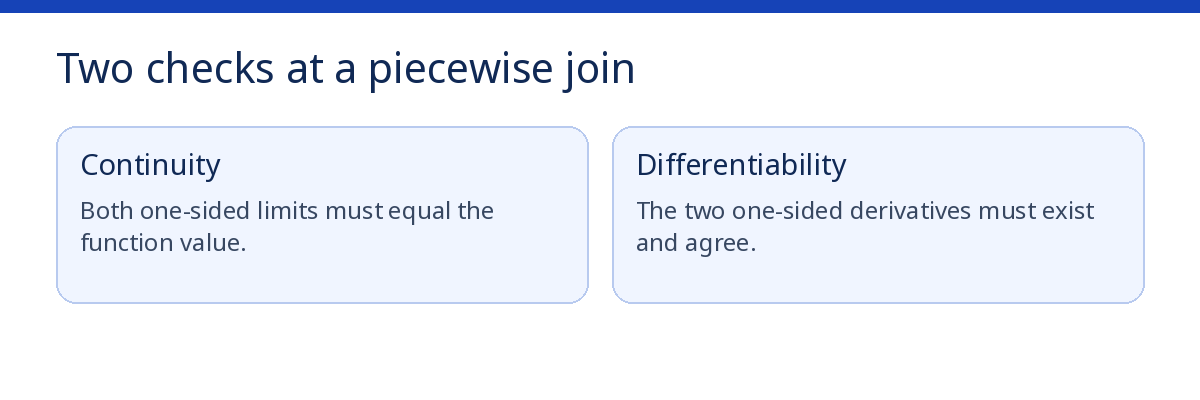
The paper tests both continuity and differentiability. At an interior join of a piecewise function, first compare the two one-sided limits with the actual function value. A function can pass that check and still have unequal one-sided derivatives. A sketch may suggest a corner or a jump, but the relevant limits tell you which condition fails.
Domain checks matter in other differentiation questions too. For a parametric curve, the usual quotient can be used where the derivatives exist and . Cancelling a common factor does not make the original quotient valid where its denominator vanished. For inverse trigonometric expressions, check the principal-value range before cancelling a trigonometric function with its inverse: the result need not be the original angle.
From an integral to an area or a particular solution
The integration questions range from recognising the derivative of a product to setting up a bounded area. When reviewing an indefinite integral, differentiate your proposed antiderivative on the domain of the original integrand. This checks the signs and factors and can reveal a restriction, such as the requirement that a real logarithm have a positive argument.
For an area question, sketch the boundaries before choosing the variable of integration. Vertical slices use upper minus lower; horizontal slices use right minus left. Split the region if those boundaries change across the interval. In a differential equation, an antiderivative is only part of the task: when the question gives an initial condition, use it to fix the arbitrary constant and check that the particular solution satisfies that condition.
Vectors and 3D lines: separate position from direction
The paper moves from scalar projections and angles to equations of lines, perpendicularity, intersection and shortest distance. In the vector equation of a line, the position vector fixes a point on it and the direction vector gives its orientation. Two distinct points supply a direction by subtraction. For perpendicular directions, check that the dot product of the two nonzero direction vectors is zero. That test does not establish that the lines intersect.
For an intersection question, use a separate parameter for each line. The same pair of parameter values must satisfy all three coordinate equations. Agreement in only two coordinates is not enough: the points could still differ in the third.
Quick self-check: what does the model represent?
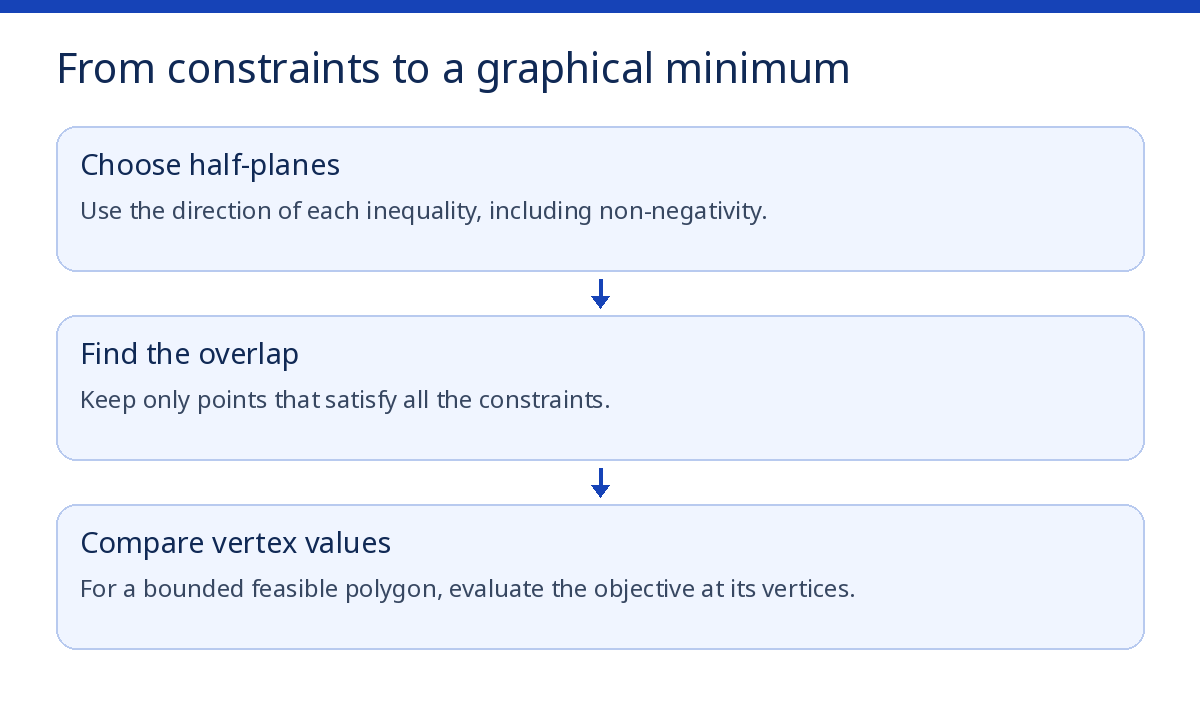
In graphical linear programming, each inequality selects a half-plane. Ask whether your shaded region satisfies all constraints at once, including non-negativity, before comparing objective values. For a bounded feasible polygon, a linear objective attains a minimum at a vertex; evaluating a point that violates even one constraint does not help find the feasible optimum.
In conditional probability, ask which group you are restricting attention to. The attendance-and-grade question gives grade probabilities for attendance groups but asks about group membership after a grade is known. Those are different directions of conditioning. The sales case study makes another distinction: expected income is a probability-weighted average, not the income corresponding to the most likely sales count.
Use the worked solutions to diagnose mistakes
The PDF links question numbers to worked solutions organised around a formula, the concept behind it and the steps. After an independent attempt, compare your first mathematical decision with the worked method, not just your final line. For the sandbag case, for instance, check whether you distinguished vertical height from horizontal shadow distance before comparing any rate calculations. Try the unused OR alternatives afterwards as separate practice, not as part of the timed attempt.
The guide leaves out the direction-cosines item’s answer choice because the wording permits an unlisted sign case. It also leaves out the probability assertion–reason item because a probability-one condition does not by itself settle literal event inclusion without assumptions about zero-probability outcomes.
Spotted an error? Report a correction. Practise this in the app: notes, formula sheets and mind maps.





























































































































































Loading comments…