CBSE Class 12 Mathematics 2025 Paper with Worked Solutions
CBSEMathematics2025 Previous Year Paper
Paper code: 65/6/3 · 2025Use the complete 2025 CBSE Class 12 Mathematics main examination paper (65/6/3) for a three-hour board practice attempt. Then use the worked solutions to check not just your calculations, but also the definitions and conditions that justify each method.
This set is one of the year's papers. See every set from 2025, grouped by series.
What this year-wise file contains
This is the English version of the 2025 CBSE Class 12 Mathematics main examination, paper code 65/6/3. The paper carries 80 marks and allows three hours. It is organised as one complete paper rather than a chapter-wise question bank, so you can practise moving between topics in the order they appear in the exam.
The file preserves the original English question layout, options and diagrams. Its question-number index links to worked solutions for all 38 questions, including both printed internal choices. The worked entries separate the formula, the concept and the explanation in steps. That separation is useful when an answer looks familiar but you are unsure why a particular formula applies. The topics discussed below come from the supplied solution excerpt; they are not a full inventory of the paper.

Mathematics 2025 | Class 12 | Previous Year Paper | Code 65/6/3
In the StudentCurio app
The complete 2025 CBSE Class 12 Mathematics paper (code 65/6/3) with worked solutions, covering questions across the syllabus. It helps students practise the board-paper format and review solution methods.
What matrix definitions let you decide
The matrix questions show why shape and entry conditions are different tests. A matrix is square if its row and column counts match. That alone does not make it diagonal, scalar or skew-symmetric. A diagonal matrix has zero off-diagonal entries, while a scalar matrix must also have equal diagonal entries. Skew-symmetry is a different condition: the transpose must equal the negative of the matrix.
For products involving a transpose, write the dimensions before doing any algebra. Transposing swaps the row and column counts; a product exists only when the first factor's column count equals the second factor's row count. If the question specifies two products in different orders, check each one separately. Being able to form one product does not, by itself, establish that the other is defined.
When domains and branches determine the method
The inverse-trigonometry material makes a useful distinction between recognising an inverse relation in a graph and evaluating a principal value. For inverse secant, the input must satisfy . A trigonometric equation may admit angles on several branches, but the principal-value convention selects the range from which the inverse function returns its value. When comparing or combining inverse-trigonometric expressions, check that range before carrying out the angle arithmetic.
Similar checks matter in differentiation. A substitution involving requires in real-valued work. In implicit differentiation, obtaining a relation between a variable and a derivative is not the same as being free to divide by that variable: if the divisor could be zero, state the restriction before isolating the derivative. As you review, look for the exact line where the condition first matters.
Read calculus solutions for the choice of method
The calculus entries illustrate several different starting points. In a continuity problem, the limiting expression and the function's assigned value at the point play distinct roles: continuity requires the limit to exist and equal that value. For an indefinite integral, recognising the derivative of a familiar expression can be more direct than a longer manipulation. You can check the proposed antiderivative by differentiating it on the relevant interval. If an initial value is supplied, use it to determine the constant of integration.
For a differential equation, order is the order of the highest derivative present. Degree concerns the power of that derivative when the equation is expressed as a polynomial in its derivatives. The excerpt also illustrates separation of variables after rewriting an equation. On review, distinguish the rewrite that makes separation possible from the integration that follows.
A useful connection: regions in calculus and optimisation
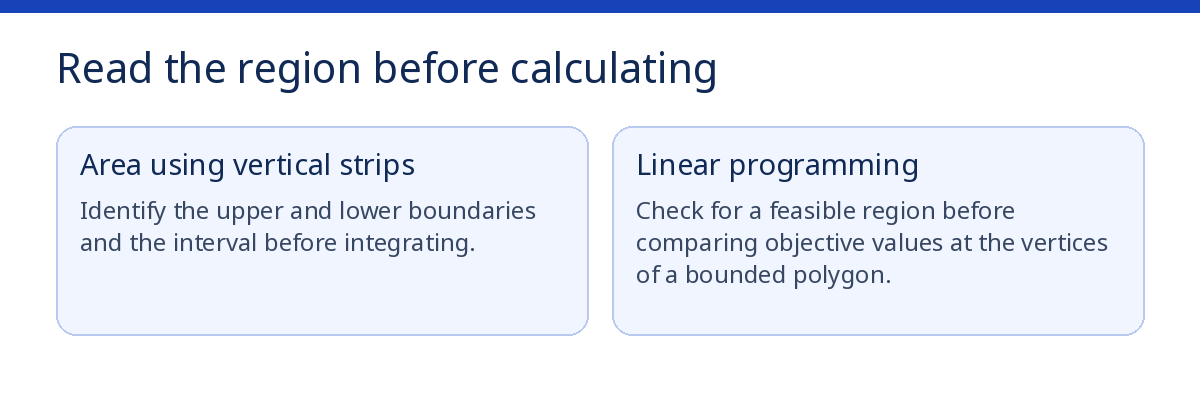
The area and linear programming entries both reward reading the diagram before calculating. For an area found using vertical strips, the integrand is the upper boundary minus the lower boundary on the interval where those boundaries apply. When a curve has two branches, the lower branch need not be the horizontal axis. Identify both boundaries and the interval before setting up the integral.
In linear programming, first ask whether the inequalities have any points in common. If the constraints are incompatible, there is no feasible point at which to optimise the objective. For the bounded polygonal case illustrated by a corner-point comparison, the objective is evaluated at the feasible vertices. Keep the two stages separate: the constraints determine which points are admissible; the objective is used to compare those points.
Common mistakes: assuming a sign or independence
In the vector material, a negative scalar can reverse a nonzero vector's direction, but it cannot make the magnitude negative. The magnitude of a scalar multiple is . When a scalar varies over an interval, consider the absolute value across that interval rather than treating magnitude as a signed expression.
In the attendance probability item, individual attendance probabilities do not by themselves establish the probability that everyone attends. Multiplying all three probabilities directly requires mutual independence; taking the complement of the all-attend event does not. This guide leaves out the printed options and worked results for the vector and attendance items, where the solution notes flag an option mismatch and an independence assumption, respectively.
Use the question index after a timed attempt
Work through the question pages first, without opening the linked solutions. For a timed attempt, use the stated three hours and make your internal choices as you would when sitting the paper. Afterward, revisit the alternative branches of those choices separately so they provide additional practice without changing the conditions of your first attempt.
Use the index to return to questions you skipped, guessed or could not justify. Compare your first substantive step with the worked explanation before checking the final result. If your final answer differs, identify whether the first divergence came from a definition, a missing condition, the setup or the calculation. A useful final check is to write down the condition you would test before using that method again.
Spotted an error? Report a correction. Practise this in the app: notes, formula sheets and mind maps.





























































































































































Loading comments…