CBSE Class 12 Mathematics 2023 Paper 65/3/2 With Solutions
CBSEMathematics2023 Previous Year Paper
Paper code: 65/3/2 · 2023Practise with the full English version of the 2023 CBSE Class 12 Mathematics main examination, paper code 65/3/2. Use the worked solutions after your attempt to check not just your calculations, but also your choice of method and the conditions that make it valid.
This set is one of the year's papers. See every set from 2023, grouped by series.
Know the format before you start
This is a year-wise previous year paper, not a chapter worksheet. It contains 38 questions across five sections, with three hours allowed, a maximum of 80 marks and no calculator use. Section A includes 18 multiple-choice questions and two assertion–reason questions, worth one mark each. Sections B, C and D contain very short, short and long answers worth two, three and five marks per question, respectively. Section E contains three case studies worth four marks each.
There is no overall choice: all question numbers are compulsory, but some questions in Sections B to E offer an internal choice. In a timed attempt, answer one branch where an OR is printed. In review, try the other branch if it tests a method you have not yet practised.

Mathematics 2023 | Class 12 | Previous Year Paper | Code 65/3/2
In the StudentCurio app
Complete CBSE Class 12 Mathematics examination paper code 65/3/2 from 2023, with worked solutions. It covers questions across the syllabus, including calculus, matrices, vectors, three-dimensional geometry, linear programming and probability, for exam practice and review.
Read function questions through their domains
The paper tests inverse trigonometric functions, differentiability at a join between two expressions, and a proof that a function is one-one and onto. These tasks use the domain differently. In an inverse trigonometric graph, the stated input interval determines which part of the principal branch to draw and therefore which outputs belong to the range. In an onto proof, the stated codomain is the set of outputs you must show are attained; it is not automatically the range.
Common mistake: Checking that the pieces of a function meet at a point establishes continuity there, not differentiability. To establish differentiability at an interior join, check that the left-hand and right-hand derivatives at that point exist and agree. When reviewing your attempt, identify which of these checks your written argument actually makes.
Distinguish the jobs that calculus is doing
The paper uses integration to find antiderivatives, evaluate definite integrals and describe a bounded area. An indefinite integral represents a family of antiderivatives on an interval, so it includes an arbitrary constant. For the area question, the key decision comes earlier: use the boundaries and their intersections to decide the limits and which curve lies above the other on each interval if integrating with respect to the horizontal coordinate. A correct antiderivative cannot fix a wrongly described region.
The differential-equation questions ask for different decisions. When identifying order, look for the highest derivative; degree is defined only when the equation can be expressed as a polynomial in its derivatives. When solving by separation, note any expressions you divide by so you can check whether the division excludes a possible solution.
Keep matrix order and vector direction visible
The matrix questions test more than entry-by-entry arithmetic. Matrix products need compatible dimensions, and changing the order can change the result. The transpose of a product reverses the factor order. In the longer question that uses an inverse to solve simultaneous equations, write the coefficient matrix in the same variable order on every row and check that it is invertible before relying on the inverse method.
In vectors and three-dimensional geometry, keep track of which point you start from and which point you reach. Direction cosines are obtained by dividing the components of a nonzero direction vector by its length. To examine whether two lines intersect, distinguish comparing their directions from finding a point that satisfies both line equations. The second check is essential: nonparallel lines in three dimensions need not meet.
Separate feasible points from optima, and events from values
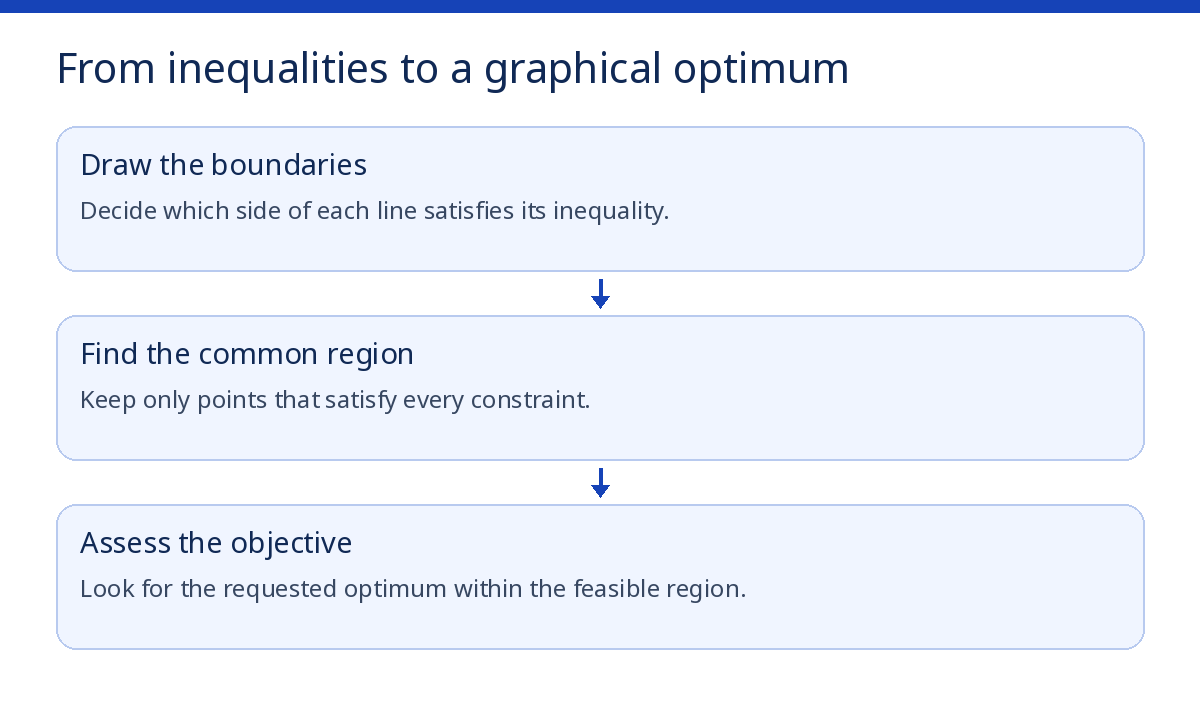
In linear programming, a feasible point satisfies every constraint. A corner point is a particular kind of feasible point, not the only kind. The paper asks you to read constraints from a shaded region as well as solve an optimisation problem graphically. When constructing a region, use each boundary line to identify the allowed side, then take the common region before assessing the objective.
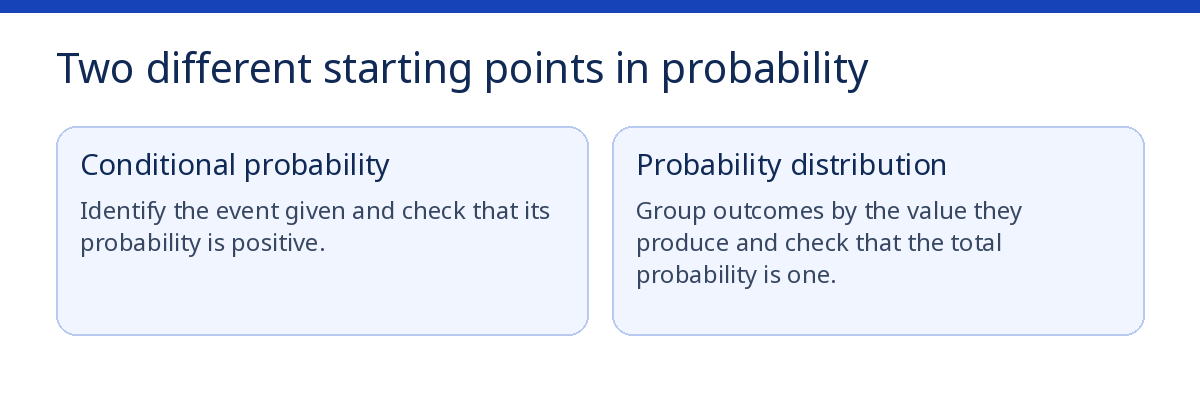
In probability, the paper moves between conditioning on an event and building a distribution for a random variable. In a conditional probability question, name the event given first: its probability is the denominator and must be positive. In a distribution question, list the possible values of the variable, combine outcomes that produce the same value, and check that the assigned probabilities sum to one.
Read each case study as a mathematical model
The final section uses rainwater harvesting, a numbered prism and a volleyball trajectory to test mathematical interpretation. In the tank problem, the fixed capacity links the base dimensions and depth, so identify the independent variable before differentiating a cost expression. In the prism problem, read the supplied probability table rather than assuming the faces are equally likely. In the trajectory problem, use the stated time domain when interpreting continuity or a maximum.
Quick self-check: Before calculating, can you say which variable changes, which quantity or condition is fixed, and what the requested result represents? For a case study with linked subparts, label an intermediate expression clearly so you can reuse it without losing track of what it measures.
Use the worked solutions to diagnose your attempt
The file pairs the question paper with numbered worked solutions organised around the formula, the concept and the steps. Complete an attempt before opening those explanations. Then mark the first point where your reasoning diverges: did you misread the task, choose a rule without checking its conditions, or make a calculation error after a sound setup? That distinction tells you what to practise next.
For assertion–reason questions, check the truth of each statement separately and then ask whether the reason explains the assertion. For a longer response, compare your setup and justification, not just the final line. Exact options and expressions with unclear extracted notation have been left out of this guide; consult the printed layout in the PDF for those details.
Spotted an error? Report a correction. Practise this in the app: notes, formula sheets and mind maps.





























































































































































Loading comments…