CBSE Class 12 Mathematics 2022 Solved Paper: Set 65/5/2
CBSEMathematics2022 Previous Year Paper
Paper code: 65/5/2 · 2022Practise the full 2022 CBSE Class 12 Mathematics Term 2 main examination paper, then use the worked solutions to review how each method is chosen and where its conditions matter.
This set is one of the year's papers. See every set from 2022, grouped by series.
What this year-wise paper contains
This file contains the English version of the CBSE Class 12 Mathematics main examination paper for the 2021–22 session, Term 2. The set code is 65/5/2, the printed duration is two hours, and the maximum is 40 marks. It is a full paper from one examination session, not a chapter-wise collection. The resource preserves the original question layout, options and diagrams.
The worked solutions are organised by question number, with coverage of subparts and both branches wherever an OR choice is printed. Each solution separates the formula, the underlying concept and the explanation in steps. That distinction is useful when you recognise a formula but cannot yet explain why it fits the question.

Mathematics 2022 | Class 12 | Previous Year Paper | Code 65/5/2
In the StudentCurio app
A solved CBSE Class 12 Mathematics Term 2 main examination paper, set 65/5/2, with worked solutions and questions across topics including probability, vectors, integration and three-dimensional geometry. Helps students practise the 2022 exam and review solution methods.
Integration: choose a method from the expression
The integration questions reward looking at the structure before calculating. A quadratic under a square root can be completed to a square to reveal the standard inverse-sine form. When the square root is in the denominator, its radicand must be strictly positive on the real interval being used. Recognising the form is therefore only part of choosing a valid method.
An exponential multiplied by a sine illustrates why integration by parts can be useful even when the first application leaves another integral: the second application brings back the original integral, which you can then isolate. In the rational-integral alternative, a substitution comes before partial fractions. When comparing the solutions, notice which transformation makes the remaining calculation simpler rather than treating the methods as interchangeable.
Definite integrals: decide whether to reflect or split
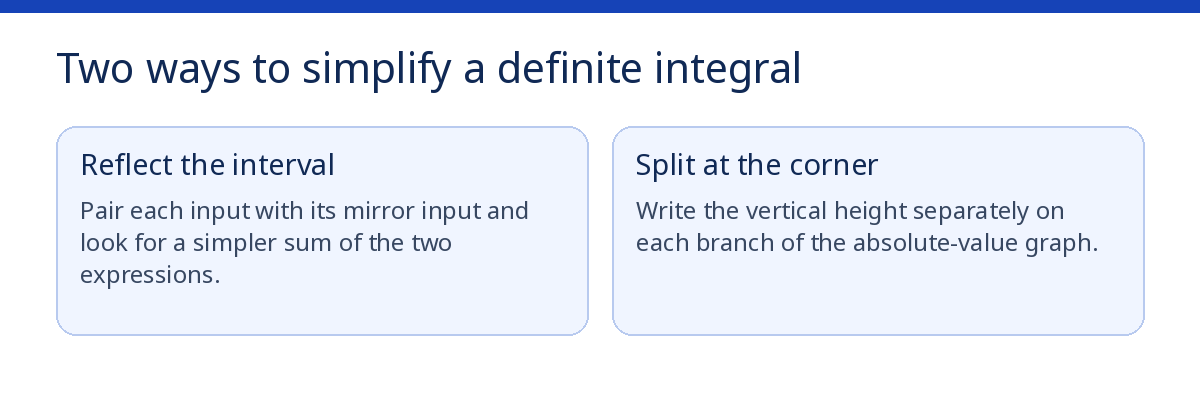
The paper gives two different reasons to transform a definite integral. Reflection pairs a point in the interval with its mirror point, replacing by on . For an integrable function, this leaves the definite integral unchanged. It helps when adding the original and reflected expressions simplifies the integrand, as it does in the complementary-angle question.
For the area bounded by an absolute-value graph and a horizontal line, the useful step is instead to split the interval where the graph changes branch. A sketch helps you identify the outer limits from the intersections and the internal split from the corner. With vertical strips, the height on each piece is the upper boundary minus the lower boundary.
Common mistakes when rewriting differential equations
One differential-equation solution uses the chain rule in reverse: after multiplication by an exponential in the dependent variable, the left-hand side becomes a single derivative. If you subsequently take a real logarithm to make the solution explicit, check that its argument is positive. An implicit relation and its logarithmic form must describe the solution on intervals where the rewrite is valid.
A different question uses an integrating factor after rewriting the equation in linear form. Do not divide by an expression that vanishes on the interval being considered. In the printed alternative, changing the independent variable and introducing a new dependent expression makes a linear equation available. The solution also checks separately a case excluded by division, a step worth comparing with your own working.
Vectors and 3D geometry: distinguish directions from points
For a line parallel to the join of two points, the difference of their position vectors supplies a direction; the point the new line must pass through supplies its position. A plane question makes a related distinction: the two given planes determine a common line, while an additional point selects the required plane from the family through that line.
The cross product serves different purposes across the paper. Its magnitude gives the area of a parallelogram formed by two side vectors; its direction gives a common normal, which can be turned into a unit normal only if the cross product is nonzero. In the line-intersection problem, the shortest-distance formula uses nonparallel directions. A common point of the two paths establishes where a collision is geometrically possible, not whether the riders arrive together.
Probability checks before testing independence
Check that the supplied values can describe events before deciding whether the events are independent. An intersection cannot have a probability greater than either constituent event. In a discrete distribution, the probabilities must be nonnegative and sum to one. These checks serve different purposes: one tests an overlap against its bounds, while the other tests a distribution across its possible values.
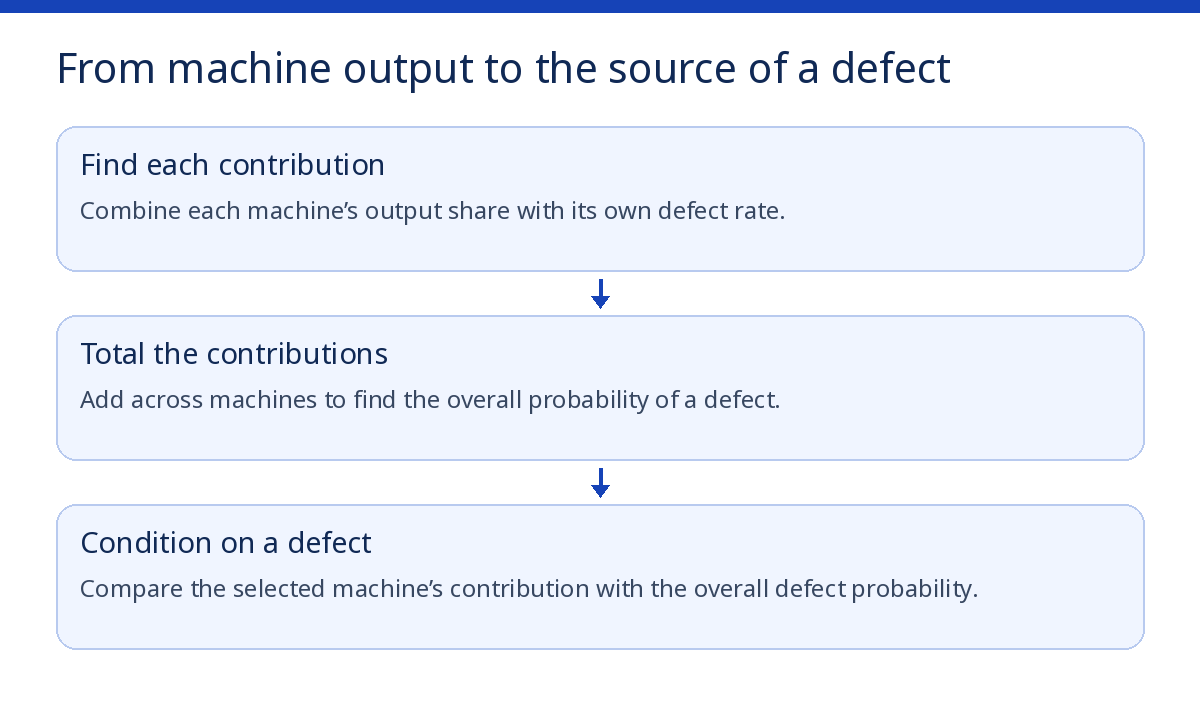
The paper also uses Bayes’ theorem to distinguish the chance of a defect given a machine from the chance that a defective item came from that machine. The second probability uses the overall defect probability, combining contributions from all the machines. This guide omits the worked answer to Q4(a), which the file flags as having inconsistent printed data.
Use the paper for a timed attempt and a method review
For an exam-style attempt, keep the worked pages closed, use the printed time limit and follow the OR choices as presented. During review, go back to the first step where your reasoning differed. If the difficulty was choosing a method, start with the Concept used note. If you chose a suitable method but lost track of a condition or a sign, compare the relevant step with your own working.
After reviewing the timed attempt, try the OR branches you did not select. The two branches of an integration question, for example, can test different techniques, so completing one does not show that you can choose and apply the method required by the other.
Spotted an error? Report a correction. Practise this in the app: notes, formula sheets and mind maps.





























































































































































Loading comments…