Magnetism and Matter: Class 12 NCERT Physics Guide
CBSEPhysicsMagnetism and Matter
This CBSE Class 12 NCERT Physics chapter connects the field of a bar magnet to the behaviour of magnetic materials. Use its diagrams and exercises to distinguish field direction from force, zero net flux from zero field, and magnetisation from magnetic intensity.
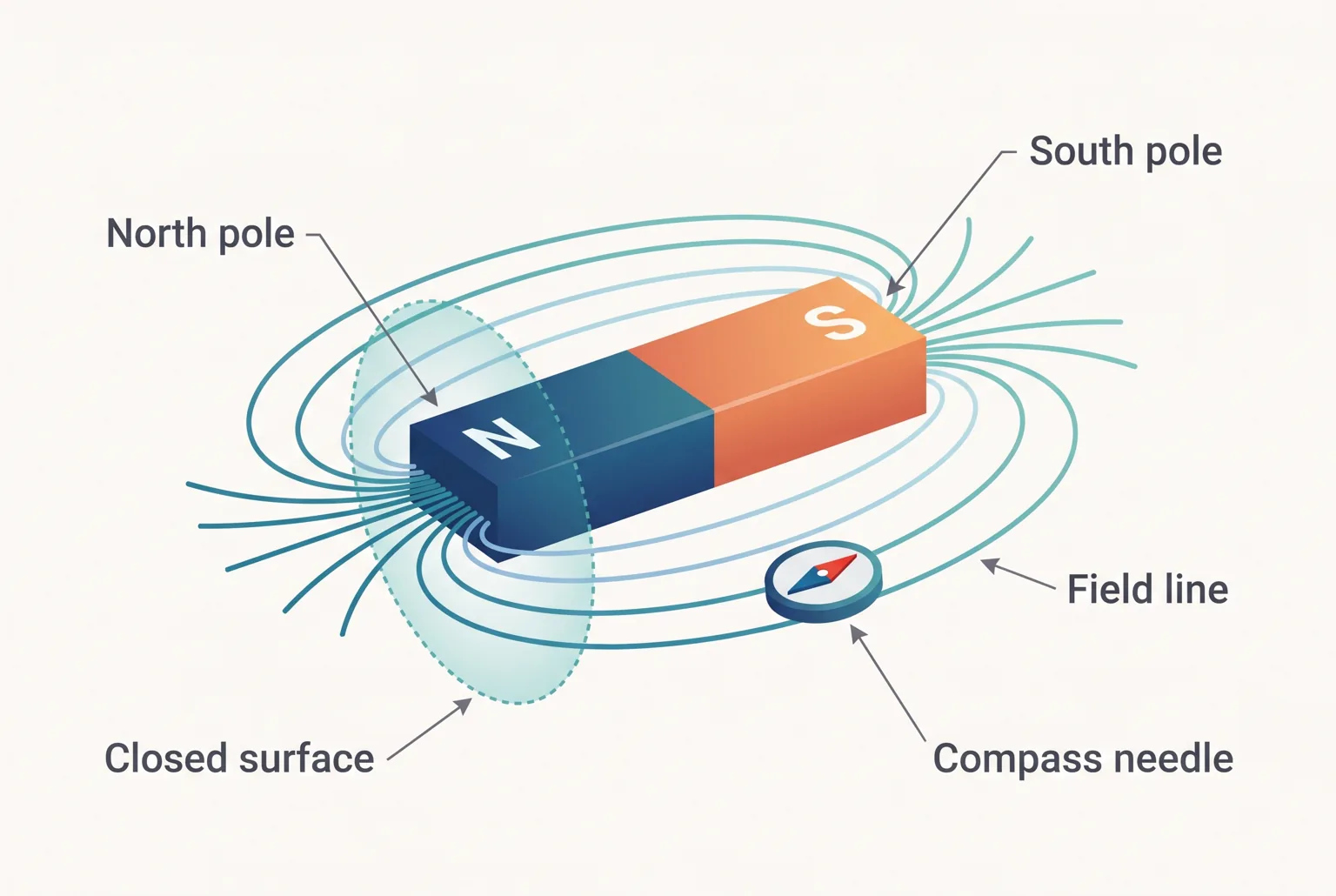
Read a magnetic field diagram
The chapter introduces magnetic poles through a familiar observation: a freely suspended bar magnet points approximately north–south in Earth’s magnetic field. Its north-seeking end is called its north pole. Unlike the opposite charges of an electric dipole, the poles of a bar magnet cannot be separated by cutting it. Each piece is still a magnet with two poles.
Use the iron-filings pattern in Figure 5.1 to recognise the shape of the field, then use Figure 5.2 to read its direction. The tangent to a field line gives the direction of the local magnetic field, and a greater density of lines indicates a stronger field. The lines cannot cross, since a crossing would assign two directions to the field at one point. The arrows show how a small compass aligns, not the direction of magnetic force on a moving charge.

Magnetism and Matter | Class 12 | NCERT Textbook
In the StudentCurio app
This NCERT textbook chapter covers magnetic dipoles, Earth’s magnetism, magnetic field lines, magnetisation and magnetic materials, including dia-, para- and ferromagnetism. It also includes chapter exercises to help Class 12 students understand and practise these concepts.
When a solenoid and a bar magnet have the same field
Figure 5.2 places a bar magnet beside a finite current-carrying solenoid. Their similar field patterns make sense once you recall that a current loop acts as a magnetic dipole. The chapter makes the comparison quantitative using the axial field of the solenoid: far from the source, an equivalent solenoid and a bar magnet with the same magnetic moment have the same dipole field. This does not mean their fields match at every point close to either source.
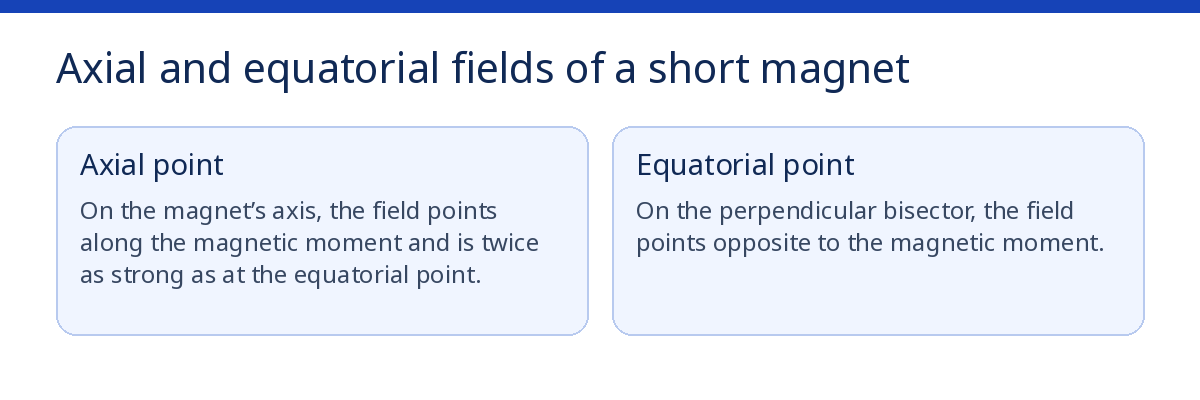
Use Table 5.1 to compare two locations at the same distance from a short magnet. When the distance is much greater than the magnet’s size, both the axial and equatorial field magnitudes fall as . The axial field is twice as strong and points along the magnetic moment; the equatorial field points opposite to it. Check both position and direction before choosing an expression.
Why zero torque does not guarantee stability
A magnetic dipole in a uniform external field can experience a torque even though it experiences no net force. The torque is , with magnitude , where is the angle between the magnetic moment and the field. The no-net-force statement depends on uniformity: when the external field varies across the dipole, a net force is possible.
The energy expression answers a different question. Taking the energy to be zero when the moment is perpendicular to the field gives . Both parallel and antiparallel orientations have zero torque, but the parallel orientation is stable because the energy is a minimum. The antiparallel orientation is unstable because the energy is a maximum. Use the torque to identify equilibrium and the energy to distinguish the two kinds.
Common mistake: zero net flux means zero field
Gauss’s law for magnetism says that the net magnetic flux through any closed surface is zero. It does not say that the magnetic field vanishes on that surface. Flux is a signed sum: where the field points outward it contributes positively, and where the field points inward it contributes negatively. The total cancels, even for a closed surface surrounding just one end of a bar magnet.
Compare the closed surfaces drawn for the magnet, solenoid and electric dipole in Figure 5.2. Magnetic field lines continue through the magnet to form closed loops; a magnetic pole is not an isolated source or sink of field. An electrostatic surface, by contrast, can have nonzero net flux if it encloses a net charge. The word closed matters: the magnetic law does not require zero flux through a single face.
Separate the applied field from the material response
Magnetisation is the net magnetic dipole moment per unit volume. The moments add as vectors, so their directions matter as much as their magnitudes. Magnetic intensity and magnetisation are both measured in , but they describe different quantities. In the chapter’s ideal long-solenoid model, the winding current sets , while describes the core’s response.
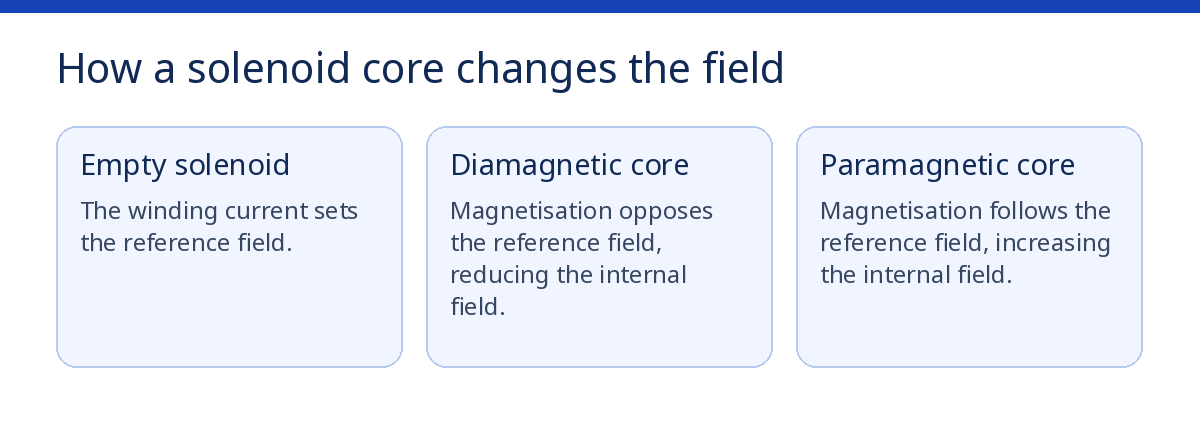
For the empty solenoid, the field magnitude is , where is the number of turns per unit length and is the current. With a core, the chapter writes . Read this as a vector sum, not as an instruction to add magnitudes. At the same current, the internal field increases when the magnetisation points along the empty-solenoid field and decreases for a diamagnetic core, whose magnetisation points against it.
Use susceptibility to compare magnetic materials
For the linear response described in Section 5.4, and . Both susceptibility and relative permeability are dimensionless. A diamagnetic material has a small negative susceptibility and relative permeability below one. A paramagnetic material has a small positive susceptibility and relative permeability above one. The sign of susceptibility therefore tells you whether the induced magnetisation opposes or follows the applied magnetic intensity in this model.
The chapter also covers ferromagnetism. Keep the scope of the equations clear when reading that section: the relation using a constant susceptibility describes a proportional response, not a rule to impose on every magnetic material. When comparing a ferromagnetic core with the empty solenoid, use the direction of its magnetisation to reason about its contribution to the field.
Before the exercises: name the condition you need
For a field sketch, try tracing a complete loop rather than stopping at a labelled pole. For a dipole calculation, decide whether you are finding the field produced by the dipole or the torque on a dipole in an external field. Then identify the relevant condition: large distance for the short-dipole field expressions, uniformity for the no-net-force result, or a closed surface for Gauss’s law.
Use those distinctions to annotate your reasoning when you attempt the chapter exercises. In a materials question, mark the direction of magnetisation before comparing the core-filled field with the empty-solenoid field. This guide omits the disputed field comparison immediately before Eq. (5.9) and the worked solution to Example 5.5.
Spotted an error? Report a correction. Practise this in the app: notes, formula sheets and mind maps.













































































































































































Loading comments…