Laws of Motion: CBSE Class 11 Physics NCERT Notes
CBSEPhysicsLaws of Motion
These CBSE Class 11 Physics notes connect Newton’s laws to momentum, impulse, equilibrium, friction and circular motion. Use them to practise deciding which forces belong in an equation and when a rule applies, rather than just memorising formulas.
How the notes organise the chapter
The chapter checklist gives you the full topic list, while the clickable index separates Newton’s laws from the later treatment of common forces and circular motion. The opening pages use Galileo’s inclined planes to introduce inertia, then move from momentum to the second law and its component form. Later index entries include apparent weight in a lift, particle equilibrium, and the motion of cars on level and banked roads.
Follow that order on a first reading: the road examples make more sense once you can identify a net force and resolve it into components. For revision, use the index to go straight to the distinction you need, such as static versus limiting friction, and use the chapter summary to check what you can recall.

Laws of Motion Class 11 |Physics | NCERT Theory | Revision Notes
In the StudentCurio app
Comprehensive revision notes covering Newton's laws, momentum, impulse, friction, and circular motion. It provides clear explanations and solved examples to help Class 11 students prepare for CBSE and competitive exams.
Galileo’s planes and Newton’s first law
The notes contrast Aristotle’s idea that motion needs a sustaining force with Galileo’s reasoning about resistance. In the ideal two-plane setup, an object rolls down one slope and climbs the other to its starting height. A gentler second slope makes the object travel farther to reach that height. In the ideal horizontal limit, it keeps moving with constant velocity. The point is not that real surfaces behave this way, but that resistance explains why a rolling object ordinarily slows down.
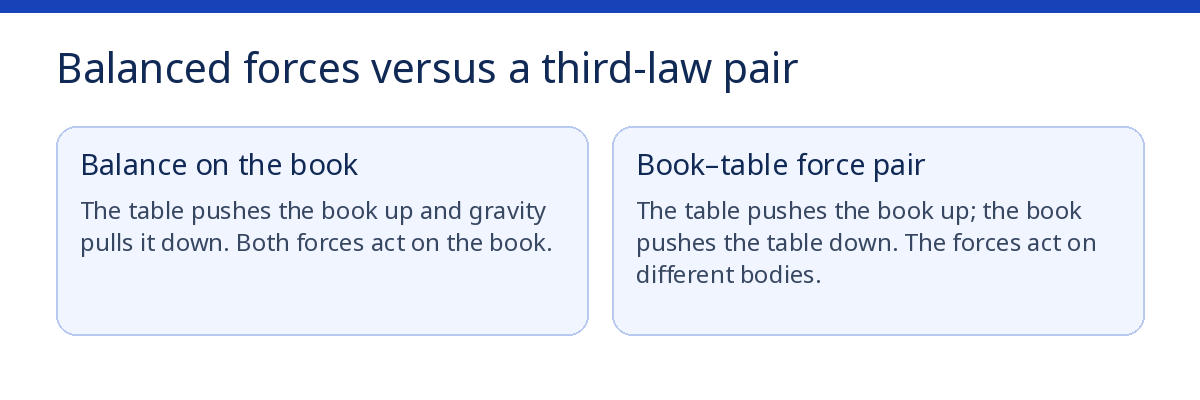
In an inertial frame, Newton’s first law says that zero net external force means zero acceleration. That allows both rest and uniform motion in a straight line. It does not mean that no forces act: for the book resting on a horizontal table in the notes, the upward normal force balances the downward weight.
Momentum, force and impulse describe different things
Momentum is a vector, , measured in . The notes compare what happens when mass, velocity or momentum is held fixed. Read those comparisons with their conditions in mind: at the same speed, a larger mass gives a larger momentum magnitude; at the same mass, a larger speed does the same. Neither comparison tells you the direction unless you know the velocity direction.
The second law links net external force to the rate of change of momentum, . For fixed mass, this becomes . Net impulse, by contrast, is the change in momentum over an interval. For the same momentum change, a longer interval means a smaller magnitude of average net force. Multiplying force by the interval gives impulse directly when that force is constant; for a varying force, use its average over the interval.
Before using the second law, choose your axes
The puck diagram and hint show why the notes introduce the component form of the second law. Choose axes and positive directions, resolve each force, then add the signed components along each axis separately. For a fixed mass, the net component along an axis equals the mass times the acceleration component along that axis. Adding force magnitudes without checking direction does not give the resultant.
Use the puck diagram to practise labelling components before reading any calculation. The supplied excerpt ends just as the solution begins, so the diagram and hint are the usable parts here. The X-ray worked example is omitted from this guide because its calculation assumes a start from rest that the question does not state.
Force pairs, equilibrium and system boundaries
Newton’s third-law forces are equal and opposite, but they act on different bodies. That is why they do not cancel on a force diagram for one body. Compare the book and table: the normal force on the book and the weight of the book balance, but they are not a third-law pair. The partner to the table’s push on the book is the book’s push on the table.
This distinction helps connect two later entries in the notes. Particle equilibrium requires the net force on the particle to be zero. Conservation of total momentum concerns the chosen system: internal interaction forces cancel in pairs when you consider the whole system, and its total momentum stays constant if the net external force is zero. Changing which bodies you include changes which forces count as external.
Friction: check whether the surfaces are sliding
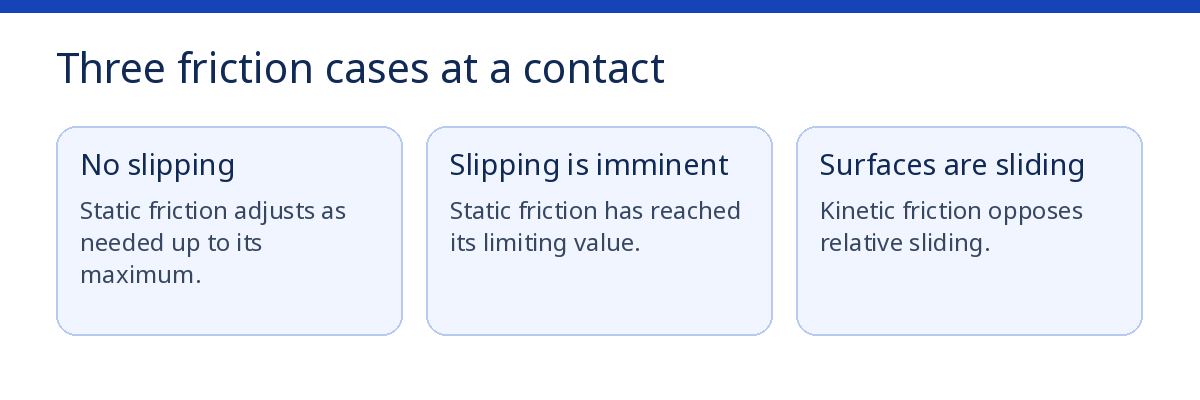
The friction section distinguishes static, limiting and kinetic friction. Static friction opposes the tendency for the surfaces to slip relative to one another. Its magnitude adjusts as needed up to a maximum, so do not substitute just because the surfaces are at rest relative to each other. That equality describes limiting friction, when slipping is impending. Once the surfaces slide, the relevant category is kinetic friction. Making this classification before writing the force equation avoids treating the maximum static friction as if it were always present.
Quick self-check: what makes a car turn?
Uniform circular motion is not uniform velocity: speed stays constant, but the direction of velocity and momentum changes. The net force is therefore directed inward. Centripetal force names the inward resultant required for the turn, not an extra force to add to the diagram. When you reach the level-road and banked-road entries, ask which actual force supplies that inward component on a level road without skidding, and which contact force gains an inward component when the road is banked. Compare your force diagrams before looking at any speed formula.
Spotted an error? Report a correction. Practise this in the app: notes, formula sheets and mind maps.








































Loading comments…