Chemical Bonding and Molecular Structure: JEE Formula Sheet Notes
JEEChemistryChemical Bonding and Molecular Structure
Chemical Bonding and Molecular Structure on the StudentCurio JEE Chemistry Formula Sheet connects lattice energy, Fajans' rules, steric number and hybridisation, bond order and dipole moment. This guide explains what each relation means, when it applies and which printed details need care during revision.
Where Chemical Bonding sits in the Classes 11–12 sheet
The formula sheet covers physical, inorganic and organic chemistry for JEE across Classes 11 and 12. Its chapter index places Chemical Bonding in the inorganic block from page 41, between Periodic Table & Periodicity and Coordination Compounds.
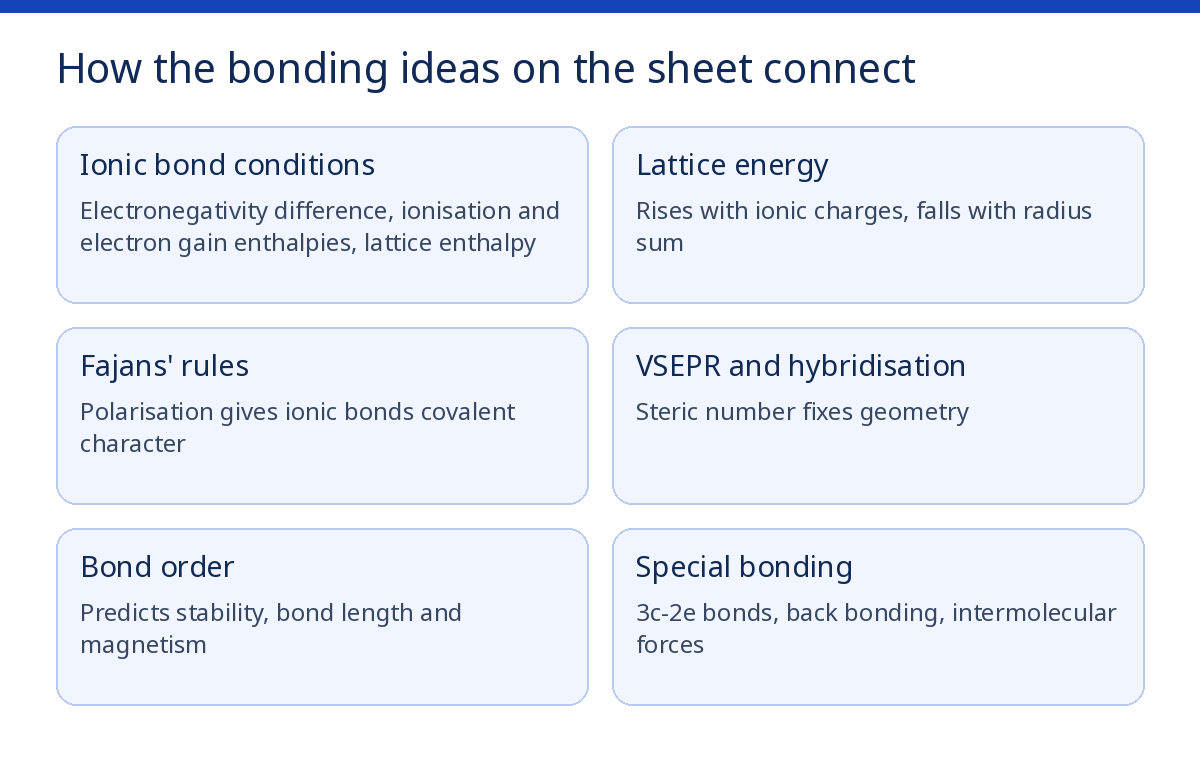
This guide uses only the bonding pages that could be checked: 41, 42, 45, 46 and 48. It does not discuss pages 43, 44 and 47, so study those directly from the file alongside your NCERT Class 11 chapter. The verified pages follow a clear order. They begin with what makes a bond ionic and how ionic bonds gain covalent character. They then show how electron pairs fix shape and how bond order predicts stability, and they end with special bonding and intermolecular forces.

JEE Chemistry Formulae | Formula Sheet
In the StudentCurio app
This formula sheet spans physical, inorganic and organic chemistry, including chemical bonding, periodicity, coordination compounds, p-block chemistry, and organic reactions. It supports JEE students revising key formulas and relationships across Classes 11 and 12.
When an ionic bond forms and what controls lattice energy
Page 41 lists four conditions that favour an ionic bond:
- a large electronegativity difference between the atoms
- a low ionisation enthalpy for the atom forming the cation
- a highly negative electron gain enthalpy for the atom forming the anion
- a high lattice enthalpy for the solid
Read these conditions as one energy balance, not four separate facts. Making ions costs energy at the ionisation step, and the lattice enthalpy released when the solid forms helps make the overall process favourable.
The sheet gives two proportionalities for lattice energy: and . Smaller ions sit closer together, so they give a larger lattice energy. Higher ionic charges also raise it. When you compare two salts, apply both factors together. If the charges are equal, the radius sum decides.
The Born–Haber cycle is described as a thermochemical cycle based on Hess's law. The enthalpy change for forming an ionic solid from its elements equals the sum of the enthalpies of the individual steps around the cycle.
Fajans' rules and covalent character in ionic compounds
Page 42 explains covalent character in ionic compounds through polarisation. A cation distorts the electron cloud of a nearby anion, and the greater this distortion, the more covalent character the bond has. According to Fajans' rules on the sheet, polarisation increases with:
- a smaller cation
- a larger anion
- a higher charge on the cation or the anion
- a pseudo inert gas configuration of the cation
The size rules point in opposite directions for the two ions. A small cation polarises strongly, while a large anion is easier to polarise. Many comparison questions depend on applying the correct direction to each ion.
From steric number to hybridisation and VSEPR shape
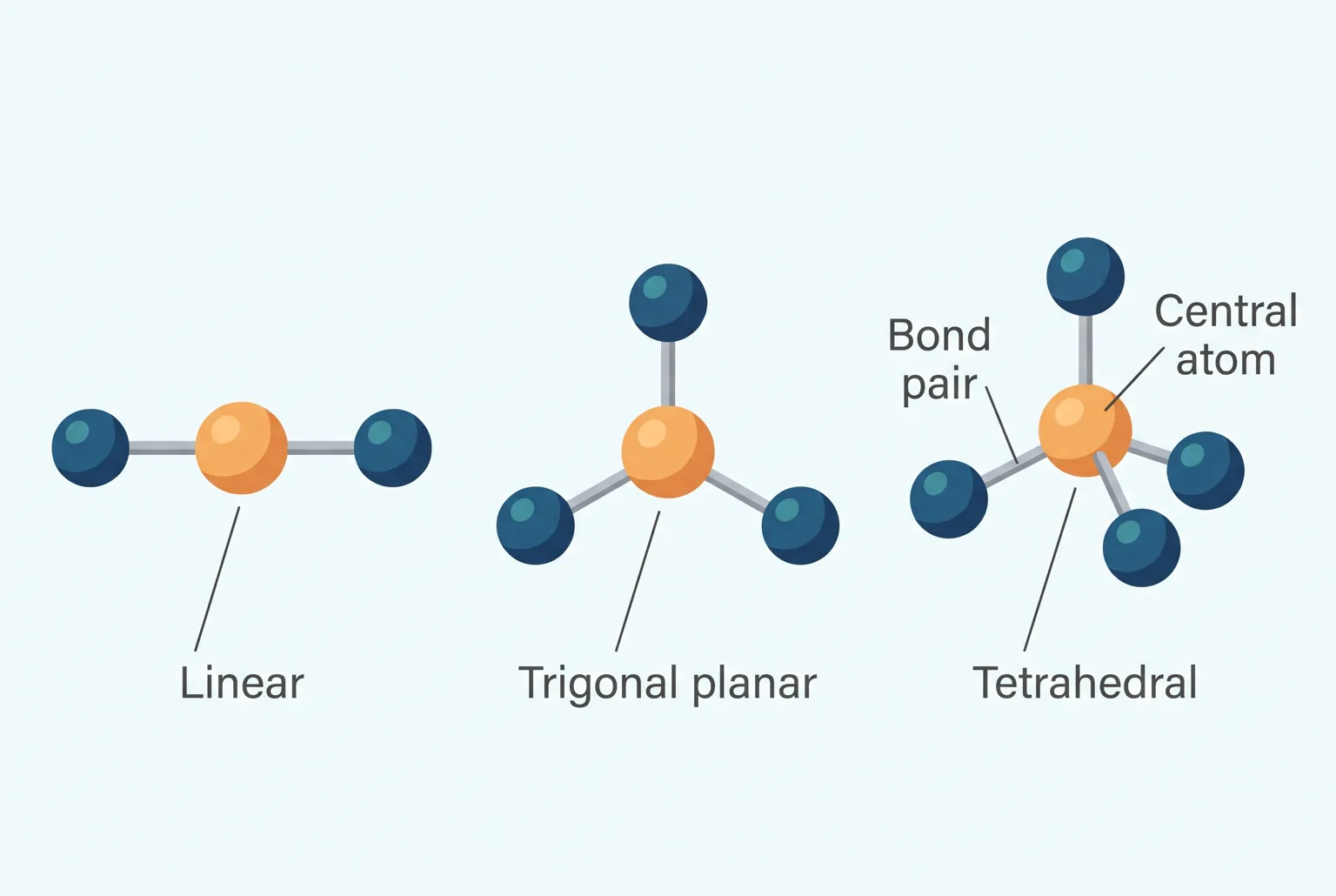
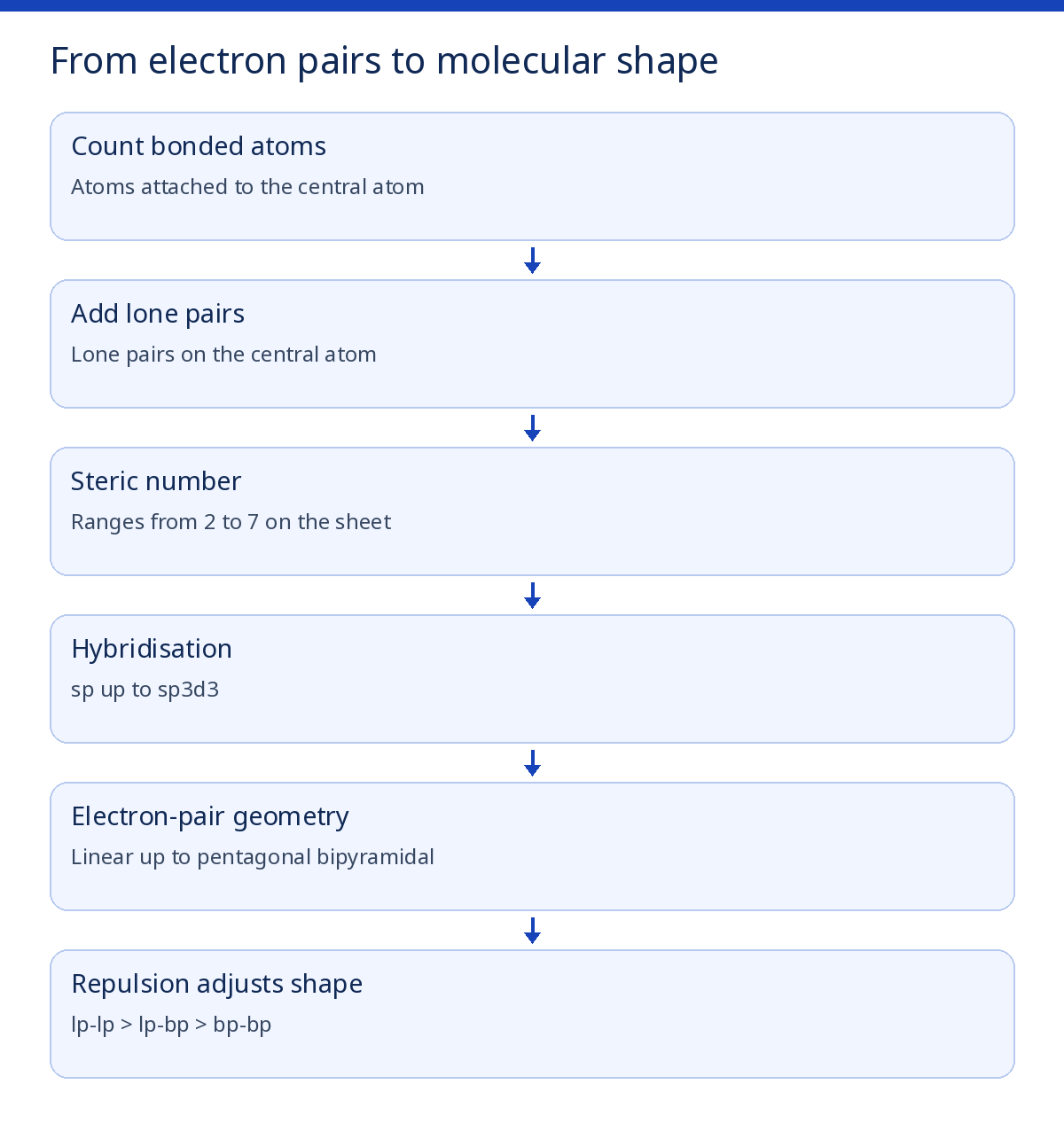
Page 45 defines steric number as the number of atoms bonded to the central atom plus the lone pairs on that atom. This one count gives the hybridisation and the electron-pair geometry:
- 2: , linear
- 3: , trigonal planar
- 4: , tetrahedral
- 5: , trigonal bipyramidal
- 6: , octahedral
- 7: , pentagonal bipyramidal
The sheet also names the d orbitals used in each case:
- uses
- uses and
- uses , and
- uses
Lone pairs then refine the shape. The VSEPR repulsion order is lone pair–lone pair > lone pair–bond pair > bond pair–bond pair. Lone pairs therefore occupy positions that keep them farthest from other pairs, and bond pairs are pushed closer together.
Bond order as a test of stability and bond length
Page 46 gives bond order . Here is the number of electrons in bonding molecular orbitals and is the number in antibonding orbitals. A positive bond order indicates a stable species. A bond order of zero or less indicates an unstable one. Among related species, bond length decreases as bond order increases.
The same orbital filling also decides magnetic behaviour. A species with all electrons paired is diamagnetic, and the sheet gives N₂ as an example.
Good to remember: bond order is only as reliable as your electron counts. The orbital filling order you use must suit the molecule you are working on.
Dipole moment and its unit conversions
Page 46 defines dipole moment as : the magnitude of the separated charge multiplied by the distance between the charges. The sheet links three units: .
Put charge and distance in the same unit system before you multiply. Mixing coulombs with centimetres gives a number that matches none of these units.
Three-centre bonds, back bonding and intermolecular forces
Page 48 covers bonding that does not fit the simple picture of two electrons shared between two atoms. In three-centre two-electron (3c–2e) bonds, one electron pair holds three atoms together. The sheet lists them in B₂H₆, Al₂(CH₃)₆ and solid BeH₂.
Back bonding increases bond strength and decreases bond length. Its extent follows the order BF₃ > BCl₃ > BBr₃, falling down the halogen group. Learn this order exactly as printed.
The same page lists the types of intermolecular forces:
- ion–dipole
- dipole–dipole
- ion–induced dipole
- dipole–induced dipole
- London dispersion
It also notes that HF molecules associate into zig-zag chains.
Quick self-check: Which of these forces needs a permanent dipole on both partners? Which can act between molecules that have no permanent dipole at all?
Common slips with steric number, Fajans' trends and MO ordering
- Counting only bonded atoms. Steric number also includes the lone pairs on the central atom.
- Reversing a Fajans' trend. More covalent character comes from a small cation and a large anion, not the other way round.
- Dropping a lattice-energy factor. Both the radius sum and the charge product affect lattice energy.
- Trusting the page 46 MO energy order for O₂ and F₂. That printed sequence matches the order used for lighter diatomics such as N₂. Check the O₂/F₂ order against your NCERT textbook before using it for bond order or magnetism. This guide does not rely on that passage.
Frequently asked questions
Which bonding pages of the formula sheet does this guide cover?
It covers pages 41, 42, 45, 46 and 48: ionic bonding and lattice energy, Fajans' rules, steric number and hybridisation, bond order and dipole moment, and 3c–2e bonds, back bonding and intermolecular forces. Pages 43, 44 and 47 are not discussed.
Why does this guide not use the sheet's MO energy diagram for O₂ and F₂?
The order printed on page 46 for O₂ and F₂ matches the order used for lighter diatomics such as N₂. Check it against NCERT before you use it.
Spotted an error? Report a correction. Practise this in the app: notes, formula sheets and mind maps.


































































Loading comments…