Electromagnetic Waves: CBSE Class 12 PYQs and Solutions
CBSEPhysicsElectromagnetic Waves
This guide explains the ideas behind the solved CBSE Class 12 previous year questions on Electromagnetic Waves (NCERT Chapter 8): wave equations, E–B–propagation links, displacement current and the spectrum. It also shows how the MCQ, assertion-reason and subjective questions are framed and suggests an order for practising them.
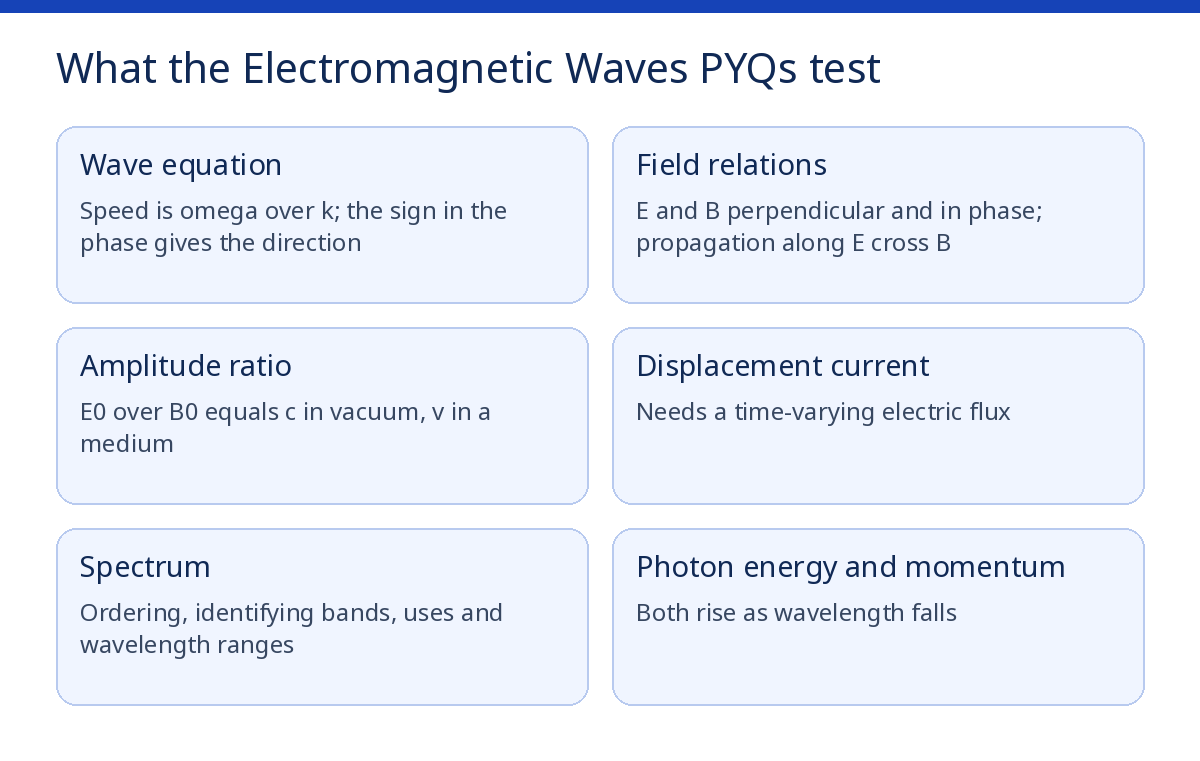
Seven tested areas and where the weight falls
The collection prints 96 previous year questions with exam-year coverage of 2022–2026. They are kept in the original source order, with the original question numbers and set labels. A topic index sorts them into seven groups:
- Electromagnetic spectrum and applications: 41 questions
- Mixed electromagnetic-wave PYQs: 15
- Electric and magnetic field relations: 12
- Wave properties and propagation: 11
- Displacement current and Maxwell equations: 10
- Generation and transverse nature: 4
- Energy, intensity and momentum: 3
The spectrum accounts for over 40% of the questions, so recalling bands, ranges and uses carries a lot of weight. Wave equations and field relations form a second, more numerical cluster.

Electromagnetic Waves | Class 12 | Previous Year Paper
In the StudentCurio app
A comprehensive 72-page collection of solved previous year questions from CBSE Class 12 Physics exams, covering displacement current, EM wave properties, and the electromagnetic spectrum.
Reading a wave equation for speed and direction
Many MCQs give a field such as and ask for the speed, the direction or a missing constant. In this form, the coefficient of is the angular frequency and the coefficient of is the wave number . The speed follows from these two:
The relative sign fixes the direction. A phase describes a wave moving along , while describes one moving along . The space variable inside the sine names the axis of propagation.
Two variations recur:
- Free space. Several equations are listed and you must pick the one travelling in free space. Check which ratio equals m s.
- A medium. The wave travels in glass of refractive index , where . You work backwards from this speed to an unknown .
A related type lists field expressions for different regions and asks where a wave exists. A travelling wave needs space and time combined in one phase, such as . A pattern that depends on position alone does not travel.
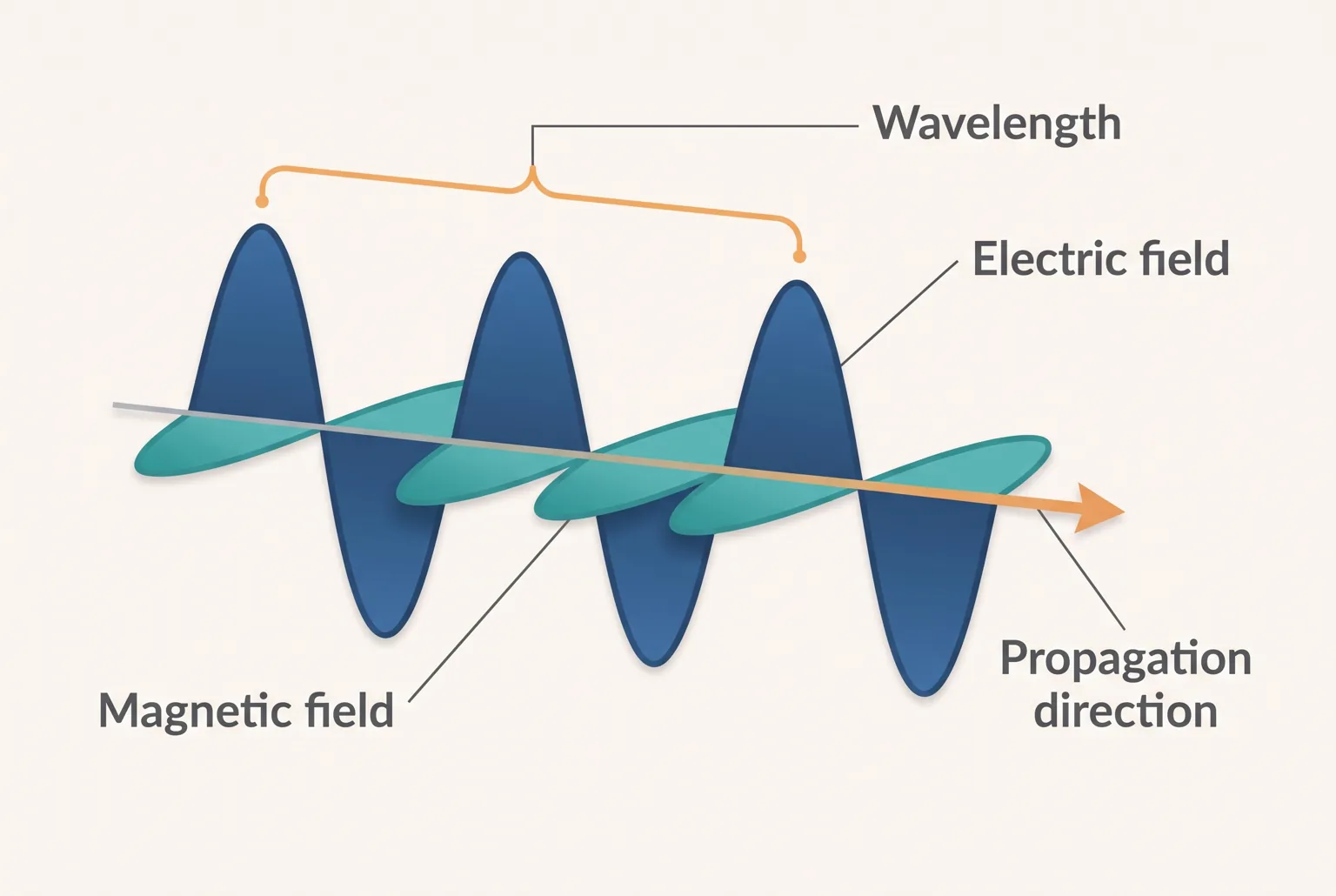
How E, B and the propagation direction are linked
Field-relations questions test three properties of a plane electromagnetic wave:
- Perpendicularity. and are perpendicular to each other and to the direction of travel. This is why EM waves are transverse.
- Phase. In a plane wave, the two fields oscillate together and reach their maxima at the same place and time.
- Direction. The wave travels along . Given two of the three directions, the cross-product order gives the third, including its sign.
The amplitudes are linked by
The ratio has units of speed, m s. Questions give one amplitude, in V m or in tesla, and ask for the other.
The subjective section goes further. It asks you to sketch and against the propagation direction and state their characteristics. It also asks you to show that gives the speed of the wave in free space.
When displacement current appears
Maxwell's correction to Ampère's law adds a displacement current. It arises from a changing electric flux, not from moving charges:
For a parallel plate capacitor with plate area and a uniform field between the plates, . This gives . A typical numerical supplies the plate area and the rate of change of the field.
The conceptual versions test the condition behind the formula. A displacement current exists only where the electric field changes with time. If the field is constant, or varies only in space, then and there is no displacement current.
Charging-capacitor questions ask what kind of current exists between the plates. To reason it out, ask whether charges actually cross the gap, and what keeps the current continuous around the circuit.
The small generation group asks which motion of a charge radiates EM waves. It also asks who first produced EM waves in the laboratory in particular wavelength ranges.
Spectrum questions: order, ranges and applications
The largest group repeats a few patterns with small changes in wording:
- Ordering. Arrange bands by frequency or wavelength, or pick the highest-frequency or shortest-wavelength option.
- Identification. Name the band for a given frequency, such as Hz, or a given wavelength, such as 10 nm.
- Uses. Water purification, welders' eye protection, "heat waves", radar, Earth's warmth and medical diagnosis recur across years.
- Trends. Describe how speed, wavelength and frequency change across the spectrum, or explain why one radiation is more harmful than another.
All bands travel at in vacuum, so means wavelength falls as frequency rises. Photon energy and momentum both increase towards shorter wavelengths. This underlies the energy–wavelength graph and photon-momentum questions.
The 3-mark subjective questions ask you to name the waves for three listed uses and write each wavelength range. A name without its range is incomplete.
Common mistakes these questions are built around
- Assuming frequency changes in a medium. When a wave enters a medium, its frequency stays the same. Its speed and wavelength change, following .
- Using inside glass. In a medium, equals the speed in that medium, not .
- Reversing the cross product. Propagation is along , not .
- Mixing up the constant. Displacement current uses , not .
- Rushing assertion-reason items. Check each statement on its own first. Then decide whether the reason actually explains the assertion, because a true reason can still be the wrong explanation.
Practising MCQs, assertion-reason and subjective answers
The questions are split into MCQ (Single Correct Answer), which includes the assertion-reason items, and Subjective questions. The solutions sit in separate sections, and in-PDF links connect each question to its solution. A source review notes section closes the file.
A practical order:
- Start with the field-relations and wave-property MCQs, which rely on the same few formulas.
- Move on to the displacement-current numericals.
- Do the spectrum questions in one sitting. The repeated application questions will show whether you have really memorised the bands and their uses.
- Attempt the subjective questions last, writing them out in full. This means the sketches, the derivation and the wavelength ranges.
After each attempt, compare your answer with the solution and note any step you skipped.
Quick self-check:
- Why does identify a free-space wave?
- Why does a static field produce no displacement current?
Frequently asked questions
How many questions does this Electromagnetic Waves collection contain?
It prints 96 previous year questions with exam-year coverage of 2022–2026. A topic index groups them into seven sub-topics.
Which question formats are included?
Single-correct MCQs, including assertion-reason items, and subjective questions, some of them labelled 3 marks. All come with worked solutions.
Which topic has the most questions?
Electromagnetic spectrum and applications, with 41 of the 96 questions.
Spotted an error? Report a correction. Practise this in the app: notes, formula sheets and mind maps.













































































































































































Loading comments…