Electromagnetic Induction: Class 12 NCERT Solutions
CBSEPhysicsElectromagnetic Induction
This CBSE Class 12 Physics solutions file covers NCERT Chapter 6, Electromagnetic Induction. Use the worked steps to connect changes in magnetic flux with induced emf, predict current direction, and distinguish motional emf from self- and mutual induction.
What the Chapter 6 solutions cover
The file is organised around NCERT exercises 6.1–6.10, with an exercise index and links between questions and solutions. The early exercises use diagrams to ask for current directions. Later questions involve a solenoid, a loop leaving a magnetic field, a rotating rod and coil, conductors moving through Earth’s magnetic field, and circuits with self- or mutual inductance.
These setups test different decisions, even when they involve the same law. In a direction question, you need a reference view of the loop. In a numerical question, you may first need to choose the relevant field component or decide whether the question asks for an emf, a current, or a change in flux linkage.

Electromagnetic Induction | Class 12 | NCERT Solutions
In the StudentCurio app
Step-by-step NCERT solutions cover Faraday’s and Lenz’s laws, induced current, motional EMF in moving conductors and loops, and self- and mutual inductance. Helpful for Class 12 students practising electromagnetic induction problems.
Read Faraday’s law through the flux graph
The opening flux–time graph illustrates the central idea: for one turn, the magnitude of induced emf is the absolute value of the graph’s slope. A straight segment has a constant slope, so the magnitude of the average emf over that segment equals the instantaneous magnitude there. On a curved graph, the slope of the tangent gives the instantaneous rate; the change in flux divided by the elapsed time gives the average rate over the interval.
For a flat loop in a uniform field, the flux is , where the angle is measured from the normal to the loop, not from its plane. A change in field strength, enclosed area, or orientation can therefore induce an emf. The solenoid and changing-shape exercises are useful to compare: one changes the field through a fixed loop, while the other changes the area in a steady field.
Common mistake: opposing the field instead of the change
Lenz’s law says that the magnetic effect of the induced current opposes the change in flux. It does not say that the induced field always points against the original field. If flux in a particular direction is increasing, the induced field acts against that increase. If flux in that direction is decreasing, the induced field acts to sustain it.
For the diagram exercises, identify the original flux direction and whether that flux is increasing or decreasing before applying the right-hand rule. State which side you are viewing the loop from: what looks clockwise from one face looks anticlockwise from the other. Also check whether the field passes through the loop at all. A changing field that stays parallel to the loop’s plane contributes no flux through it.
When the motional emf shortcut applies
For a straight conductor moving uniformly in a uniform magnetic field, applies when the field, velocity and conductor are mutually perpendicular. If the alignment differs, check the component of along the conductor rather than automatically inserting the full field strength. That is the distinction to look for when comparing the falling wire and aircraft questions.
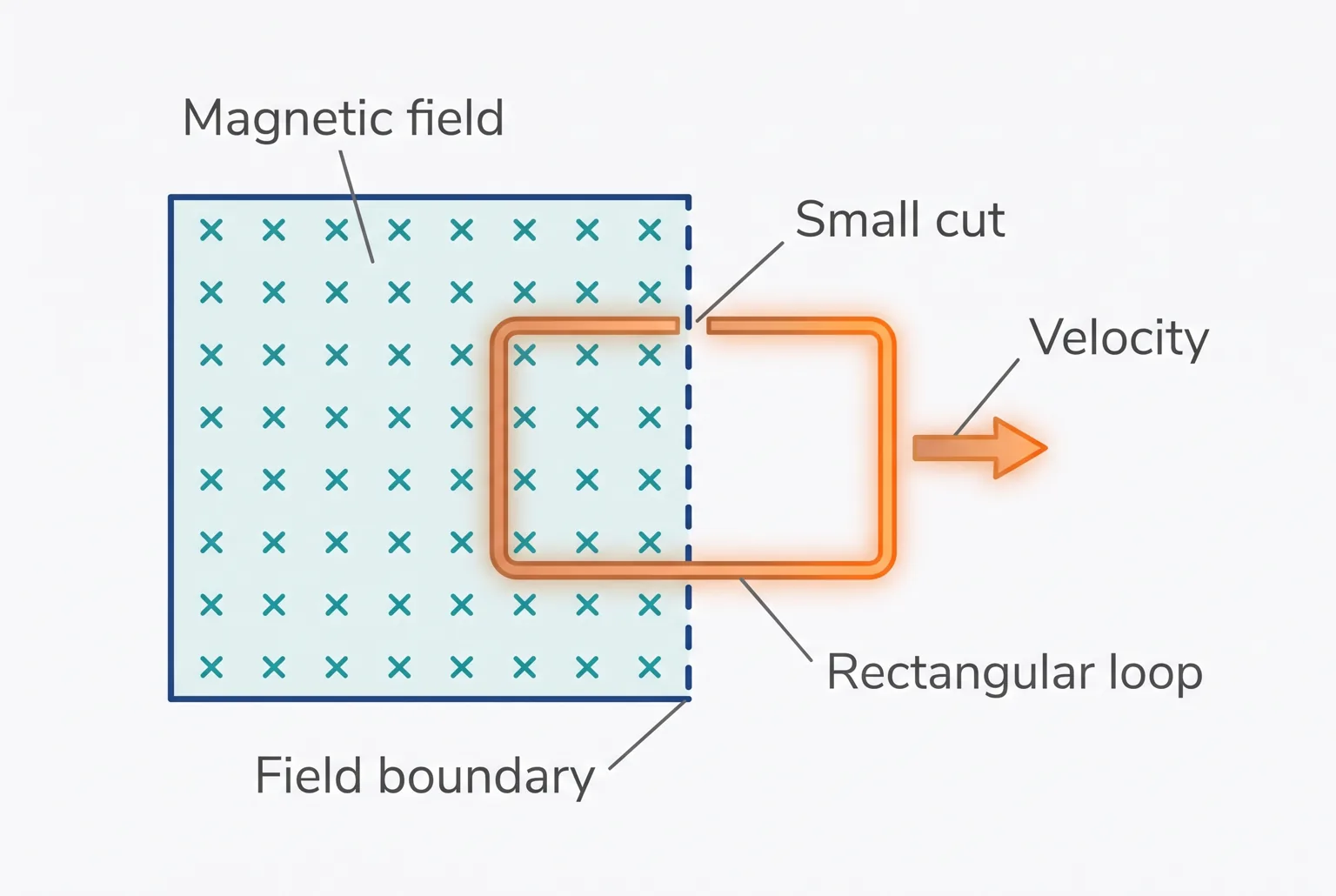
In the rectangular-loop exercise, the small cut lets the question ask for a voltage without requiring a circulating current. While the loop crosses the field boundary, the side parallel to the boundary sets the rate at which the area inside the field changes. The dimension along the motion instead sets the distance over which the loop crosses. Distinguishing these two lengths helps you check the emf and its duration separately.
Why the rotating rod and rotating coil differ
In the rotating rod, points farther from the axis move faster. Using the tip speed for the whole rod would therefore misrepresent the motion. The solution uses the average speed along the rod because speed increases linearly with distance from the axis and the field is uniform and parallel to that axis.
The rotating coil is a different setup: its orientation changes the magnetic flux through each turn. Read the question carefully when it switches between peak emf, signed average emf, and average heating power. A signed average can include cancellation between opposite polarities, whereas resistive heating depends on the square of the current. The solution’s discussion of the external drive connects the electrical energy dissipated as heat with the mechanical work needed to maintain rotation.
Self-inductance and mutual inductance
Self-inductance relates the emf in a circuit to the rate of change of its own current. With constant inductance, the average emf over an interval depends on the current change divided by that interval. Keep the sign of the current change when reasoning about polarity, but use its magnitude if you are finding the inductance from an emf magnitude.
Mutual inductance relates a change in one coil’s current to a change in flux linkage with another coil. Flux linkage includes the turns of the receiving coil; it is not just the flux through one turn. For constant mutual inductance, the change in linkage depends on the current change, while the induced emf depends on how quickly that change occurs.
Quick self-check before opening a solution
Use the question-to-solution links to compare your setup before comparing your arithmetic. For a direction problem, can you state what changes the flux and which face you are viewing? For a numerical problem, can you explain why you chose a particular field component, length, or time interval?
Check conversions where they enter the calculation. A solenoid’s turns per centimetre describe a quantity per unit length, while a loop’s area in square centimetres requires squaring the length conversion. Checking those two steps separately helps you tell a unit error from a mistake in the induction law.
Spotted an error? Report a correction. Practise this in the app: notes, formula sheets and mind maps.













































































































































































Loading comments…