Dual Nature of Radiation and Matter: CBSE Class 12 PYQs and Solutions
CBSEPhysicsDual Nature of Matter and Radiation
CBSE Class 12 Physics board questions on Dual Nature of Radiation and Matter test Einstein's photoelectric equation, threshold frequency, stopping potential, photon energy and momentum, and de Broglie wavelength. This guide explains each idea and shows how this 147-question collection, labelled 2022–2026, frames them as MCQs, assertion-reason and subjective items.
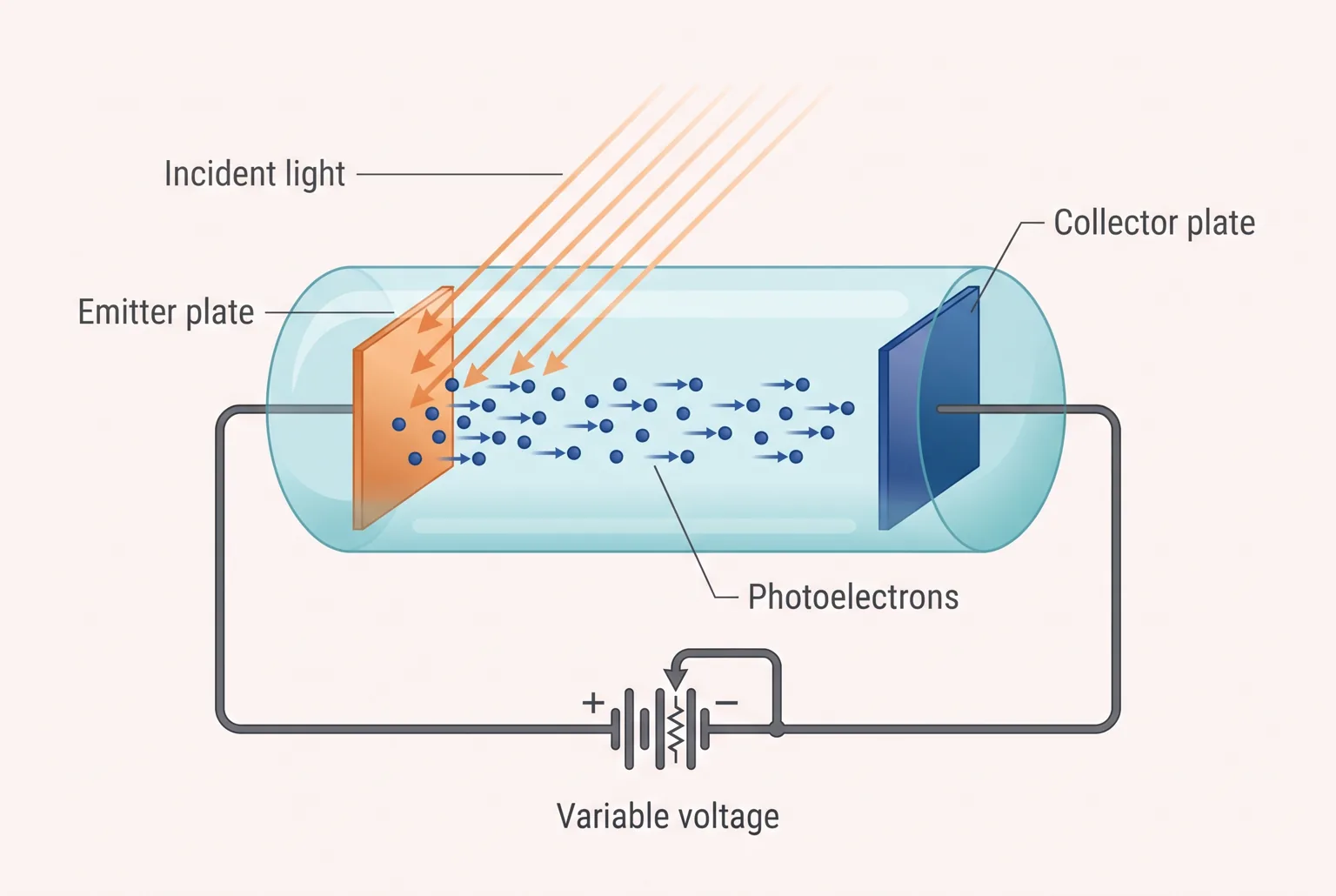
Einstein's photoelectric equation and the threshold condition
Most questions in this chapter start from one energy balance. A photon of frequency carries energy . An electron that absorbs it must first spend the work function to leave the surface. The fastest photoelectrons therefore have
Emission happens only when . The lowest frequency that allows emission is the threshold frequency . Equivalently, there is a cut-off wavelength above which no electrons are emitted, however bright the light is.
The PYQs test this in several ways. You may get a wavelength and a work function in eV and be asked for the energy of the fastest electrons. You may need to decide which metals in a table of work functions emit under a given radiation, or which colour of visible light cannot eject electrons from a metal.
In each case, find in electron-volts using . Then compare it directly with .

Dual Nature of Matter and Radiation | Class 12 | Previous Year Paper
In the StudentCurio app
A comprehensive 108-page collection of solved previous year questions (PYQs) for CBSE Class 12 Physics, covering the photoelectric effect, Einstein's equation, and de Broglie matter waves with detailed solutions.
What intensity changes and what frequency changes
A large group of questions turns on one distinction: intensity and frequency control different things.
At a fixed frequency above threshold, raising the intensity sends more photons per second onto the surface. More electrons are emitted each second, so the photocurrent and saturation current rise. Each photon still carries the same , so and the stopping potential stay the same.
Raising the frequency, which means shortening the wavelength, increases . Since , the stopping potential (the cut-off potential) increases too.
The photon picture also explains why emission is effectively instantaneous. One photon delivers its energy to one electron at once, whereas a wave picture would need energy to build up gradually.
The questions probe this from several angles. Examples include halving the intensity at constant frequency, changing the wavelength at constant intensity, and ranking stopping potentials for UV and visible wavelengths. Always ask first which quantity actually changed.
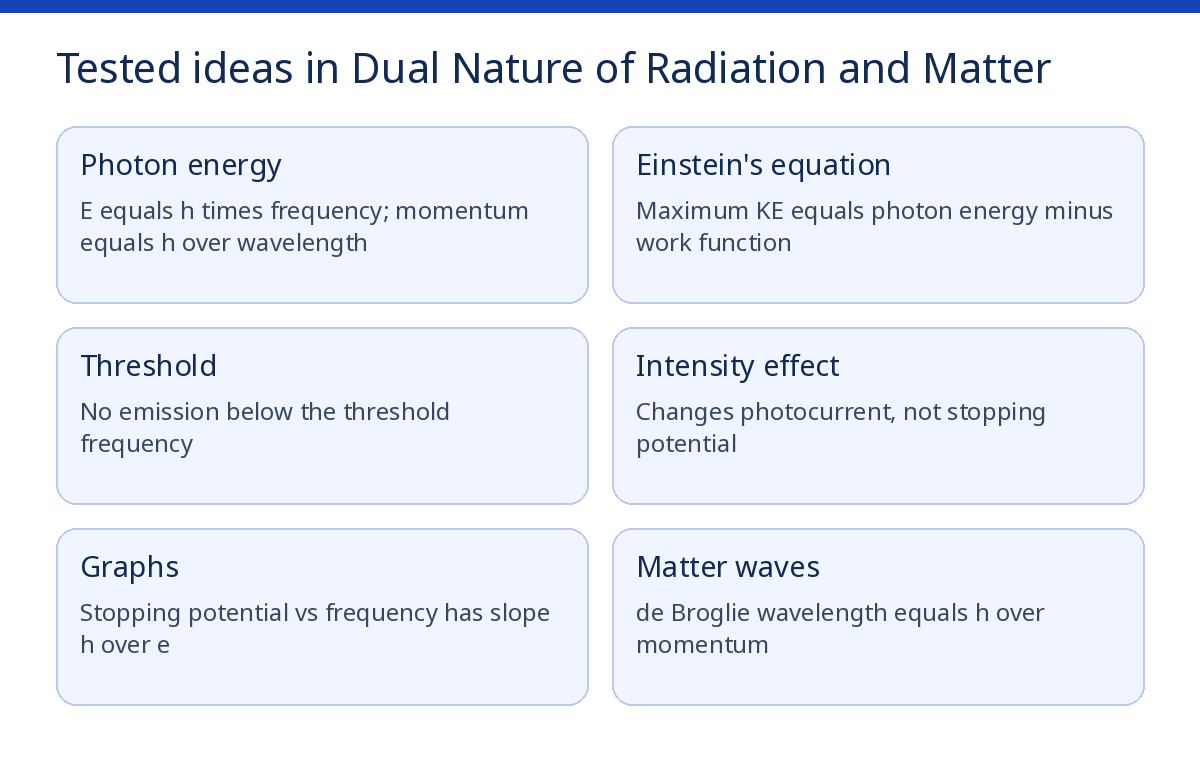
Reading stopping-potential and $K_{max}$ graphs
The topic index has a separate group for photoelectric graphs and experimental observations. To read these graphs, write Einstein's equation as a straight line:
Three facts follow.
- The slope of a – graph is .
- The slope of a – graph is . This is the same for every metal, so lines for different metals are parallel.
- Each line meets the frequency axis at that metal's threshold frequency, and a larger intercept means a larger work function.
At a common frequency, the metal with the smallest threshold gives the largest .
Common mistake: drawing the – line through the origin. The correct line starts at and does not extend below threshold.
Photon energy, momentum and counting photons
The photons, energy and momentum group uses these relations:
A source of power at frequency emits photons per second.
These relations explain the comparisons the board sets. Blue light has a shorter wavelength than red, so each blue photon carries more energy. For two beams of equal intensity, the beam with less energy per photon must deliver more photons.
Other items ask for a photon's momentum, its "equivalent mass", or the momentum transferred when it reflects from a surface. Keep SI units throughout, and convert nm or cm wavelengths to metres before you substitute.
de Broglie wavelength and its proportionalities
The second-largest topic group is matter waves. A particle of momentum has wavelength
The last form uses .
Most of these PYQs ask for ratios, so reason from proportionality:
- At equal momentum, wavelengths are equal and kinetic energy varies as .
- At equal speed, .
- For a given particle, .
Comparisons involve electrons, protons, deuterons and alpha particles, so note their relative masses.
One pattern asks what a photon and an electron share when their wavelengths are equal. Since holds for both, check momentum first. Electron diffraction through a narrow slit is the evidence that electrons, like photons, show dual nature.
How assertion-reason items test this chapter
Several board sets place assertion-reason questions at numbers 13 to 16, with the standard four codes. In this chapter, both statements are often about photoemission but describe different causes. One typical pair links photocurrent depending on intensity with stopping potential being independent of intensity.
Judge each statement separately using the intensity-versus-frequency rules. Only then ask whether the Reason explains the Assertion.
Two true statements need not be linked. A Reason about stopping potential cannot explain a claim about photocurrent. Statements about which colour ejects electrons from a named metal need a direct comparison of photon energy with the work function.
Practising the 147 PYQs topic by topic
The questions keep their original source serial order and carry year and set tags such as Delhi, Outside Delhi and Compartment. A clickable index sorts them into five groups: photoelectric effect and Einstein's equation (the largest), graphs and observations, photons, de Broglie wavelength, and mixed questions.
Single-correct MCQs and subjective questions come first. Complete solutions with numbered mathematical steps follow, then source review notes on corrections and interpretation.
Work through the photoelectric MCQs first, then the graphs, photons and de Broglie groups, and finish with the mixed set. Attempt each question before opening its solution. Then use the numbered steps to check that you wrote the governing equation, converted units and stated the condition used.
Frequently asked questions
Does this collection include subjective questions or only MCQs?
Both. The contents list an MCQ (single correct answer) section and a subjective section, each with its own worked solutions.
Which years do the questions come from?
The cover states verified question labels from 2022 to 2026, and each question shows its year and set code.
Spotted an error? Report a correction. Practise this in the app: notes, formula sheets and mind maps.













































































































































































Loading comments…