Differential Equations: CBSE Class 12 PYQs and Solutions
CBSEMathematicsDifferential Equations
Differential Equations in CBSE Class 12 Mathematics tests a small set of methods across many board papers. This guide uses a 136-question PYQ collection from 2022-2026 to explain order and degree, separable, homogeneous and linear equations, initial conditions and growth-decay models.
How 136 questions split across six sub-topics
The collection contains 136 previous-year questions labelled 2022 to 2026. They keep their original serial order, question numbers and exam labels, such as Delhi, Outside Delhi, Compartment, Term 2 and set codes like 65/1/1. There is a Subjective block and an MCQ (Single Correct Answer) block. Each block has its own numbered worked solutions, and source review notes appear at the end.
The topic index tags every question once:
- order, degree and classification: 32
- linear equations and integrating factors: 31
- particular solutions and initial conditions: 27
- separable equations: 23
- homogeneous equations: 20
- growth, decay and mixed applications: 3
Each tag names a question's main part. Many internal-choice OR pairs mix methods. For example, a question tagged homogeneous may offer an initial-value problem of a different type as its alternative. Order and degree carries the largest tag count, so it deserves early attention even though each item is short.

Differential Equations | Class 12 | Previous Year Paper
In the StudentCurio app
Solved CBSE Class 12 previous-year questions on differential equations, covering homogeneous and first-order linear equations, separation of variables, and order and degree. Helps students practise exam-style problems and review solution methods.
Reading order and degree before solving anything
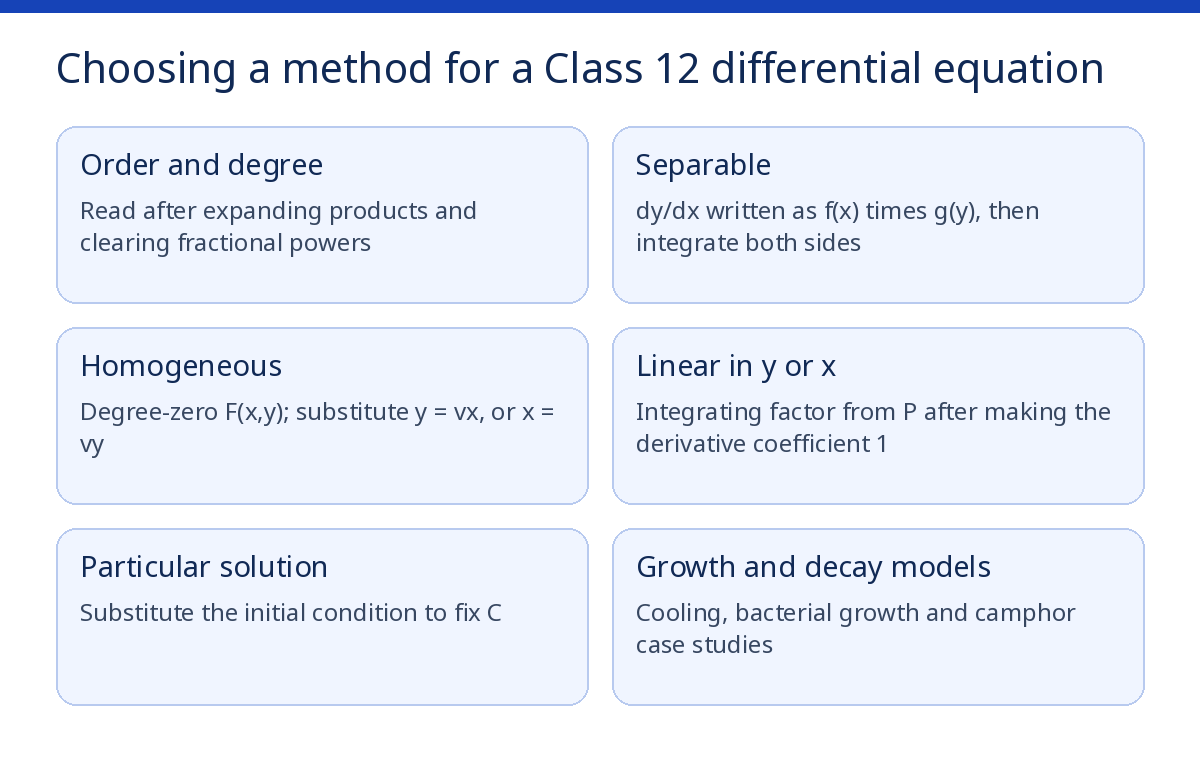
The order is the order of the highest derivative in the equation. The degree is the power of that highest-order derivative, but only once the equation is a polynomial in its derivatives. If a derivative sits inside a function such as a logarithm or exponential, the equation is not a polynomial in that derivative.
Board questions rarely ask for these values alone. They ask for small arithmetic on them: the sum of order and degree, their product, or an expression such as , where is the order and the degree. The camphor case study also opens by asking for the order and degree of before any solving begins.
Work in this order:
- expand products of derivatives first, as in an expression like
- clear fractional powers of derivatives
- only then read off the highest derivative and its power
Expanding derivative expressions hidden in the question
Several PYQs write part of the equation as a derivative of a product, such as or . Apply the product rule before classifying. For instance, , and .
Only after this expansion can you see whether the equation is linear, homogeneous or separable. Skipping it often leads to the wrong method, or to a wrong order and degree.
When separation of variables works directly
An equation is separable when can be written as a product . You then gather -terms with and -terms with , and integrate both sides with a single constant.
The PYQs often hide this form:
- Common exponential factor. In , take out first.
- Logarithm of the derivative. When the log of equals an expression like or , exponentiate. The right side then becomes a product of exponentials.
- Exponential of the derivative. When equals a function of , take logarithms so that stands alone.
- Trigonometric forms. In , divide by .
All three modelling questions also reduce to separable equations.
Testing homogeneity and substituting y = vx
The 2023 case study states the definitions the board expects. A function is homogeneous of degree if . The equation is homogeneous when has degree zero, so it can be written as .
To test a quotient of polynomials, check that every term in the numerator and denominator has the same total degree. Dividing both by a suitable power of then leaves only the ratio .
The method has four steps:
- Put , so .
- Separate and .
- Integrate both sides.
- Replace by in the final answer.
Typical forms include , and equations containing , or . When the ratio appears as , as in an question written with , substitute instead.
Linear in y or linear in x: setting up the integrating factor
A first-order linear equation has the form , where and depend only on . The integrating factor is , and the solution is . When is a logarithm, use to simplify the integrating factor.
Several PYQs write the equation with a coefficient on the derivative, such as . Divide through first, so that .
A recurring pattern is linear in , not in . Equations such as , and should be rearranged as . Here and depend only on , and .
Common mistakes
- Taking before the derivative's coefficient has been made 1.
- Forcing as the dependent variable when terms like or make the equation linear only in .
- Integrating with respect to when the integrating factor was built from .
From general solution to particular solution, and three models
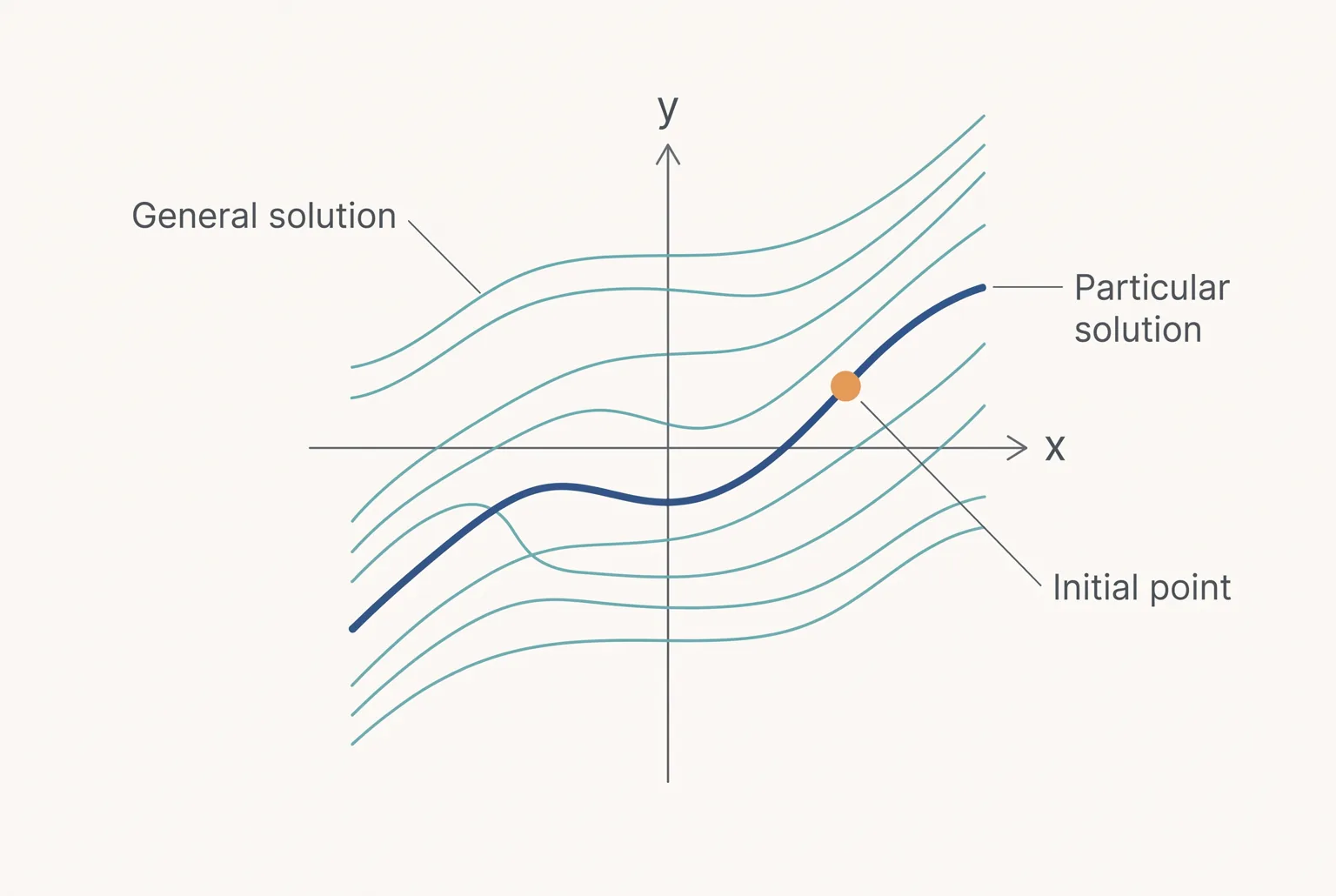
A particular solution question gives a condition such as or " when ". Find the general solution first. Then substitute the condition to fix the constant . Keep in every line until that substitution. Finish by writing the solution with the value of in place, not by stopping at the constant.
The three application questions are case studies built on stated models:
- Processor cooling: , with room temperature C, C and in minutes. Part of the question asks when reaches C, given and .
- Bacterial growth: . You give the general solution as an exponential in , then find from the population at and .
- Camphor tablet: , with time in hours. The volume and surface area are rewritten in terms of the radius , and the question uses radius conditions.
Practising with internal choices and case studies
Follow the topic index from simple to layered:
- order and degree
- separable equations
- homogeneous equations
- linear equations, including those linear in
- particular solutions
- the case studies
Attempt each question before opening its numbered solution. In OR pairs, do both alternatives, because they often test different methods. Then move to the MCQ block to build speed in classifying equations.
Quick self-check
- Can you explain why a degree-zero function can be written as ?
- Given any equation, can you decide in one line whether it is separable, homogeneous, linear in or linear in ?
- Do you know where the initial condition enters, and why it comes last?
Frequently asked questions
Which years and how many questions does this collection include?
It prints 136 previous-year questions with exam-year coverage labelled 2022-2026, including Compartment and Term 2 papers.
Are worked solutions included?
Yes. Both the Subjective and MCQ blocks have numbered worked solutions, and source review notes appear at the end.
Spotted an error? Report a correction. Practise this in the app: notes, formula sheets and mind maps.





























































































































































Loading comments…