Integrals: CBSE Class 12 Definite Integration PYQs and Methods
CBSEMathematicsIntegral Calculus
This guide explains definite integration from NCERT Chapter 7, Integrals, as it appears in CBSE Class 12 board papers. It covers the properties of definite integrals, symmetry methods, substitution with changed limits, integration by parts, splitting absolute values and parameter problems, using patterns from a solved collection of 106 previous-year questions from 2022–2026.
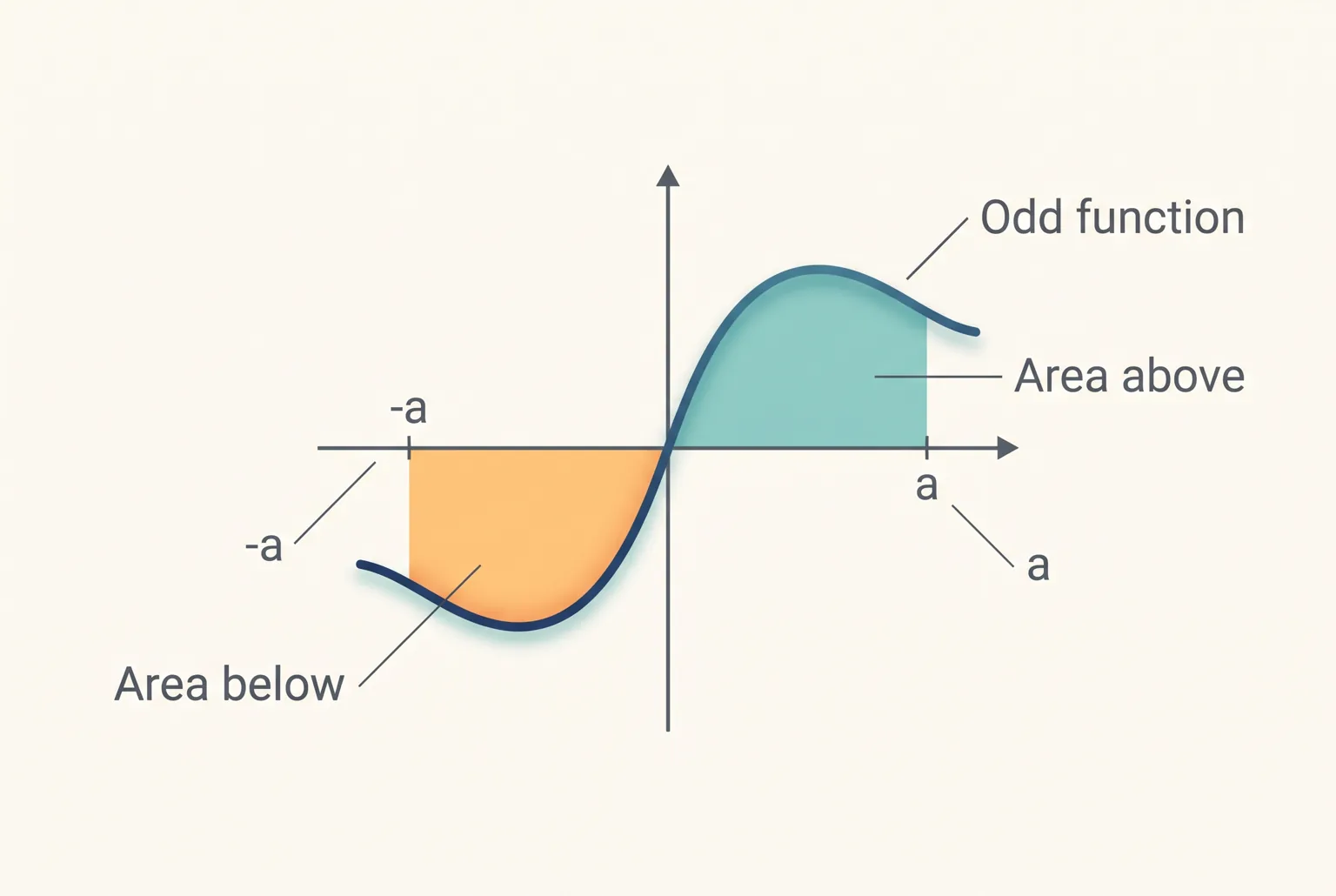
The definite-integral properties behind the largest question group
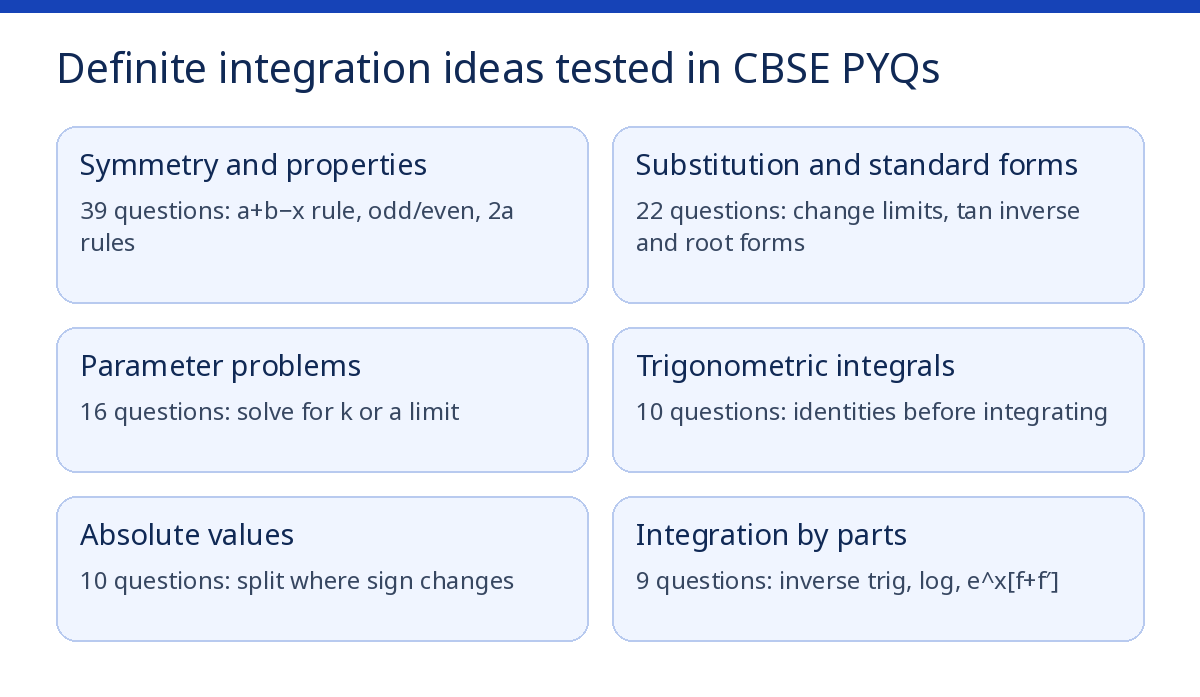
The collection's topic index places 39 of its 106 questions under symmetry and integral properties, more than any other sub-topic. These questions rest on a short list of NCERT results:
- . A special case is .
- if is even (). The integral is if is odd ().
- if , and if .
- .
Several MCQs simply ask which property statement is true. Their distractors swap the conditions, for example by attaching the even-function result to odd functions. Others give a condition, such as a continuous with , and ask about an integral over . Here you must match the stated condition to the correct rule rather than recognise a familiar-looking option.
The odd/even shortcut applies only when the interval is symmetric about . The product of an odd function and an even function is odd. This is why integrands such as , or with odd, appear on intervals like or .

Definite Integrals | Class 12 | Previous Year Paper
In the StudentCurio app
A collection of solved CBSE Class 12 previous-year questions on definite integration, including properties, symmetry, substitutions, trigonometric forms, integration by parts and parameter problems. It helps students practise exam-style questions and review solution methods.
Pairing an integral with its f(a+b−x) twin
Many subjective questions are built so that replacing by produces a companion integral. You then add the two forms of , and becomes easy to evaluate.
Recurring integrands in the collection include:
- Ratios of square roots, such as over , where the two roots swap under the substitution.
- with a large power.
- on . Here the numerator becomes , so reappears on the right-hand side.
- Denominators like or , where pairing with its reflection lets the two denominators combine.
A typical stem asks for the value of .
The written steps follow a fixed order:
- Name the integral .
- State the property used.
- Write the transformed integral.
- Add the two forms and simplify.
- Evaluate what remains.
The same idea underlies the log-of-tan integrals over or , and over . The method helps only when the limits make the transformed integrand related to the original. For tan and cot to swap, for instance, the limits must add to .
Substitution and standard forms with changed limits
There are 22 questions under substitution and standard forms. When you set in a definite integral, the limits become and . You then evaluate in without substituting back.
The standard results that keep appearing are:
The integrand appears more than once. Multiplying the numerator and denominator by and putting turns it into the form.
Trigonometric expressions like need an identity first. Using shows that is the natural substitution, because its derivative is the numerator.
Common mistakes with logarithms, limits and roots
- , not . MCQ options containing or test exactly this. The interval of integration must also not contain the point where the denominator is zero.
- If you substitute but keep the old limits, the answer is wrong even when the antiderivative is right.
- . You may drop the modulus only after checking the sign on the given interval.
- Inverse-trigonometric values must be principal values, especially when you solve for an unknown limit.
Integration by parts and the e^x[f+f′] pattern
The nine integration by parts questions use .
The first function is usually the inverse-trigonometric or logarithmic factor. Examples include , and . A lone is treated as .
A second family uses . Integrands such as are first rewritten with half-angle identities until they show the shape.
The ten trigonometric integrals depend on choosing the right identity before integrating:
- Product-to-sum for
- forms for
Absolute values: split where the sign changes
Ten questions involve absolute values and piecewise integrals. The method has three steps:
- Find where each expression inside a modulus changes sign within the interval.
- Split the integral at those points.
- Replace each modulus by or on each piece.
A sign-change point that coincides with an endpoint needs no split. Points outside the interval are ignored, because there the expression keeps one sign throughout.
Examples in the collection range from on to sums like . They also include and on . In the last case the split point is , where the two functions are equal, and you must decide which function is larger on each side.
Symmetry can shorten this work. For instance, is odd.
Parameter problems: treating an integral as an equation
Sixteen questions are indexed as integral identities and parameter problems. In these, you evaluate the integral in terms of an unknown and set the result equal to a given value.
A representative stem gives and asks for . Other versions place the unknown in a limit, often through a result. One MCQ states the condition as an inequality in the unknown limit.
Evaluate the integral completely before solving. With a result, use the principal value to fix the unknown.
The subjective "show that" items work differently. They ask you to prove an identity from given conditions, such as together with . The proof again comes from applying and adding the two forms.
How the MCQ, assertion-reason and OR-choice questions are framed
The collection groups its questions into three formats:
- MCQ (Single Correct Answer): Q1–Q44.
- Assertion and Reason: Q36, whose reason is the property.
- Subjective: Q45 onward.
Many subjective items offer internal choice, marked OR. The alternative is sometimes an indefinite "Find" question, such as a partial-fraction integral. Each question keeps its original number and exam label, such as the year, set, Delhi or Outside Delhi, compartment, or Term 2 for 2022.
Worked solutions begin on page 31, and source review notes appear on page 88.
A sensible practice order is:
- Property MCQs.
- Substitution and standard forms.
- Integration by parts and trigonometric identities.
- Absolute values.
- The longer subjective pairing problems.
Attempt each question before opening its solution. As a quick self-check, ask three questions: Is the interval symmetric? Do the limits pair the integrand with a related form? Does any modulus change sign inside the interval?
Frequently asked questions
Does this collection cover indefinite integration?
It is organised around definite integration. However, some OR alternatives in the subjective questions ask you to find indefinite integrals, such as partial-fraction forms.
Which question formats appear?
Single-correct MCQs, one assertion-reason question (Q36) and subjective questions, many of which offer an internal OR choice.
Spotted an error? Report a correction. Practise this in the app: notes, formula sheets and mind maps.





























































































































































Loading comments…