Class 12 Physics Case Studies for Current Electricity Mastery
CBSEPhysicsCurrent Electricity
Master the practical and conceptual applications of Current Electricity through 15 structured case-based assessments designed for CBSE Class 12 Physics learners.
Navigating the Current Electricity Case Studies
This StudentCurio resource is a specialized assessment tool for Class 12 Physics learners focusing on Chapter 3: Current Electricity. It comprises 15 detailed case-based questions, totaling 75 individual items. The structure is designed to bridge the gap between theoretical NCERT concepts and the practical application required by the CBSE curriculum. The material covers a broad spectrum of topics, from the microscopic behavior of charge carriers like drift velocity and mobility to macroscopic circuit laws including Ohm’s Law, Kirchhoff’s rules, and Wheatstone bridge applications.
Learners can use this resource to refine their understanding of how electrical quantities behave under varied physical conditions. Each case study presents a descriptive passage or a circuit diagram, followed by five targeted questions. These questions range from conceptual multiple-choice items and numerical problems to complex circuit analyses and graph interpretations. The resource includes a clickable index and two-way links between questions and their respective step-by-step solutions, making it an efficient tool for self-directed study and revision.

Current Electricity | Class 12 Physics | CBSE Case-based Assessment
In the StudentCurio app
This resource features 15 detailed case-based assessment questions for Class 12 Physics, covering drift velocity, Ohm's law, and Kirchhoff's rules with full step-by-step solutions.
Microscopic View of Current and Drift Velocity
The first major conceptual block in the resource addresses the mechanism of current flow within conductors. It establishes a clear distinction between the random thermal motion of electrons, which occurs at speeds of approximately , and the slow net drift velocity, typically around . The material explains that while electrons suffer frequent collisions with ions or atoms, the application of a potential difference creates an electric field that guides this drift toward the positive terminal.
Learners will encounter questions that challenge their understanding of why a bulb glows almost instantaneously despite such a low drift speed. The source clarifies that this is because the electric field is established throughout the circuit immediately, causing electrons everywhere to begin drifting simultaneously. Furthermore, the material explores the relationship between drift velocity, number density, and the dimensions of the conductor. For a steady current in a uniform conductor, the drift speed is shown to be dependent on both the physical dimensions and the number density of free electrons.
Resistivity and Temperature Dependence
A significant portion of the assessment focuses on Ohm's Law and the factors affecting electrical resistance. The resource reinforces that resistance is directly proportional to the length and inversely proportional to the cross-sectional area of a uniform wire, expressed as , where is the electrical resistivity. Crucially, the material distinguishes between resistance and resistivity, noting that resistivity is a material property that, at a fixed temperature, does not depend on geometrical quantities like length or mass.
The temperature dependence of resistivity is explored through linear approximations and graphical interpretations. For conductors, the resource introduces the formula , where is the temperature coefficient. Learners are required to distinguish between materials with positive coefficients, such as copper, and those with weak temperature dependence like nichrome, or negative coefficients typical of semiconductors. The assessment includes specific exercises on calculating resistivity from wire dimensions and interpreting graphs for ohmic conductors.
Circuit Laws and Analysis Techniques
Kirchhoff’s Current Law (KCL) and Kirchhoff’s Voltage Law (KVL) form the core of the circuit analysis sections. The resource treats KCL as a manifestation of the law of conservation of charge, stating that the sum of currents entering a node must equal the sum of currents leaving it. Conversely, KVL is presented as the conservation of energy, where the directed sum of potential differences around any closed loop in a steady circuit is zero.
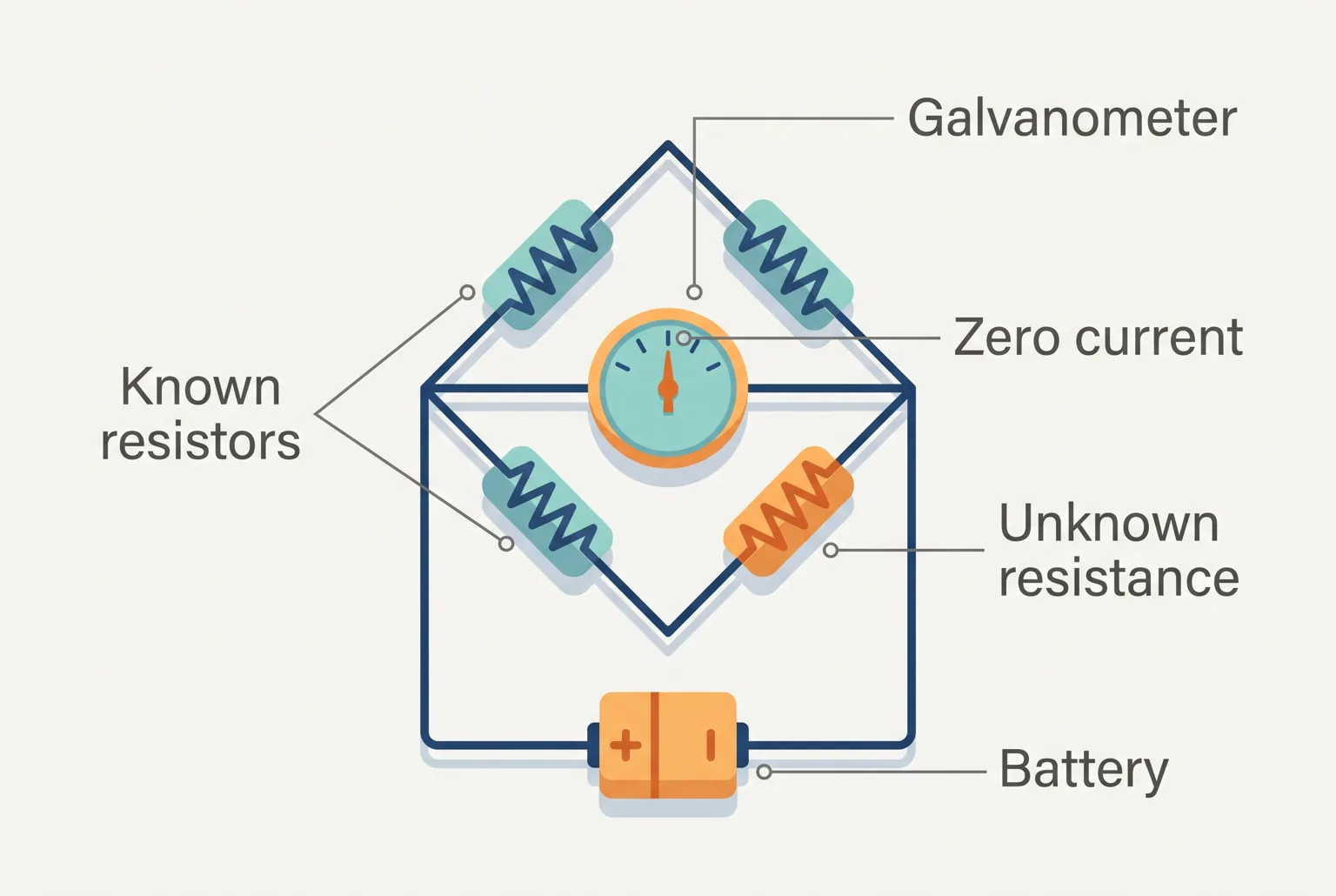
The assessment provides practical circuit problems where these laws must be applied to find unknown currents and potentials. It specifically tests the ability to solve for current at junction points and analyze potential drops across resistors. This section serves as a prerequisite for understanding more complex arrangements, such as the Wheatstone bridge, which uses a null-balance method to measure unknown resistance accurately.
Dynamics of Cells and Emf
The behavior of real-world voltage sources is analyzed through the concepts of Electromotive Force (emf), terminal voltage, and internal resistance. The resource defines emf as the open-circuit potential difference when no current is drawn (). When a cell delivers current through an external load , the terminal potential difference is given by . This distinction is vital for understanding why terminal voltage is usually lower than the rated emf.
The material also covers the conditions for maximum power delivery, stating that for an adjustable external resistance , the power delivered is maximum when equals the internal resistance . Learners will also find case studies on the grouping of cells in series, parallel, and mixed combinations. This includes calculating effective emf and total internal resistance when cells are connected with like terminals together or in reverse.
Bridge Circuits and Potentiometers
The final sections of the resource cover precision measurement instruments. The Wheatstone bridge is detailed as a device that achieves a balance condition where no current flows through the central galvanometer. The condition is emphasized as the foundational principle for the metre bridge and other laboratory applications.
Similarly, the potentiometer is introduced as an 'ideal voltmeter' because it measures potential difference in a null-balance state, meaning it draws no current from the source being measured. The assessment requires learners to understand the mechanical analogies of these systems and their practical implementation in laboratory settings to find unknown resistance or compare the emfs of two cells.
Frequently asked questions
What conservation law does Kirchhoff's Current Law represent?
Kirchhoff’s current law (KCL) is a statement of the conservation of charge.
How does the internal resistance of a primary cell change with use?
In many primary cells, the internal resistance is initially low and typically increases as the cell is used.
What physical conditions must remain constant for Ohm's law to hold?
The current remains proportional to potential difference provided the temperature and other physical conditions of the conductor remain constant.
Under what condition is the terminal potential difference of a cell equal to its emf?
This occurs in an open-circuit condition, where no current is being drawn from the cell ().
Spotted an error? Report a correction. Practise this in the app: notes, formula sheets and mind maps.













































































































































































Loading comments…