Current Electricity: Class 12 CBSE Practice Questions and Key Ideas
CBSEPhysicsCurrent Electricity
Current Electricity in Class 12 CBSE Physics rests on one microscopic picture: free electrons drifting through a lattice and being scattered after each relaxation time. This guide explains drift velocity, mobility, resistivity versus resistance and the limits of Ohm's law, then shows how to work through a 160-question assessment arranged by NCERT topic.
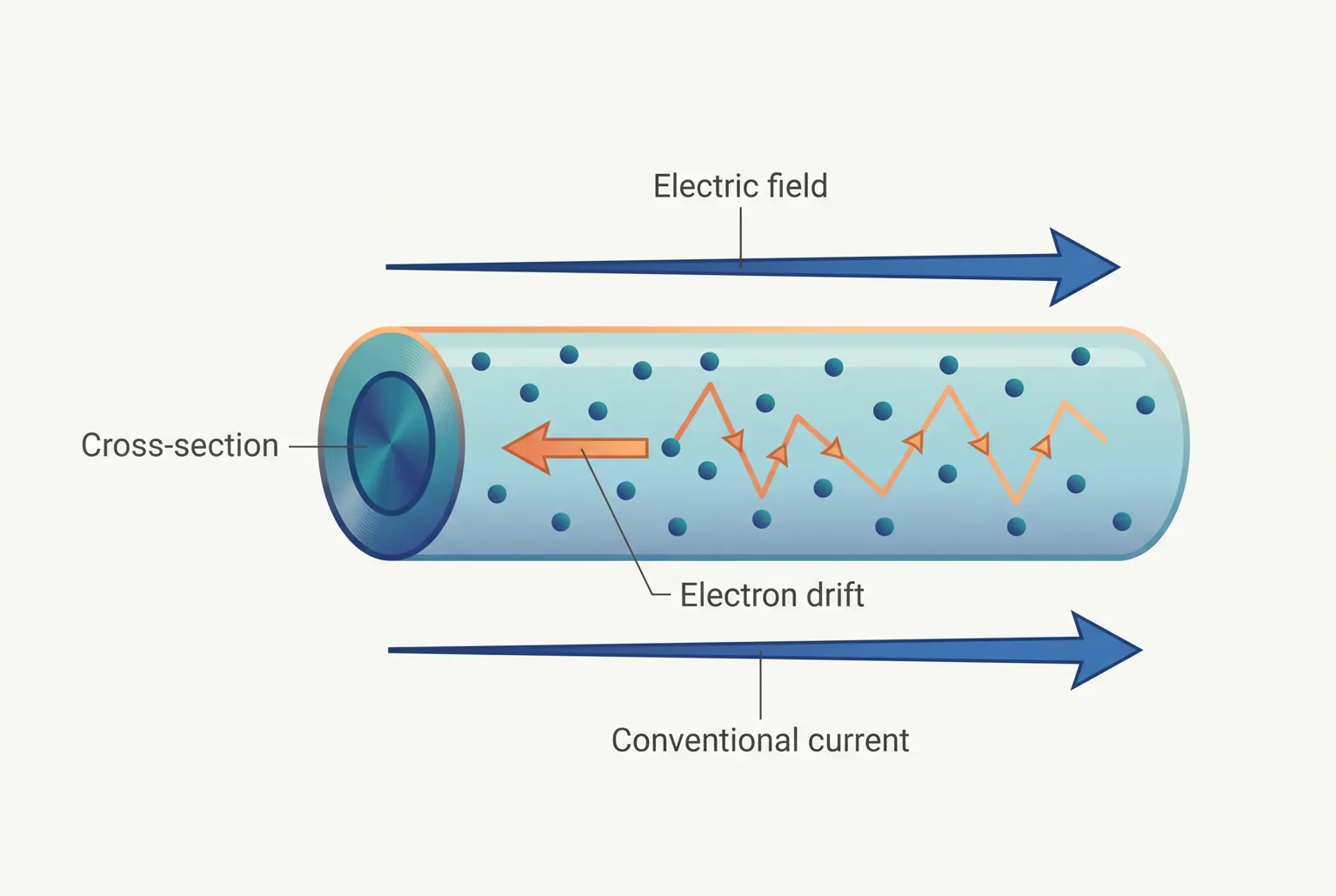
Why drift, not thermal motion, carries the current
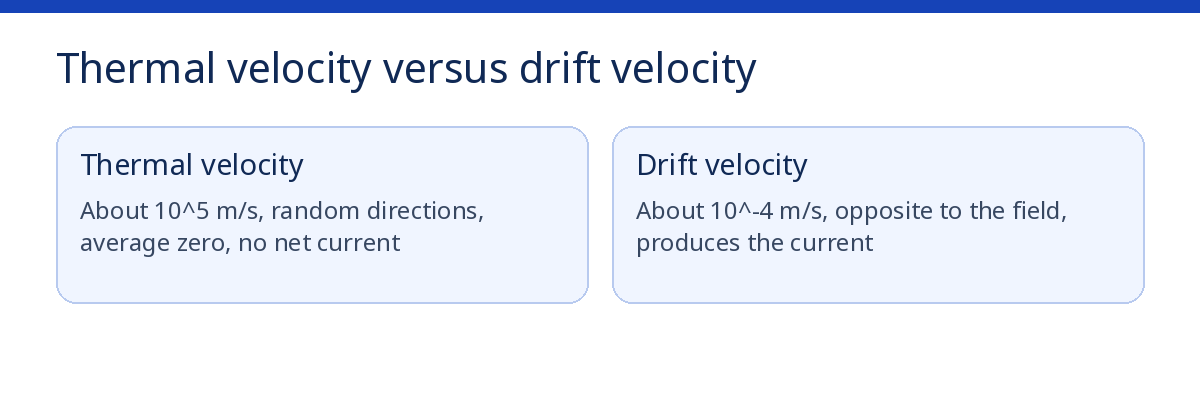
Free electrons in copper already move randomly at about m s. Their directions are random, so the vector average is zero and no net charge crosses a cross-section.
An applied field adds a small average velocity, the drift velocity, of about m s, directed opposite to the field. Only this directed drift produces a current.
Count the electrons in a length behind an area : they carry charge , so . The current density is then .
This picture has three consequences:
- Not every electron moves towards higher potential at each instant. Only the average velocity points that way.
- Conventional current is opposite to the direction in which electrons move.
- A lamp lights almost instantly even though drift is slow. The field is set up throughout the circuit almost at the speed of light, so electrons everywhere start drifting together.

Current Electricity | Class 12 | CBSE Assessment
In the StudentCurio app
160 original Class 12 Physics questions on current electricity, arranged by NCERT topic, with step-by-step worked solutions. Four topic sections (electric current, drift and Ohm's law; resistivity, temperature and electrical power; cells, emf and internal resistance; Kirchhoff's rules and Wheatstone bridge) plus mixed chapter practice, each with MCQs, assertion-reason, 2-, 3- and 5-mark questions and case-based questions.
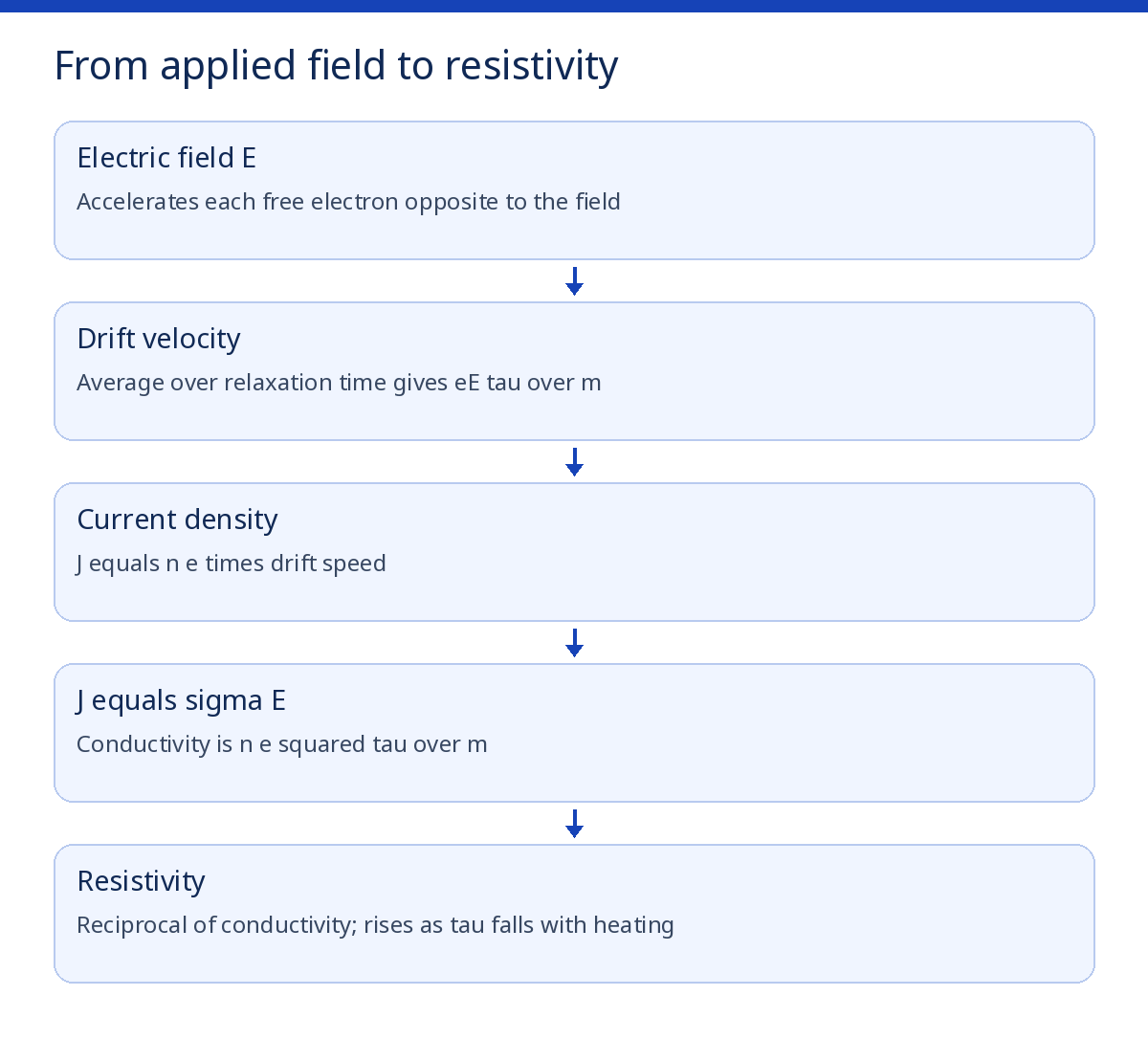
Relaxation time, mobility and the microscopic Ohm's law
The relaxation time is the average time between successive collisions of a free electron with the lattice ions.
In a field , an electron accelerates at . Just after each collision its velocity is random, with an average of zero. Averaging over gives .
Substituting into gives . This is the microscopic law , with . Equivalently, with .
Ohm's law follows because, at fixed temperature, hardly depends on . So and .
Mobility is the drift speed per unit field: . Its SI unit is m V s. Keep the two ideas separate:
- Drift speed depends on the applied field.
- Mobility is a property of the carriers in a given material at a given temperature.
For the 3- and 5-mark derivations, the expected chain is: acceleration, averaging over , , then comparison with .
Resistivity versus resistance when a wire is reshaped
Resistivity depends on the material (through ) and on its temperature and purity (through ). It does not depend on the wire's dimensions. Because , the product for any material at any temperature.
Resistance, , does depend on shape. This makes reshaping questions a recurring pattern.
- Stretching or drawing a wire: volume stays constant, so and . A small percentage stretch therefore raises resistance by nearly twice that percentage.
- Pipes or tubes: use the annular area between the outer and inner radii, not the full circle.
- Drift speed after reshaping: first identify what stays fixed, usually the source's emf or potential difference. Then use and with unchanged. Cross-check with .
For a conductor whose cross-section varies, use the steady-state rule. Charge cannot pile up, so the same current crosses every section. Quantities defined per unit area, such as , then depend on the local area.
How temperature and device behaviour limit Ohm's law
Heating a metal increases lattice vibrations, so electrons are scattered more often and falls. Since stays nearly constant in a metal:
- rises.
- Mobility falls.
Cooling does the opposite: scattering becomes less frequent and the relaxation time increases.
The assessment's cover graph shows the ohmic case. For a fixed at constant temperature, doubling the voltage doubles the current.
NCERT section 3.6 covers devices that break this rule. A device is ohmic only where its – graph is a straight line through the origin. If current falls while voltage rises, then , and that portion shows negative differential resistance.
Dimensional reasoning also appears, for example finding the dimensions of resistance from , where is heat produced.
Common mistakes the worked solutions correct
- Thicker wire, lower resistivity? No. A thicker wire has lower resistance, but its resistivity is unchanged.
- Thermal speeds carry current? No. Their average is zero; only the drift produces a net flow of charge.
- Current direction. Conventional current runs opposite to the electrons' motion.
- Momentum at a joint. Where a thick wire joins a thin one or bends, surface charges set up local fields that change each electron's momentum. Only the current is the same on both sides.
- Forgetting constant volume. When a wire is stretched, its length and area change together.
Moving from the four topic sets to the 59-question chapter mix
The 160 questions fall into five sets:
- Topic Practice 1, Electric Current, Drift and Ohm's Law (NCERT 3.2–3.6): 28 questions.
- Topic Practice 2, Resistivity, Temperature and Electrical Power: 27 questions.
- Topic Practice 3, Cells, EMF and Internal Resistance: 30 questions.
- Topic Practice 4, Kirchhoff's Rules and Wheatstone Bridge: 16 questions.
- Chapter Practice, mixed across the chapter: 59 questions.
Each set runs through the same formats: MCQs (1 mark), very short answers (2 marks), short answers (3 marks), case-based questions (4 marks) and long answers (5 marks). Assertion–reason items close each MCQ block. Step-by-step worked solutions follow each set.
Work through the topic sets in order before attempting the mixed set. Circuit questions in the later topics rely on the resistance ideas built first.
Attempt each question fully before opening its solution, then compare your steps line by line. The Topic 1 case study gives data for copper along with and , so it is good practice in handling powers of ten.
Quick self-check: Can you explain why heating a metal lowers mobility? When a wire is drawn longer, which changes: its resistance, its resistivity, or both?
Frequently asked questions
Which question formats does this Current Electricity assessment use?
Each set has 1-mark MCQs, 2-mark very short answers, 3-mark short answers, 4-mark case-based questions and 5-mark long answers. Assertion–reason items close each MCQ block.
Does resistivity change when a wire is stretched?
No. Resistivity depends on the material and its temperature, not its dimensions. Only the resistance changes.
Spotted an error? Report a correction. Practise this in the app: notes, formula sheets and mind maps.













































































































































































Loading comments…