Coordination Compounds: CBSE Class 12 NCERT Guide
CBSEChemistryCoordination Compounds
This NCERT Chemistry textbook chapter for CBSE Class 12 connects the formula of a coordination compound to its bonding, shape and properties. The excerpt gives you experimental evidence to interpret, naming rules to practise and diagrams for comparing isomers.
Werner’s evidence: which chlorides are bound?
The chapter begins with a puzzle: cobalt(III) chloride–ammonia compounds do not all release the same amount of chloride when treated with excess silver nitrate in the cold. Read the silver chloride results alongside the conductivity column in Table 5.1. Together, these observations support a distinction between chloride ions outside the complex and chloride ions directly bonded to cobalt. The distinction cannot be read from the empirical formula alone.
Werner described two kinds of linkage. In his model, primary valences are normally ionisable and are satisfied by negative ions. Secondary valences are non-ionisable and are satisfied by directly attached neutral molecules or negative ions. Square brackets put that distinction into the formula: the groups inside form an entity that remains intact under the conditions of the experiment. This is why chloride can appear either inside or outside the brackets.

Coordination Compounds | Class 12 | NCERT Textbook
In the StudentCurio app
This textbook chapter covers coordination-compound terminology, nomenclature, isomerism, valence bond theory, crystal field theory, magnetic and colour properties, and applications. It helps Class 12 students build a complete understanding of the chapter and practise its concepts.
Read the coordination sphere before naming it
Start with the central metal atom or ion and identify the ligands directly attached to it. The metal and its ligands make up the coordination sphere. Counterions are written outside the brackets and balance the charge of the complex in a salt. In , potassium is the counterion; the bracketed species remains a complex ion in water rather than separating into simple iron and cyanide ions. The chapter contrasts this behaviour with double salts, which dissociate into simple ions in water.
Next, look at the kinds of groups bound to the metal. A homoleptic complex has only one kind of donor group; a heteroleptic complex has more than one. This distinction describes the groups inside the sphere, not the number or kinds of counterions outside it.
Count donor atoms, not ligand molecules
The coordination number counts the ligand donor atoms directly bonded to the metal. Count the contributions from metal–ligand sigma bonds; pi bonding does not increase the count. Ammonia is unidentate because it binds through one donor atom. Ethane-1,2-diamine is didentate: when both nitrogen atoms bind to the same metal, one ligand contributes two donor atoms. A ligand that binds one metal simultaneously through two or more donor atoms acts as a chelate ligand.
Do not confuse a didentate ligand with an ambidentate ligand. Nitrite can bind through nitrogen or through oxygen. Those are alternative attachment sites, not two sites to count together in that binding mode. Also keep coordination number separate from geometry: the chapter’s tetrahedral nickel carbonyl and square planar tetrachloridoplatinate examples show that the same coordination number can correspond to different arrangements.
Common naming mistakes: order, charge and prefixes
For a mononuclear coordination entity, write the single central metal first in the formula, within the square brackets. In the systematic name, name the ligands alphabetically before the metal. If the compound is ionic, name the cation before the anion. The textbook uses names such as aqua for water and ammine for coordinated ammonia. Multipliers such as di and tri indicate ligand counts, while forms such as bis and tris are used when the ligand name itself contains a numerical prefix.
The Roman numeral gives the metal’s oxidation state, not the overall charge of the complex. To distinguish them, add the metal’s oxidation number and the charges of the attached ligands: the sum must equal the charge of the bracketed entity. Counterions can help establish that overall charge, but they are not ligands. Check the sign before writing the metal name: an anionic complex has a metal name ending in -ate, whereas a neutral complex follows the naming pattern of a complex cation.
Tell isomers apart by what changes
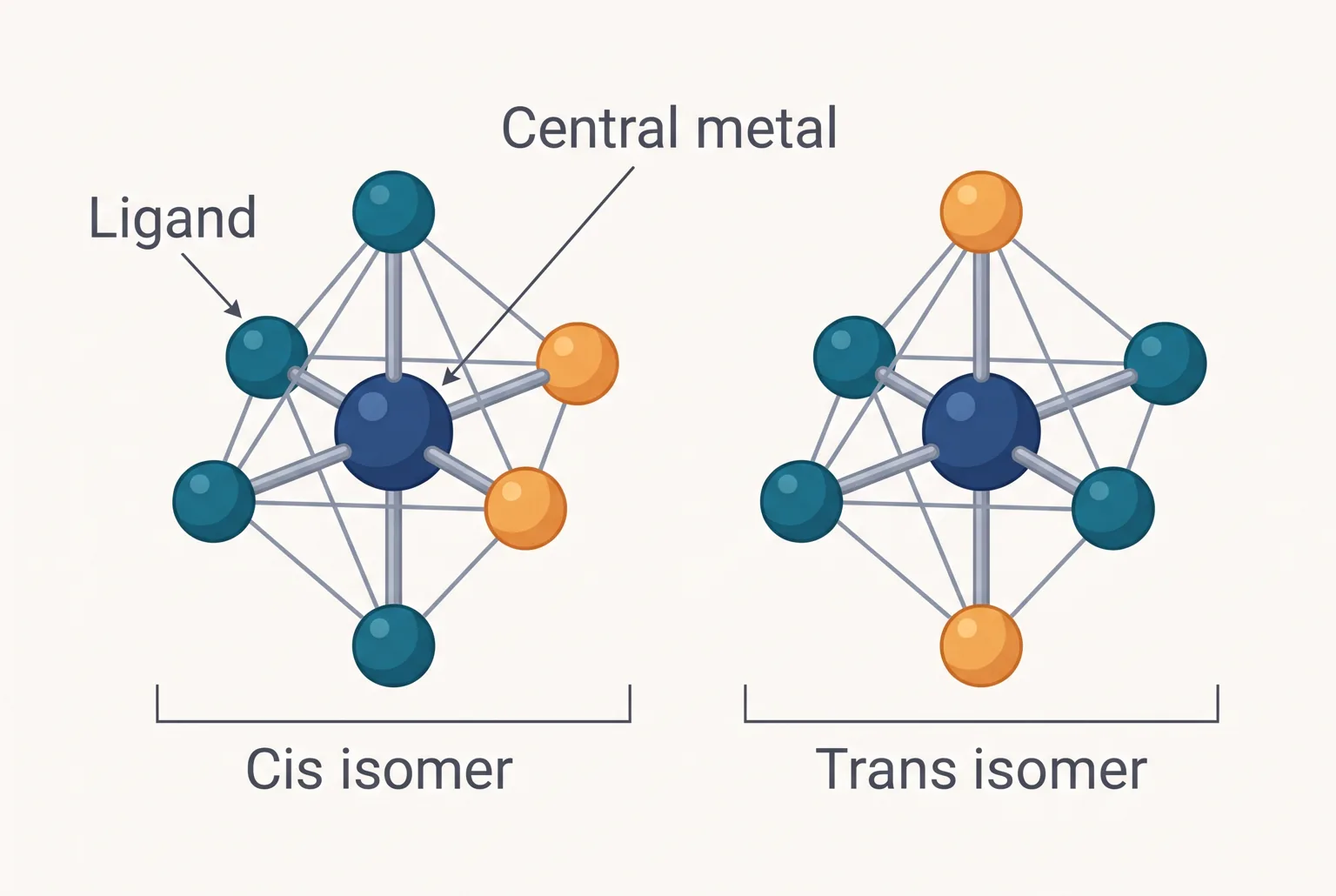
Stereoisomers keep the same bonds but differ in spatial arrangement. For geometrical isomerism, read the diagrams by comparing positions rather than by looking at how the drawing is turned on the page. In the square planar and octahedral examples with two identical ligands singled out, cis means those ligands occupy adjacent positions and trans means they occupy opposite positions. For the octahedral case with three ligands of each of two kinds, follow one matching set of three: in the facial form it occupies one face; in the meridional form it lies along a meridian.
Optical isomers are non-superimposable mirror images. Use the chapter’s drawings to distinguish being mirror images from being identical after rotation. Structural isomerism, by contrast, changes which atoms are bonded. The chapter lists linkage, coordination, ionisation and solvate isomerism under that category. The earlier discussion of nitrite shows why the donor atom matters: the ligand can stay chemically the same while the atom attached to the metal changes.
Use the textbook examples, questions and diagrams together
Use the worked nomenclature examples to trace how each part of a name comes from the formula. Then try the intext questions in both directions: translating a name into a formula tests charge balance and bracket placement, while translating a formula into a name tests ligand names, order and oxidation state. For isomerism, compare the labelled drawings before attempting to redraw the arrangements yourself.
The chapter overview also identifies valence bond theory, crystal field theory, magnetic and colour properties, and applications as part of the wider unit. The introduction gives those topics a concrete context by connecting coordination chemistry with chlorophyll, haemoglobin and vitamin B12, as well as industrial catalysts and analytical reagents.
Spotted an error? Report a correction. Practise this in the app: notes, formula sheets and mind maps.















































































































































Loading comments…