Continuity and Differentiability: Class 12 NCERT Guide
CBSEMathematicsContinuity and Differentiability
This CBSE Class 12 Mathematics textbook chapter builds on limits and differentiation from Class 11. The supplied pages focus on continuity: how to test it at a point, how the domain affects the test, and how to use continuity rules before moving on to derivatives.
Where these pages fit in the chapter
Chapter 5 of the NCERT textbook starts by asking what happens to a function’s values as its input approaches a given point. The opening graphs show why knowing the function’s value at that point is not enough. Worked examples then turn that observation into a test you can apply to polynomials, piecewise functions and functions built from simpler ones.
The full chapter also covers standard derivatives, the chain rule, implicit and parametric differentiation, logarithmic differentiation and higher derivatives. The supplied pages develop the continuity material through Exercise 5.1, then begin differentiability by recalling the definition of a derivative. Use this part of the textbook to understand the limit arguments before moving on to the differentiation techniques.

Continuity and Differentiability | Class 12 | NCERT Textbook
In the StudentCurio app
This NCERT textbook chapter covers continuity and differentiability, including standard derivatives, the chain rule, implicit and parametric differentiation, logarithmic differentiation, and higher derivatives. It helps Class 12 students build understanding through explanations, worked examples, and exercises.
At a point, compare the limit with the value
At an interior point of an interval in the domain, continuity requires the left-hand limit, the right-hand limit and the function value to agree. There are two separate checks: first decide whether the two-sided limit exists as a real number, then compare it with the value at the point.
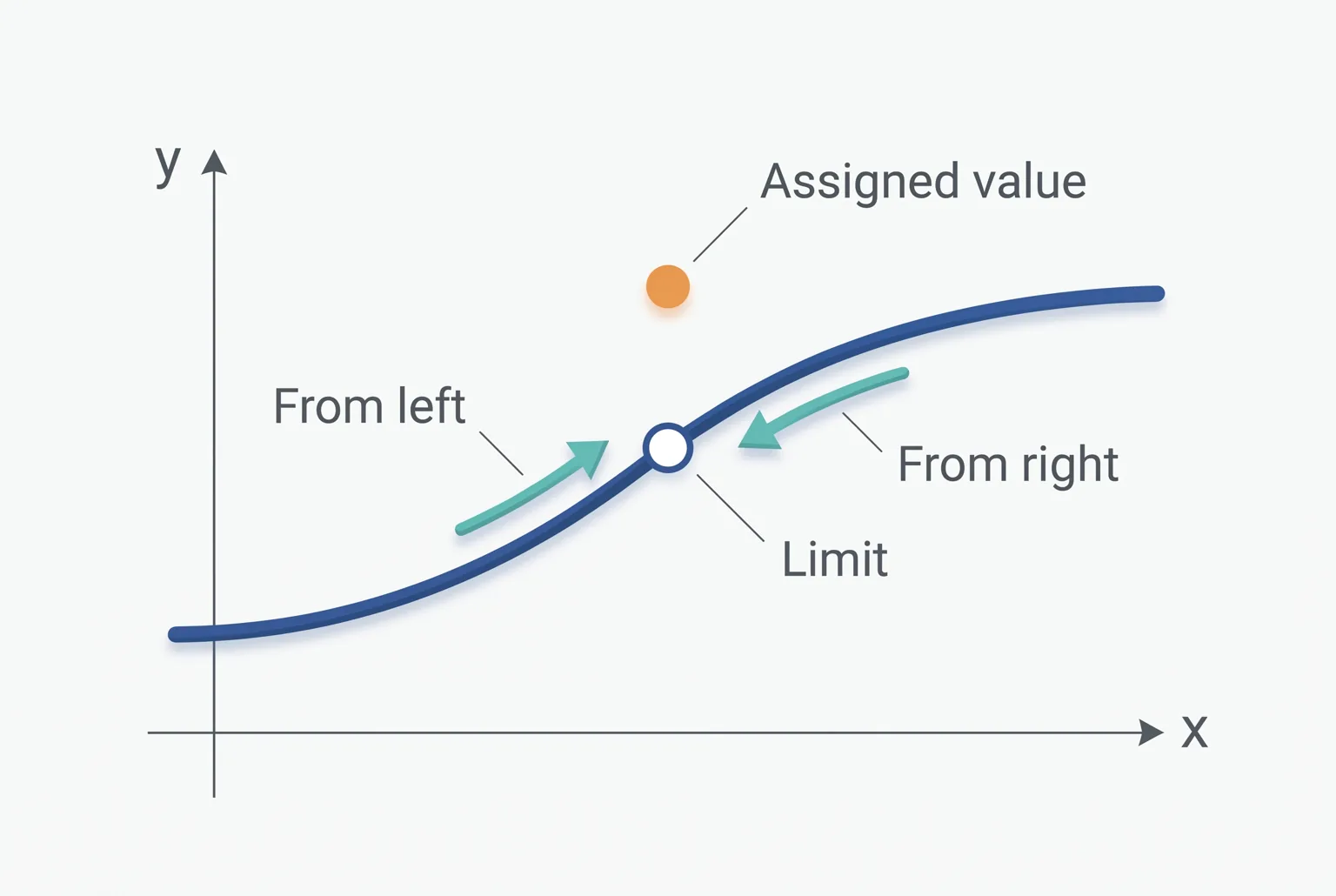
The opening pair of examples shows how those checks can fail. In the first, the graph jumps at zero: the values to the left approach one number and the values to the right approach another. The value at zero agrees with one side, but that cannot make the two-sided limit exist. In the second, both sides approach the same number, yet the value assigned at zero is different. Changing just that value can fix the second mismatch, but it cannot fix the first. That distinction is more reliable than trying to decide from a sketch whether you need to lift your pen.
Common mistake: testing a point outside the domain
A continuous function is continuous at every point in its domain. For the reciprocal function , zero is excluded, so continuity on its domain does not require a value there. The chapter still investigates what happens near zero: the values grow without bound from the right and decrease without bound from the left. The infinity symbols describe that behaviour; they are not real numbers that can be assigned as limits in the continuity test.
An included endpoint is different from an excluded point. If the domain is the closed interval , the value at the left endpoint must match the limit from the right, and the value at the right endpoint must match the limit from the left. In each case, approach from within the interval rather than asking for a limit from a side outside the domain.
When the algebra and composition rules apply
Once you know that two functions are continuous at the same point, their sum, difference and product are continuous there. Their quotient is continuous there only where the denominator is nonzero. This is why the textbook can establish continuity for rational functions on their domains using polynomial continuity, without recomputing a limit from scratch at every point.
Composition requires a different check. For to be continuous at by the chapter’s theorem, the composition must be defined there, the inner function must be continuous at , and the outer function must be continuous at the inner output . The worked example with illustrates how identifying the inner and outer functions gives you a direct route to continuity. The key is to test the outer function at the input it actually receives.
Use Exercise 5.1 to choose a method
Exercise 5.1 asks you to check continuity at specified points, locate discontinuities and determine parameters that make pieces join continuously. These tasks do not all call for the same calculation. For a piecewise function, mark the points where the formula changes. Away from those points, look for a continuity rule that applies to the active formula. At an included join, use the appropriate branch for each approach and read the function value from the branch that includes the point.
For a parameter question, keep the one-sided limits and the assigned value separate until you can state exactly which quantities must agree. For a quotient, record the excluded inputs before simplifying: cancelling a factor does not put an excluded point back into the original domain. If the question asks about the whole function rather than a single point, account for the rest of the domain as well as the joins.
Quick self-check before differentiability
The excerpt ends by recalling the derivative as the limit of a difference quotient. The continuity test asks whether nearby function values approach the assigned value. The derivative test asks whether the change in function value divided by the change in input approaches a finite number. At an interior point, differentiability implies continuity, but continuity alone does not guarantee differentiability: matching function values does not mean the slopes from the two sides agree.
Before moving on, ask yourself: If the two one-sided limits of a piecewise function agree, what do you still need to check? If continuity is established, what new quantity does the derivative definition ask you to examine? Being able to explain both distinctions will help you keep the tests separate when a question asks about continuity and differentiability at the same point.
Spotted an error? Report a correction. Practise this in the app: notes, formula sheets and mind maps.





























































































































































Loading comments…