CBSE Class 12 Chemistry Supplementary Paper 2026
CBSEChemistry2026 Previous Year Paper
Paper code: 56/7/2 · 2026Practise the full 2026 CBSE Class 12 Chemistry supplementary paper (56/7/2) in its original English layout. Use the linked worked solutions to review how formulas, chemical reasoning and reaction conditions apply across physical, inorganic and organic chemistry.
This set is one of the year's papers. See every set from 2026, grouped by series.
Five sections, from one-mark choices to long answers
This year-wise resource pairs the question paper with worked solutions. The paper allows 3 hours for 70 marks, contains 33 questions, and does not permit calculators. Section A has 16 one-mark multiple-choice questions, including assertion–reason items. Section B has five two-mark very short answers, Section C has seven three-mark short answers, Section D has two four-mark case-based questions, and Section E has three five-mark long answers.
There is no overall choice. The printed OR is an internal choice in some questions outside Section A: choose one branch of that question or subpart rather than treating the whole question as optional. The worked solutions cover both branches, so you can attempt the unused branch later without changing the conditions of your first sitting.

Chemistry Supplementary 2026 | Class 12 | Previous Year Paper | Code 56/7/2
In the StudentCurio app
Complete CBSE Class 12 Chemistry supplementary examination paper with worked solutions, covering questions across physical, inorganic and organic chemistry. Useful for practising board-exam questions and reviewing solution methods.
Physical chemistry: choose the rule after checking its conditions
The solutions questions move from matching colligative properties with their expressions to calculations involving vapour pressure and freezing-point depression. In the freezing-point problem, complete dissociation is an explicit assumption. It matters because the change in freezing point depends on the number of dissolved particles, not simply the number of formula units added. Keep molality, which uses the mass of the solvent, distinct from molarity, which uses the volume of the solution.
In electrochemistry, the paper moves between electrode reactions, cell potentials and a calculation that starts with measured resistance. Resistance describes the particular column of solution; conductivity accounts for its dimensions; molar conductivity also accounts for concentration. In kinetics, distinguish a rate-law question about how concentration changes affect the rate from a first-order question about how much reactant remains after a given time. The percentage completed and the percentage remaining are not interchangeable.
Inorganic chemistry: separate periodic trends from ligand effects
The transition-metal case passage explains why atomic radii change only modestly across much of a series: increasing nuclear charge and increased shielding from added d electrons partly offset each other. It also connects the similarity of the second and third transition series to lanthanoid contraction. Use the passage to distinguish a trend across one row from a comparison between rows; they call for different explanations.
Coordination chemistry asks for a different kind of reasoning. The paper tests naming, coordination number, isomerism and the use of valence bond theory to explain bonding and magnetic behaviour. When reading a complex formula, separate the metal’s oxidation state from its coordination number. The former is a formal charge assignment; the latter counts donor atoms directly attached to the metal. A ligand that binds through two donor atoms therefore contributes two to the coordination number, even though it is only one ligand.
Organic chemistry and biomolecules: read the structure and the conditions
The organic questions cover chemical tests, acidity and basicity comparisons, reagent selection and multistep conversions. Conditions are part of the reasoning: the haloalkane questions distinguish aqueous from alcoholic potassium hydroxide, while an amine comparison specifies the gaseous phase. For a conversion, track which functional group changes at each step. For a comparison, state the condition under which you are making it rather than recalling an order without context.
The carbonyl case passage links reaction behaviour to the polarity of the carbon–oxygen double bond and to the presence or absence of an alpha hydrogen. It also distinguishes the alkali conditions for the reactions it describes. Use the preserved diagrams when a decision depends on where a group is attached; a flattened text extraction may not show the connectivity clearly. The biomolecules questions shift towards structural vocabulary, asking about DNA bases, starch, linkages between amino acids and anomers.
Quick self-check: does the reason explain the claim?
For an assertion–reason item, make three separate checks: whether the assertion is true, whether the reason is true, and, if both are true, whether the reason actually explains the assertion. Two true statements about the same topic do not automatically form an explanation.
Apply a related check to the case-based questions. Underline the trend or reaction condition in the passage, then ask which part of it supports the response you intend to write. If a prompt asks why, repeating the trend or naming the reaction is not enough: your response needs to connect it to the relevant chemical cause.
From first attempt to worked-solution review
For a timed attempt, start with the question pages and leave the solution links unopened. Write the setup for numerical answers, including the units, and give a separate response for each labelled subpart of a longer question. Mark which OR branch you attempted so you can tell what you completed under exam conditions and what you practised afterwards.
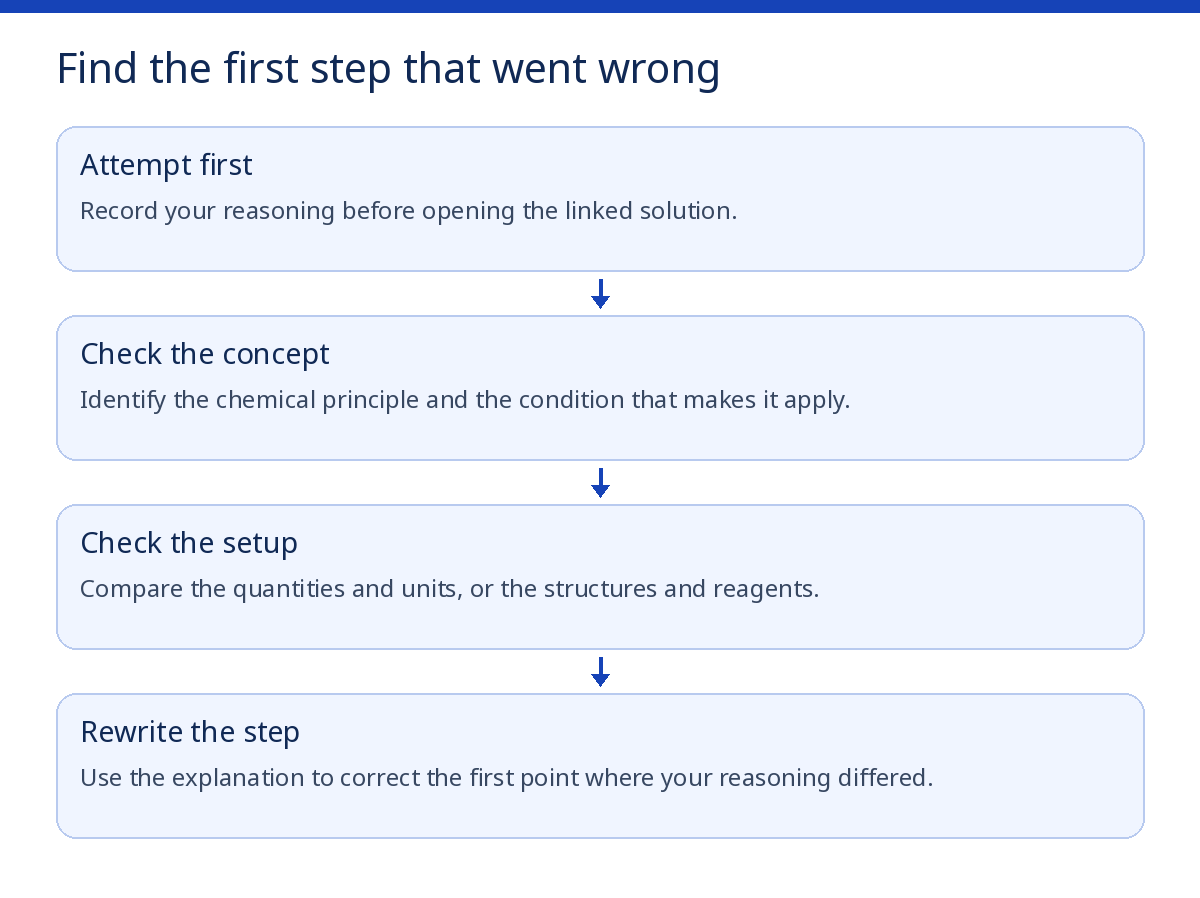
During review, use the question-number links to find the corresponding solution. Read the formula used, concept used and explanation in steps to locate the first point where your reasoning differed. A wrong expression calls for a different fix from a correct expression used under the wrong assumption. Once you have identified the difference, rewrite that step without looking, then try an unused internal choice if you want another task in the same topic area.
Editorial note: this guide omits the ether-cleavage item’s worked answer because the product labels conflict in the supplied extract. It also leaves out the specific complex-stability ranking where the solution preview ends before its conclusion.
Spotted an error? Report a correction. Practise this in the app: notes, formula sheets and mind maps.















































































































































Loading comments…